
5 Best Garden Hose Nozzles of 2026 (Expert Picks)


When I started comparing garden hose nozzles, I realised that a small attachment at the end of a hose could make a considerable difference to everyday watering. I needed a gentle shower for my vegetable seedlings, controlled watering around marigolds and petunias, and a longer-reaching spray for parts of my lawn. A basic nozzle could deliver water, but it did not necessarily give me the control I wanted for all these jobs.
My main concern was not finding the nozzle with the highest number of spray patterns. I wanted one that could deliver suitable water flow, connect properly to my hose, remain comfortable during watering and resist unnecessary leakage. I also wanted to understand which construction materials justified spending more and which advertised features were unlikely to improve my gardening.
The best garden hose nozzles are not necessarily the most expensive or the ones with the strongest jet. A nozzle that produces a gentle, consistent shower may be more useful for vegetables and flowers than one designed mainly for cleaning hard surfaces. Similarly, a simple brass nozzle may outlast a complicated multi-pattern model in some conditions, although it will not provide the same variety of spray shapes.
| Product | Title | Features | Explore |
|---|---|---|---|
 | Gilmour Heavy-Duty Thumb Control Nozzle |
| Check Price |
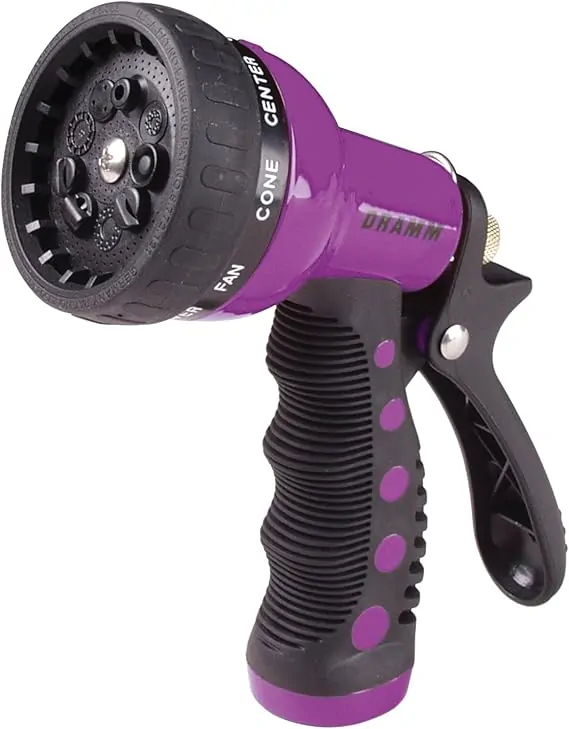 | Dramm 9-Pattern Revolver Spray Gun |
| Check Price |
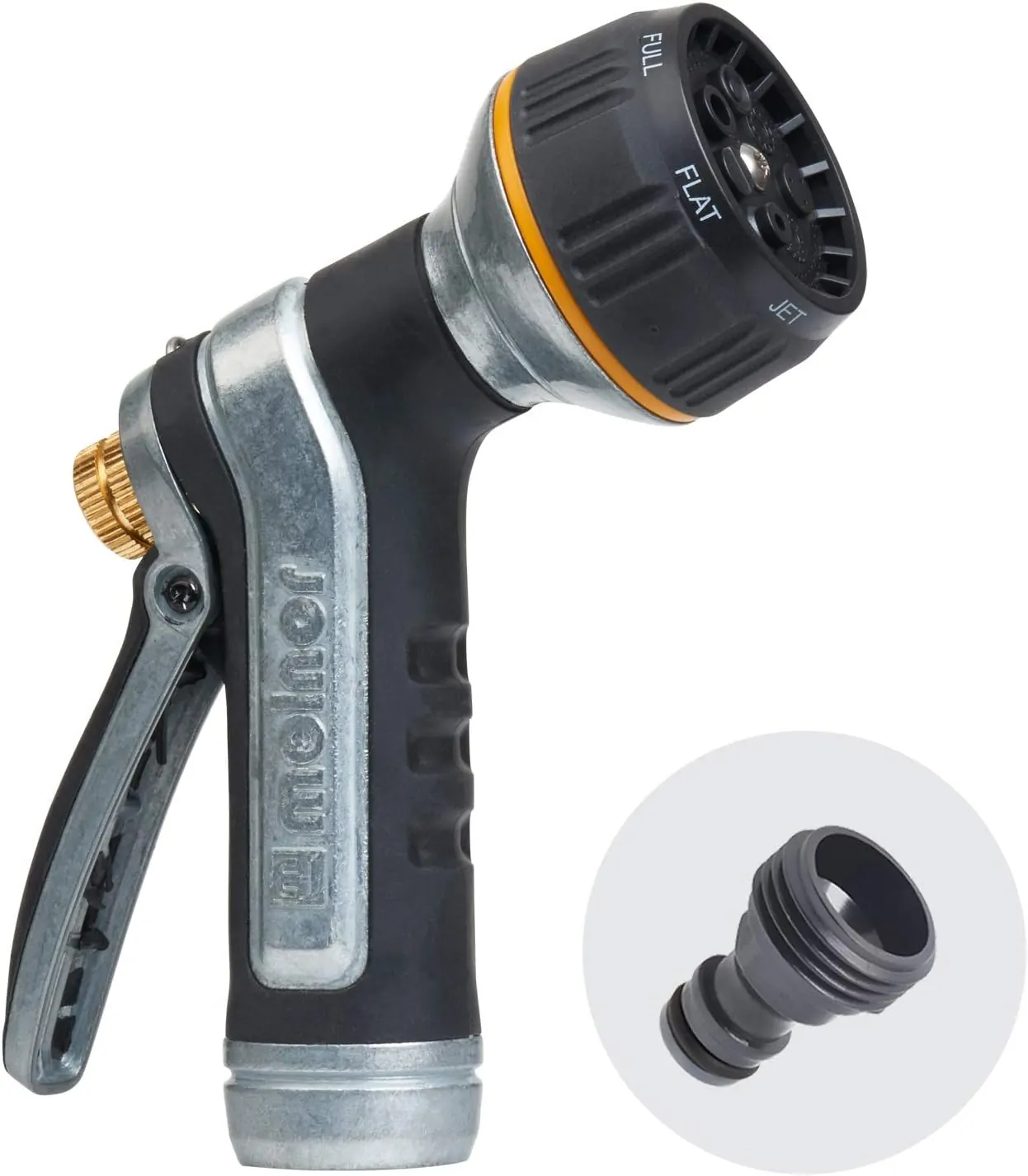 | Melnor 2-in-1 Adjustable Hose Nozzle |
| Check Price |
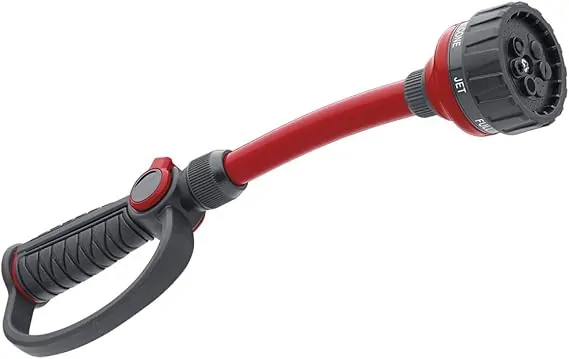 | Orbit 58995 Pro Flo 7-Pattern Watering Nozzle |
| Check Price |
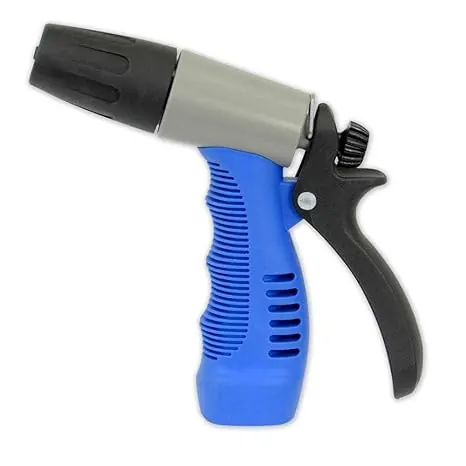 | HoseCoil ¾-inch Hose Nozzle |
| Check Price |
Know What Your Garden Actually Needs
My first priority was understanding where an ordinary hose nozzle became inconvenient. Watering young tomatoes and newly transplanted chilies required a controlled stream that did not wash soil away from the roots. Established flower beds needed wider coverage, while lawn edges and containers required different levels of precision.
A garden hose nozzle is a water-control attachment fitted to the outlet of a garden hose. It changes the water stream through an adjustable opening, internal valve, spray plate or combination of these components. Depending on the design, it can produce a concentrated stream, a wide shower, a fine mist or several other patterns.
However, a nozzle does not create an unlimited water supply. Its performance depends on the water pressure and flow reaching it. A nozzle with an impressive spray pattern on a demonstration stand may behave differently when connected to a long hose supplied by a low-pressure tap.
For planning purposes, consider a garden containing 12 vegetable containers, two flower beds and a small lawn. If each container receives 2 litres of water, the containers alone require 24 litres. At a measured delivery rate of 6 litres per minute, supplying that amount takes approximately 4 minutes, excluding movement and adjustments. The actual requirement depends on soil moisture, container size, weather and plant growth.
This calculation helped me understand why controllable delivery mattered more than maximum spray distance. I needed to deliver water where it was required without unnecessarily soaking paths or disturbing soil.
- Vegetable seedlings: Choose a gentle shower with controllable flow.
- Established flower beds: Prefer wider coverage with comfortable trigger operation.
- Lawns: Look for adequate flow and practical spray reach.
- Containers: Select precise watering with a reliable shut-off.
- Young fruit trees: Use controlled watering around the root zone rather than relying on a forceful jet.
My buying target was therefore a nozzle that could handle several garden jobs without forcing me to compromise on delicate plants. For a mixed home garden, I generally favour a well-built adjustable shower or multi-pattern nozzle over a jet-only design.
5 Best Garden Hose Nozzles for Every Watering Need (2026 Reviews)
Choosing the right garden hose nozzle can make watering plants and cleaning outdoor areas much easier. A quality hose nozzle garden sprayer helps you water flowers and plants with better control while also handling tough outdoor cleaning jobs. Since there are many hose nozzle sprayers available today, finding the right one can sometimes be difficult.
1. Gilmour Heavy-Duty Thumb Control Nozzle
Strong metal garden hose nozzle designed for long-lasting use. Built to be more durable than plastic models. Adjustable spray head for different watering and cleaning needs. A practical choice for everyday home and garden tasks.
expert start
What is it and its features
This garden hose nozzle is designed to give you better control while watering or cleaning. It comes with a swivel connection, one-turn spray adjustment, and a thumb-control flow system. The swivel connection lets the nozzle rotate without twisting the hose, helping reduce hose kinks by up to 70% and making it easier to move around plants and corners. The spray head rotates 180 degrees, allowing you to change from a powerful jet spray to a gentle rinse with a single turn. The thumb-control lever lets you adjust the water flow from completely off to full pressure without constantly squeezing a trigger.
Why it matters
These features help solve many of the common issues found with regular hose nozzles. Twisted hoses, leaking connections, and weak plastic parts can become frustrating during longer watering or cleaning jobs. The swivel connection reduces strain on your wrist, the thumb-control lever keeps water flowing smoothly, and the heavy-duty metal body is built to provide reliable performance for many gardening seasons. If you want better control and durability, this nozzle offers both.
My set-up and experience
I used this nozzle while watering my garden and cleaning my driveway, and it remained comfortable to hold throughout the job. The metal construction feels sturdy without being overly heavy, while the thumb lever makes adjusting the water flow simple. I tested it with both high-pressure and low-pressure garden hoses, and it performed consistently in each case. Compared to several plastic nozzles I have previously used, this one stayed leak-free and delivered a steady spray during extended use. Switching between the jet and rinse settings was smooth, making it suitable for cleaning muddy boots as well as watering delicate plants.
Performance
The nozzle provides a smooth and steady spray without sudden pressure changes. The swivel connection and adjustable spray head make it easy to direct the water exactly where it is needed. After several weeks of regular use, the thumb-control lever still works smoothly, and the metal body shows very little wear. The powerful jet spray removes dirt from patios and driveways effectively, while the rinse setting delivers a softer spray that is gentle on flowers and delicate leaves.
Practical Tips
- Inspect the swivel washer regularly to help prevent leaks.
- Clean the nozzle from time to time to reduce mineral buildup.
- Use the thumb-control lever to make smooth water flow adjustments.
- Avoid dropping the nozzle to keep the metal parts in good condition.
- Tighten the swivel connection if it becomes loose after extended use.
expert end
pro start
| Pros | Cons |
|---|---|
| ✔️ Swivel design helps reduce hose kinks | ❌ Swivel washer may develop leaks over time |
| ✔️ Strong and durable metal body | ❌ Metal construction may feel heavy during extended use |
| ✔️ Thumb-control provides easy water flow adjustment | ❌ Offers fewer spray patterns than some competitors |
| ✔️ Smooth adjustment from jet to rinse | ❌ Replacement washers are not included |
| ✔️ Backed by a lifetime warranty | ❌ Connection can become loose after heavy use |
pro end
2. Dramm 9-Pattern Revolver Spray Gun
Complete control for different watering jobs. Nine spray patterns for a wide range of tasks. Durable metal body with a comfortable grip. Thumb-control lever for easy water flow adjustment.
expert start
What is it and its features
The Dramm Revolver is a heavy-duty spray gun that connects to any standard garden hose. Its standout feature is the nine spray patterns, including mist, shower, jet, soaker, cone, fan, flat, angle, and center. These options allow you to water delicate seedlings, irrigate the garden, wash vehicles, clean patios, or bathe pets using a single tool. Instead of changing nozzles, you can quickly select the spray pattern and water flow that best fits the task.
Why it matters
This nozzle is built with aluminum and metal components and includes rubberized grips for improved comfort and durability. The ergonomic handle helps reduce hand fatigue during longer watering sessions, while the thumb lever lets you adjust water pressure from a gentle spray to a powerful stream with little effort. It also connects securely to all standard garden hoses, helping prevent leaks and making installation quick. Dramm is well known for producing professional-quality watering tools that are commonly used in nurseries and greenhouses, making this nozzle a dependable long-term choice.
These features are important because a durable nozzle can save both time and effort. Many inexpensive plastic models eventually crack, leak, or produce uneven water flow. The Dramm Revolver combines strong construction with accurate spray control, making everyday watering and outdoor cleaning easier and more efficient.
My Set-Up and My Experience
Installing the Dramm Revolver was quick and simple. It connected firmly to my standard garden hose without any leaking. The ergonomic rubber grip felt comfortable from the beginning, even during longer periods of use. Changing between the nine spray settings is easy because the selector disc locks firmly into each position, while the thumb lever allows smooth water flow adjustments.
During testing, I found the shower setting ideal for watering plants without disturbing the soil. The jet setting removed dirt from patios and other hard surfaces effectively, while the mist setting worked well for lightly watering seedlings or cooling off during warm weather. I also liked the soaker setting for deep watering, although a slightly higher water volume would improve it. Overall, the nozzle feels strong and well-built, offering much better durability than many standard plastic models.
Performance
The Dramm Revolver performs very well across different watering and cleaning tasks. Water pressure stays consistent with each spray pattern, and the spray remains evenly distributed. The thumb-control lever makes pressure adjustments quick while maintaining a comfortable grip. Unlike many lower-cost nozzles that leak or become unstable under high pressure, this model operates smoothly at pressures up to 90 PSI. I used it for watering plants, washing my vehicle, cleaning outdoor furniture, and filling buckets, and it performed reliably every time.
Practical Tips
- Use the lever lock to keep water flowing without tiring your hand.
- Change spray patterns slowly to avoid sudden bursts of water.
- Keep the rubber grip clean and dry for a secure hold.
- Clean the nozzle regularly to help prevent clogging.
- Pair it with Dramm’s ColorStorm hoses for a matching setup.
expert end
pro start
| Pros | Cons |
|---|---|
| ✔️ Nine spray patterns for different watering and cleaning jobs | ❌ Soaker setting could deliver more water flow |
| ✔️ Strong heavy-duty metal construction | ❌ Plastic thumb lever may not feel as durable as the metal body |
| ✔️ Comfortable ergonomic rubber grip | ❌ No full-flow setting for filling buckets quickly |
| ✔️ Easy thumb-control water adjustment | ❌ Heavier than many plastic hose nozzles |
| ✔️ Fits all standard garden hoses | ❌ Available in fewer color choices than some competing brands |
pro end
3. Melnor 2-in-1 Adjustable Hose Nozzle
Strong metal hose nozzle made for long-lasting use. Includes seven spray patterns for different watering jobs, from a soft mist to a powerful jet. Features a durable metal rear trigger with a built-in lock for better control. Great for watering flowers, cleaning patios, and handling demanding outdoor tasks.
expert start
What is it and its product features
The Melnor 65020-AMZ Metal Nozzle is a durable garden hose nozzle designed for everyday watering and cleaning. It offers seven spray patterns, allowing you to change the water flow for different jobs instead of using only one spray option. The included quick connect adapter lets you attach or remove the nozzle in just a few seconds, making it faster and easier to move around your garden.
Why it matters
Its heavy-duty metal body is much stronger than many plastic nozzles and is less likely to crack or leak over time. If you regularly water plants or clean outdoor areas, a dependable and comfortable nozzle can make the work much easier. It supports a maximum operating pressure of 80 PSI, which is suitable for most home gardening tasks. Melnor also includes a limited lifetime guarantee, giving extra peace of mind for long-term use.
My Set-Up and My Experience
Installing the Melnor 65020-AMZ Metal Nozzle was quick and easy. I attached the quick connect adapter to the end of my garden hose, and the nozzle snapped into place right away. While moving around the yard, the hose stayed smooth without twisting or kinking, which often happens with regular nozzles. The thumb-operated flow control is simple to use and allows comfortable one-handed operation. I changed spray patterns easily without changing my grip or fighting with a stiff adjustment dial. The rubberized handle stayed comfortable even after watering continuously for about 20 minutes. I used it on flower beds, shrubs, and muddy patio tiles, and it worked reliably in every situation.
Performance
The Melnor 65020-AMZ Metal Nozzle delivered excellent results throughout my testing. Every spray pattern was consistent, accurate, and easy to select. The gentle mist was ideal for seedlings and delicate plants, while the powerful jet stream cleaned dirty surfaces and reached distant areas with ease. Water flowed smoothly without leaks from either the hose connection or the nozzle itself. The strong metal trigger gives good control over water flow, and the locking feature prevents accidental spraying. Overall, it handled every watering and cleaning task without any issues.
Practical Tips for Using Melnor 65020-AMZ Metal Nozzle
- Use the quick connect adapter whenever possible to reduce hose twisting.
- Select the spray pattern that matches the job—mist for delicate plants and jet for cleaning hard surfaces.
- Use the trigger lock during long watering sessions to reduce hand fatigue.
- Avoid dropping the nozzle. The metal body is durable but can still be damaged by hard impacts.
- Rinse the nozzle from time to time to keep dirt and debris from blocking the spray patterns.
expert end
pro start
| Pros | Cons |
|---|---|
| ✔️ Heavy-duty metal construction for long-term durability | ❌ Heavier than plastic nozzles, may tire hands during extended use |
| ✔️ 7 dynamic spray patterns for all watering needs | ❌ Quick connect adapter sold separately if you need extras |
| ✔️ Quick connect adapter makes attaching and detaching easy | ❌ Metal can become hot when left in direct sunlight |
| ✔️ Comfortable rubberized grip for extended use | ❌ Needs occasional cleaning to prevent clogging |
| ✔️ Covered by Melnor’s limited lifetime warranty | ❌ Not designed for water systems above 80 PSI |
pro end
4. Orbit 58995 Pro Flo 7-Pattern Watering Nozzle
Reliable watering wand designed for many outdoor jobs. Built with durable metal and rubber for long-lasting performance. A protective finish helps reduce wear and damage over time. Suitable for watering flowers, vegetable gardens, patios, and washing cars.
expert start
What is it and its product features
The Orbit 58995 Pro Flo 7-Pattern Wand is a versatile watering wand designed for many outdoor tasks. It provides seven spray patterns, ranging from a gentle shower for delicate plants to a strong jet for cleaning hard surfaces. The wand has a 0.75-inch inlet and outlet connection with a barb fitting and supports water pressure up to 100 PSI. Its simple one-port design and thumb control make adjusting the spray pattern and water flow quick and easy.
Why it matters
Most gardeners and homeowners need different water settings for different jobs. Delicate flowers need gentle watering, while patios, driveways, and vehicles often require a stronger stream. This watering wand handles both tasks with ease, helping save time and effort. Compared with many lower-quality plastic sprayers, its metal and rubber construction feels stronger and is designed for dependable long-term performance.
My Set-Up and My Experience
Setting up the Orbit 58995 Pro Flo 7-Pattern Wand only takes a few minutes. I connected it to my hose using the 0.75-inch barb fitting and turned on the water supply. The ergonomic handle feels comfortable, and the ratcheting thumb button keeps the water flowing without constantly squeezing the trigger. I have used two of these wands in different parts of my yard, and both have worked extremely well. One feature I really like is how quickly I can switch between spray patterns. The comfortable design also makes long watering sessions much easier on my hands.
Performance
The Orbit 58995 Pro Flo 7-Pattern Wand performed very well during use. Each of the seven spray patterns worked correctly, and the water flow remained steady and powerful. It reaches long distances without losing much pressure, making it useful for larger gardens. The thumb control allows precise adjustments, so I can gently water sensitive plants or switch to a stronger spray for cleaning. Even after long-term use, it continues to perform reliably with very little sign of wear.
Practical Tips
- Check your water pressure before use; the wand is designed for up to 100 PSI.
- Choose the shower setting when watering delicate flowers and plants.
- Rotate the front ring to change spray patterns instead of adjusting the water flow at the spigot.
- Use the ratcheting thumb control during long watering sessions to reduce hand fatigue.
- Rinse the wand after heavy use to remove dirt and help prevent nozzle buildup.
expert end
pro start
| Pros | Cons |
|---|---|
| ✔️ Strong metal and rubber construction | ❌ Slightly heavier than plastic watering wands |
| ✔️ Seven useful spray patterns | ❌ Does not include a built-in fertilizer attachment |
| ✔️ Comfortable ergonomic handle | ❌ Front adjustment ring may feel stiff at first |
| ✔️ Thumb control helps reduce hand fatigue | ❌ Manufacturer recommends using only with cold water |
| ✔️ Durable and dependable long-term performance | ❌ Single-port design does not support multiple connections |
pro end
5. HoseCoil ¾-inch Hose Nozzle
Designed with a comfortable ergonomic grip. Features adjustable spray patterns for many watering and cleaning jobs. Built from durable Premium ABS and rubber for dependable, long-lasting performance.
expert start
What is HoseCoil Rubber Tip Nozzle
The HoseCoil Rubber Tip Nozzle is a premium hose nozzle that fits most standard garden and marine hoses. It gives you accurate control over water flow with adjustable spray patterns, ranging from a soft mist to a powerful jet. Its ergonomic comfort grip makes it comfortable to hold, even during longer watering or cleaning sessions.
Why it Matters
A quality hose nozzle helps you finish cleaning and watering tasks more efficiently while reducing unnecessary water use. Many standard nozzles can leak, become slippery, or offer limited spray options. The HoseCoil nozzle solves these common problems with its durable ABS body and soft rubber tip that provides a secure and comfortable grip. It is a practical upgrade for anyone who wants better control over water flow.
My Set-Up and My Experience
I tested the HoseCoil Rubber Tip Nozzle in two different situations: one for gardening and another for marine cleaning. In the garden, I connected it to a standard hose for watering plants and cleaning patio furniture. Installation was quick and simple. The adjustable spray settings made it easy to switch between a gentle spray for delicate plants and a stronger jet for removing stubborn dirt. The ergonomic grip stayed comfortable throughout longer cleaning sessions, which was especially useful when washing boats.
Performance
The HoseCoil nozzle provided consistent and accurate water control during testing. Its soft rubber tip helped prevent slipping, even with wet hands, making it easier to maintain a firm grip while cleaning. The adjustable spray patterns changed smoothly and worked well for different outdoor jobs. Overall, the nozzle performed very well for both gardening and light marine use. The materials felt sturdy and durable instead of lightweight or fragile.
Practical Tips
- Check the hose connection before use and tighten it if needed to help prevent leaks.
- Select a gentle spray pattern when watering delicate plants to avoid damaging them.
- Rinse boats or vehicles with moderate pressure first, then switch to a stronger spray for stubborn dirt.
- Keep the nozzle in a shaded place when not in use to help extend the life of the rubber grip.
- Inspect the nozzle from time to time for small leaks, especially when using high water pressure.
expert end
pro start
| Pros | Cons |
|---|---|
| ✔️ Comfortable grip for extended use | ❌ Small pinhole leaks may appear under very high pressure |
| ✔️ Multiple adjustable spray patterns | ❌ Hose connection may need extra tightening to stop leaks |
| ✔️ Durable ABS and rubber construction | ❌ Not designed for heavy-duty commercial applications |
| ✔️ Lightweight and easy to handle | ❌ Saltwater exposure may wear some parts over time |
| ✔️ Rubber tip helps protect surfaces from scratches | ❌ Spray power may not be strong enough for very large cleaning jobs |
pro end
Understand How Garden Hose Nozzles Work
Before comparing materials and features, I wanted to understand what happened inside the nozzle. The mechanism is relatively simple, but small design differences can affect comfort, leakage and spray consistency.
Water travels from the supply tap through the hose and enters the nozzle connection. An internal valve regulates whether water can pass through. When I squeeze a trigger or turn a control, the valve opens and allows water to move towards the outlet. The outlet shape or spray plate then determines how the water is distributed.
In a pistol-grip nozzle, the trigger usually operates a spring-loaded valve. A rotating multi-pattern head directs water through different openings. In a twist nozzle, turning the barrel changes the outlet geometry and often the effective opening size.
Pressure and flow rate are different measurements. Pressure is commonly expressed in PSI or bar, while flow rate is measured in gallons per minute (GPM) or litres per minute (L/min). One US gallon equals approximately 3.785 litres, so 2 GPM is about 7.57 L/min.
A smaller outlet can produce a faster, more concentrated stream under suitable pressure, but it also restricts flow. This means a narrow jet does not automatically deliver more water than a broad shower. Actual performance depends on nozzle resistance and the pressure available while water is flowing.
For example, if a nozzle delivers 8 L/min through a shower pattern, a 5-minute watering session uses approximately 40 litres. If another setting delivers 4 L/min, the same duration uses 20 litres. Neither setting is automatically better because watering effectiveness depends on distribution, soil absorption and how much water reaches the intended root zone. During selection, I therefore paid attention to the complete mechanism rather than the number of spray settings printed on the packaging.
- Trigger valve: Controls water release and shut-off.
- Spray plate: Determines the distribution of water.
- Adjustment ring: Changes available spray patterns.
- Sealing washers: Help prevent leakage at connections.
- Internal spring: Returns certain triggers to the closed position.
A nozzle with smooth controls, a reliable valve and replaceable seals may be a better purchase than a model offering several patterns that I rarely need.
Choose the Right Garden Hose Nozzle
Once I understood the working mechanism, comparing nozzle types became easier. Different designs solve different watering problems, and I found it useful to judge each one against the actual plants and areas requiring attention.
Multi-Pattern Nozzles Offer Greater Flexibility
A multi-pattern nozzle normally has a rotating head with several selectable spray shapes. Common settings include shower, mist, jet, flat, cone and soaker, although exact patterns differ between models.
For a mixed garden, this design is attractive because it allows one attachment to handle delicate flowers, vegetable beds, containers and some cleaning tasks. The shower pattern is usually my first choice for established vegetables because it distributes water through several openings rather than concentrating everything into one forceful stream.
The disadvantage is mechanical complexity. A rotating head introduces additional sealing surfaces and moving components. If the selector becomes loose or its seals deteriorate, water may escape around the head or spray patterns may become inconsistent.
For this reason, I would prioritise smooth pattern selection, clear setting positions and replaceable seals over the highest advertised pattern count.
Adjustable Twist Nozzles Keep Things Simple
Twist nozzles generally change the water stream as the front barrel rotates. Depending on the design, they may move from a concentrated stream to a wider cone or spray.
Their simpler construction can make them easier to clean and maintain. A solid brass twist nozzle is particularly worth considering where durability and straightforward operation matter more than multiple preset patterns.
However, a twist nozzle does not always provide the gentle, evenly distributed shower produced by a dedicated watering head. For young seedlings, I would check the lowest-flow setting carefully before buying.
Watering Wands Improve Reach and Control
A watering wand extends the outlet away from my hand, making it easier to reach hanging baskets, densely planted beds and containers positioned behind other plants.
Common wand lengths include approximately 16 to 36 inches, although longer and shorter designs are available. A 24-inch wand provides about 61 cm of additional physical reach, but its usefulness depends on the handle, balance and spray head.
The main disadvantage is storage space and leverage on the wrist. A long wand with a heavy metal head may become tiring during repeated use.
For gardeners working mainly with hanging baskets and crowded flower beds, I would consider a watering wand before paying extra for a compact nozzle with many unnecessary patterns.
Fireman-Style Nozzles Suit Higher Flow
Fireman-style garden nozzles typically have a larger body and an adjustable outlet. Some are designed for relatively high flow, making them useful for washing equipment or watering larger areas when the water supply can support them.
They may be less suitable for small seedlings because their output can be difficult to control gently. Their weight and larger grip also deserve attention.
I would reserve this type for gardeners who genuinely need its handling and flow characteristics rather than selecting it simply because it looks more powerful.
| Nozzle Type | Best Use | Main Limitation |
|---|---|---|
| Multi-pattern | Mixed vegetables, flowers and lawns | More moving seals |
| Twist nozzle | General watering and cleaning | Fewer spray shapes |
| Watering wand | Hanging baskets and deep beds | Longer and less compact |
| Fireman-style | Higher-flow watering and washing | May be too forceful |
| Dedicated shower head | Gentle watering | Limited versatility |
For my type of mixed garden, the most practical starting point was a comfortable multi-pattern nozzle with a reliable shower setting. However, I would choose a watering wand instead if reaching hanging baskets or the back of deep beds were my main difficulty.
Match Spray Patterns to Your Plants
Spray patterns are among the most advertised garden hose nozzle features, but their names can be misleading. Two nozzles marked “shower” may produce noticeably different droplet sizes and coverage because their outlet openings and internal designs differ. I prefer to judge a pattern by how water reaches the soil and plants rather than by its label alone.
Shower patterns distribute water through multiple openings. They are generally useful for established vegetables, flowers and containers. The main benefit is relatively broad, gentle delivery, provided the flow is controlled.
Mist patterns produce smaller droplets that may be suitable for lightly moistening certain surfaces or delicate planting tasks. However, fine droplets are vulnerable to wind drift and evaporation. Mist is not necessarily an efficient method for delivering substantial water into a deep root zone.
Jet patterns concentrate water into a narrow stream. They are useful for rinsing tools and some hard surfaces, but I avoid directing a forceful jet at seedlings, fragile stems or exposed soil around roots.
Flat patterns spread water into a fan-shaped sheet. They can cover narrow strips and some lawn edges, although distribution may become uneven at longer distances.
Cone patterns form a circular spray, sometimes adjustable from narrow to wide. They are versatile for general watering but should be checked for even distribution.
Soaker settings generally release a softer, less projected flow suitable for watering near the soil. They should not be confused with a true soaker hose, which distributes water along its length.
For example, a 30-second comparison of shower and jet settings over separate collection containers could show how differently the two patterns distribute water. Such a test should use equal supply conditions, equal duration and measured collection volumes rather than visual appearance alone.
- Chili seedlings: Gentle shower at reduced flow.
- Tomato root zones: Controlled shower or soft stream directed towards soil.
- Petunias and marigolds: Moderate shower without damaging flowers.
- Spring lawns: Wider coverage with enough flow for practical watering.
- Young mango or lemon trees: Controlled watering around the root area.
My recommendation is to test the shower setting first because it is often the most useful pattern for everyday gardening. Additional patterns should be treated as benefits only when they serve a real task.
Check Water Pressure and Flow Rate
A common buying mistake is assuming that a nozzle will perform identically on every hose. Water supply conditions can change spray distance, flow and pattern quality substantially.
Residential water pressure is often discussed within a broad range of approximately 40–60 PSI, but actual supplies can fall outside this range. These figures are not a substitute for measuring pressure at the intended tap.
For reference, 40 PSI is approximately 2.76 bar, while 60 PSI is approximately 4.14 bar. A pressure gauge can measure static pressure when the outlet is closed. Pressure during flow may be lower because of friction losses, restrictions and the supply system. I would also measure the available flow using a bucket and stopwatch. If a tap fills a 10-litre bucket in 50 seconds, the calculated unrestricted flow is:
10 ÷ 50 × 60 = 12 L/min, or approximately 3.17 US GPM.
This does not mean every nozzle attached to that hose will deliver 12 L/min. The nozzle introduces additional resistance, and its actual flow should be measured separately.
A 15-metre hose and a 30-metre hose of the same internal diameter will not necessarily deliver the same pressure at the nozzle under flowing conditions. The longer hose generally creates more friction loss, especially at higher flow rates.
For a small vegetable garden, I would prioritise smooth control at the pressure actually available. For larger lawns, sufficient flow becomes more important because a highly restricted nozzle can make watering unnecessarily slow.
- Measure water flow with a known container and stopwatch.
- Check pressure with a suitable gauge where possible.
- Compare nozzle flow at the same supply conditions.
- Watch for uneven patterns at low pressure.
- Avoid assuming that a narrow jet means higher total flow.
A nozzle that works consistently with my existing supply is more useful than one requiring pressure my garden cannot provide.
Inspect Materials Before Paying More
Construction quality was one of the most important parts of my comparison because garden hose nozzles are repeatedly exposed to water, sunlight, handling and storage conditions.
However, I would not judge durability simply by whether a nozzle is labelled metal or plastic. The specific material, wall thickness, manufacturing quality and internal components all matter.
Brass, Aluminium and Zinc Alloy
Brass is widely used for hose fittings and simple adjustable nozzles because it provides good corrosion resistance in many ordinary water conditions and can produce durable threaded components. Nevertheless, brass quality varies, and mineral deposits or unsuitable water chemistry can still cause problems.
Aluminium offers relatively low weight, which can improve handling. Its durability depends on alloy selection, surface treatment and exposure conditions. Contact with dissimilar metals in wet environments can contribute to galvanic corrosion.
Zinc alloy allows manufacturers to produce detailed cast shapes at relatively low cost. Well-made zinc-alloy components can perform adequately, but thin cast sections, damaged coatings and corrosion may reduce service life.
Engineering plastics can provide good corrosion resistance and low weight. Their limitations depend on polymer type, ultraviolet exposure, temperature and mechanical loading. A thick, well-designed plastic body may perform better than a poorly cast metal body.
My selection would therefore depend on construction quality rather than material names alone. I would inspect joints, surface finish, thread quality and any visible cracks or poorly aligned components.
Triggers, Springs and Internal Valves
A comfortable trigger is important when watering several beds continuously. A stiff trigger can cause hand fatigue, while a poorly designed lock may be difficult to operate.
I would check whether the trigger moves smoothly, returns fully and closes the valve without dripping. A spring made from corrosion-resistant material is desirable, but manufacturers do not always disclose the spring grade. The valve seat and sealing surfaces are equally important. A durable outer body cannot compensate for a valve that leaks after repeated use.
Rubber Grips, Washers and O-Rings
Rubberised grips can improve handling, particularly when hands are wet. However, some coatings may become sticky, crack or separate after prolonged sunlight exposure.
Washers and O-rings provide sealing at hose connections and inside adjustable mechanisms. Their durability depends on material quality, compression, temperature and exposure to cleaning products or other substances.
For ordinary clean-water watering, a replaceable washer is one of the simplest maintenance advantages. If a nozzle leaks at the hose connection, checking the washer is generally more sensible than immediately tightening the fitting with excessive force.
- Body: Inspect thickness, finish and assembly quality.
- Trigger: Check movement, return and shut-off.
- Selector: Look for smooth, positive engagement.
- Threads: Check alignment and visible damage.
- Seals: Prefer accessible, replaceable components.
My preference is a nozzle with dependable internal construction and readily available seals, even if it offers fewer decorative features.
Make Sure the Nozzle Fits Your Hose
After comparing nozzle construction, I turned to compatibility. A good nozzle is of little value if its connector does not fit the existing hose correctly. I would check this before ordering because connection problems are not always visible in product photographs.
One important distinction is that hose internal diameter and connector thread size are separate measurements. Common garden hose internal diameters include 1/2 inch (12.7 mm), 5/8 inch (15.9 mm) and 3/4 inch (19.1 mm). The internal diameter influences flow resistance, while the fitting determines which accessories can connect.
In North America, the common threaded garden hose connection is 3/4-inch GHT, also designated 3/4-11.5 NH. It has 11.5 threads per inch and a male thread outside diameter of approximately 27 mm. However, other regions use different systems, including BSP-based fittings and quick-connect couplings.
This difference matters because a 3/4-inch GHT fitting is not automatically interchangeable with a 3/4-inch BSP fitting. Even when the nominal sizes appear identical, the thread pitch and profile may differ. Forcing them together can damage the connector.
I would examine the hose-end fitting, check the manufacturer’s stated connection standard and confirm whether an adapter is required. A properly matched threaded connection should engage smoothly by hand. Many garden hose connections use a flat rubber washer to create the seal rather than relying on the threads themselves.
Quick-connect fittings are another useful option. They allow the nozzle to be removed without repeatedly unscrewing the threaded coupling. This is convenient when changing between a watering nozzle, sprinkler and hose-end accessory. However, different quick-connect systems are not always interchangeable.
- Thread standard: Confirm GHT, BSP or another specified fitting.
- Hose diameter: Check the internal diameter and its effect on flow.
- Connector material: Inspect brass, plastic or other coupling construction.
- Sealing washer: Ensure the correct washer is present.
- Quick-connect system: Confirm compatibility between male and female connectors.
For my buying decision, I would rather purchase a nozzle that connects directly to the existing hose than introduce several unnecessary adapters. Where an adapter is needed, its quality and sealing arrangement deserve the same attention as the nozzle itself.
Test Watering Performance After Purchase
Once the nozzle arrived, my first job would be checking it with clean water before relying on it around valuable plants. I prefer this approach because it allows me to identify leakage, awkward controls and unsuitable spray patterns without risking damage to seedlings or freshly prepared beds.
I would begin by inspecting the delivered nozzle for cracks, damaged threads, missing washers and loose components. Next, I would connect it to the hose with the tap closed, then open the water supply gradually while keeping the nozzle pointed towards a safe drainage area.
A practical initial check can take approximately 10–15 minutes. During that time, I would inspect the connection, operate the trigger repeatedly, select every available spray pattern and observe whether the nozzle shuts off cleanly.
For a more useful comparison, I would measure actual flow. Suppose a nozzle fills a 5-litre container in 40 seconds using its shower setting. The calculated flow is 7.5 L/min. If another setting fills the same container in 60 seconds, its flow is 5 L/min.
These figures show how to calculate performance, not the guaranteed output of any particular nozzle. They also demonstrate why I would measure each setting separately rather than relying on a manufacturer’s maximum-flow claim.
To assess coverage, I would place several identical containers across a small test area and operate the nozzle from a consistent position for 30 seconds. Comparing the collected volumes would help reveal whether the pattern distributes water evenly or concentrates it in certain areas.
After establishing a suitable setting, I would move to normal garden tasks. For newly transplanted chilies, I would direct a gentle shower towards the surrounding soil. For established tomatoes, I would use controlled watering around the root zone while avoiding unnecessary wetting of foliage.
For marigolds and petunias, I would reduce the flow enough to avoid disturbing flowers and loose soil. On lawn edges, I would compare a wider pattern with a concentrated stream to determine which provided more practical coverage without excessive overspray.
- Flow test: Measure litres delivered over a fixed time.
- Coverage test: Compare collected water across equal areas.
- Leakage test: Inspect connections and selector joints while operating.
- Trigger test: Check repeated opening and closing.
- Garden trial: Observe soil disturbance, reach and handling.
I would repeat these checks during ordinary watering over several weeks, recording changes in trigger movement, leakage and spray quality. Even then, a few weeks of satisfactory performance would not establish long-term durability. It would only show how the nozzle behaved during that period.
Protect Your Nozzle Through Proper Maintenance
Maintenance is often overlooked because garden hose nozzles appear simple. However, mineral deposits, trapped dirt, damaged washers and poor storage can gradually reduce performance.
After watering, I prefer to shut off the supply tap, release the remaining hose pressure safely and inspect the nozzle for visible dirt. If the spray plate contains small openings, mineral deposits or debris may affect the pattern. Cleaning should follow the manufacturer’s instructions, particularly where removable components or protective coatings are involved.
I would avoid pushing hard metal objects into fine spray openings because this can enlarge or damage them. A soft brush and clean water are generally more suitable for routine cleaning. Where mineral deposits require additional treatment, the cleaning substance must be compatible with the nozzle’s materials and seals.
For example, a nozzle that originally produced an even shower may develop several irregular streams if some openings become blocked. Comparing its spray pattern before and after cleaning provides a more useful maintenance check than judging appearance alone.
Seals also deserve periodic attention. If water begins leaking from the hose connection, I would first inspect the washer for flattening, cracks or displacement. If leakage comes from the trigger or rotating head, the problem may involve an internal seal or valve component.
Chemical compatibility should never be assumed. An ordinary garden hose nozzle is intended primarily for water delivery. Fertilizer injectors and hose-end chemical sprayers are different equipment, and their materials, seals and application systems may have separate compatibility requirements.
I would not use an ordinary watering nozzle for pesticide or fertilizer application unless the equipment manufacturer specifically permits the intended use and the product label allows that application method. A strong spray stream is not a substitute for controlled application equipment.
Storage is equally important. I would drain the nozzle and keep it away from unnecessary sunlight, impact and freezing conditions. Water trapped inside a nozzle can expand during freezing and damage internal components.
- Rinse away visible dirt after use.
- Inspect washers and O-rings when leakage appears.
- Clean spray openings without damaging them.
- Release pressure before disconnecting fittings.
- Drain and store the nozzle in a protected location.
For durability, I would inspect the same components periodically rather than assuming a heavy metal body guarantees a long service life. The trigger, selector, seals and threaded connector are often just as important as the external casing.
Use Garden Hose Nozzles Safely
Safe watering begins with controlling where the water travels. A garden hose nozzle may seem harmless, but a concentrated stream can damage delicate plants, displace soil and cause discomfort or injury if directed towards people or animals.
I avoid using a strong jet close to young stems, exposed roots or fragile flowers. The same principle applies to soil around newly transplanted vegetables because excessive force can create channels and move soil away from the root zone.
For general watering, I would start with a gentle pattern and increase flow only when necessary. The correct setting depends on the plant, soil condition, distance and available pressure.
Hose handling also matters. A long hose can become a trip hazard when stretched across paths, steps or working areas. I prefer to position the hose before watering rather than repeatedly pulling it around containers and plant supports.
When using a nozzle around electrical equipment, outdoor sockets or extension cables, I would keep water away from electrical connections. I would also avoid directing a concentrated stream towards windows, damaged surfaces or equipment not intended to receive pressurised water.
Before disconnecting the nozzle, I would shut off the supply and release trapped pressure in a controlled direction. This reduces unexpected spraying and makes fittings easier to handle.
For watering vegetables and fruit trees, the water source itself deserves attention. Water used on edible crops should be suitable for the intended irrigation method, and spraying contaminated water directly onto edible portions should be avoided.
- Plant protection: Avoid strong jets on delicate growth.
- Pressure control: Start gently and increase only when needed.
- Electrical safety: Keep water away from electrical connections.
- Hose placement: Reduce trip hazards around paths.
- Disconnection: Shut off the tap and release pressure first.
A well-designed nozzle improves control, but safe operation still depends on how carefully I direct and regulate the water.
Buy From Sellers You Can Trust
After comparing nozzle types, materials and performance requirements, I would narrow the purchase to models that match my hose and watering workload. At this stage, I would focus on verification rather than adding more features to the shortlist.
Local garden suppliers, hardware shops and irrigation equipment dealers can be useful because they may allow direct inspection. I would check the trigger movement, selector positions, connector threads and overall balance. If a shop permits a water demonstration, I would examine the shower pattern and shut-off behaviour.
However, an in-store demonstration cannot establish months of durability. It can only confirm immediate operation under the shop’s water supply conditions. Manufacturer websites can help establish the exact model, materials, stated connection standard, operating pressure limits and package contents. Reputable online sellers may provide a wider selection, but photographs and descriptions should be checked carefully.
I would also compare the complete delivered cost rather than the advertised price alone. A nozzle requiring a separate adapter, replacement connector or additional delivery charge may cost more than expected.
For example, if one nozzle costs $18 and requires a $5 adapter plus $4 delivery, the total is $27. Another nozzle costing $24 with the correct fitting and included delivery may be the more economical purchase. These are calculation examples, not current market prices.
Warranty terms also matter. A warranty may exclude accidental damage, freezing, misuse or normal seal wear. I would confirm the applicable region, seller responsibilities, return period and whether proof of purchase is required. My final buying checks would cover:
- Exact model: Confirm the advertised and delivered versions match.
- Package contents: Check washers, connectors and included accessories.
- Compatibility: Verify hose threads or quick-connect fittings.
- Seller identity: Prefer clear contact and return information.
- Total cost: Include delivery and required adapters.
- Warranty: Confirm coverage, exclusions and regional support.
After delivery, I would keep the purchase record, inspect the nozzle before use and complete the clean-water checks while the return period remains available. That provides a practical opportunity to identify immediate defects without confusing short-term testing with long-term durability.
Calculate the Real Cost of Ownership
The cheapest garden hose nozzle is not always the least expensive to own, but a higher purchase price does not guarantee better value either. I prefer to consider how often the nozzle will be used, whether seals can be replaced and whether its features genuinely reduce inconvenience.
Consider a basic nozzle costing $10 that lasts two years and a better-built nozzle costing $25 that lasts five years. Both represent a simple purchase cost of $5 per year. These are hypothetical lifespans and prices, not verified durability predictions.
If the more expensive nozzle also provides better control and easier maintenance, it may offer additional practical value. However, if the gardener only waters a few containers occasionally, the cheaper nozzle may be entirely adequate.
Water consumption should be evaluated separately. A nozzle advertised as water-saving does not automatically reduce total water use. A lower flow rate can reduce consumption over a fixed operating time, but a gardener may compensate by watering longer.
For example, a nozzle delivering 6 L/min uses 60 litres over 10 minutes, while one delivering 9 L/min uses 90 litres over the same period. Yet if both deliver the required water effectively and the higher-flow nozzle finishes sooner, the actual difference may be smaller.
To judge efficiency, I would compare water delivered to the intended soil area, watering time, overspray and soil absorption. These factors provide a more meaningful assessment than flow rate alone.
Repairability also affects ownership cost. A replaceable washer may be inexpensive, while a sealed internal valve assembly could make repair impractical. I would therefore favour models with accessible maintenance components when regular use is expected. The best value comes from matching durability, comfort and watering performance to the work required, not simply selecting the lowest or highest price.
Choose the Best Nozzle for Your Garden
After considering the available designs, I would return to the original watering problem. I needed reliable control for vegetables, flowers, containers and lawn edges without adding unnecessary complexity.
For gardeners who mainly water hanging baskets or deep flower beds, a watering wand may be more comfortable. Where simplicity and durability are the main priorities, a good adjustable brass twist nozzle deserves consideration. For larger areas requiring greater flow, a suitable higher-flow nozzle may be more practical, provided the water supply can support it.
The most important buying priorities remain correct hose compatibility, useful spray control, comfortable handling, dependable seals and realistic durability. A short demonstration can help confirm operation, while repeated use and maintenance records provide stronger evidence about long-term performance.
For me, the purpose of upgrading was never simply to buy a more complicated attachment. It was to make ordinary garden watering easier to control, more comfortable and better suited to the needs of each plant. That is the standard I would use when choosing among the best garden hose nozzles.
Frequently Asked Questions (FAQs)
How to maintain garden hose Nozzle sprayer for optimal performance?
Regular maintenance helps your garden hose sprayer perform at its best. After every use, flush the sprayer with clean water to remove any remaining residue. From time to time, take the sprayer apart for a complete cleaning and remove any blockages from the nozzles. Lubricate moving parts if needed, and always store the sprayer in a cool, dry place when it is not in use.
Can I use garden hose sprayer for different chemicals?
This depends on the design and specifications of your garden hose sprayer. Some models are specially made for applying pesticides and fertilizers and use chemical-resistant materials. Always read the manufacturer’s instructions and product specifications to make sure the sprayer is suitable for the chemicals you plan to use.

