
5 Best Backpack Garden Sprayers In 2026 (Expert Buying Guide)
- Choose the right backpack sprayer based on your garden size, spraying needs, and comfort requirements.
- A durable sprayer with a quality wand, nozzle, and tank makes gardening tasks easier and more efficient.
- Proper maintenance and the right features help your backpack sprayer deliver long-lasting performance.


My interest in backpack garden sprayers began with an ordinary frustration. A small hand sprayer worked well around a few pots, but moving between chilies, tomatoes, marigolds and a lawn border meant frequent refill stops. Rebuilding pressure interrupted my work, and carrying the tank in one hand left me less comfortable directing the nozzle.
When a friend asked which sprayer to buy, I realised that the useful answer started before any product name. We needed to work through the garden tasks, carrying load, pumping system and purchase conditions, then learn what to check after delivery. My selected products are covered separately; here I explain that decision process and recommend what to prioritise for different situations.
| Product | Title | Features | Explore |
|---|---|---|---|
 | Field King Professional 190328 No Leak Pump 4-Gallon |
| 4.5 Check Price |
 | Chapin 61900 4-Gallon Tree and Turf Pro Commercial |
| 4.2 Check Price |
 | Roundup 190314 Backpack Sprayer for Fertilizers, Herbicides, Weed |
| 4.4 Check Price |
 | Chapin International 63985 20V Wide Mouth Battery Backpack |
| 3.9 Check Price |
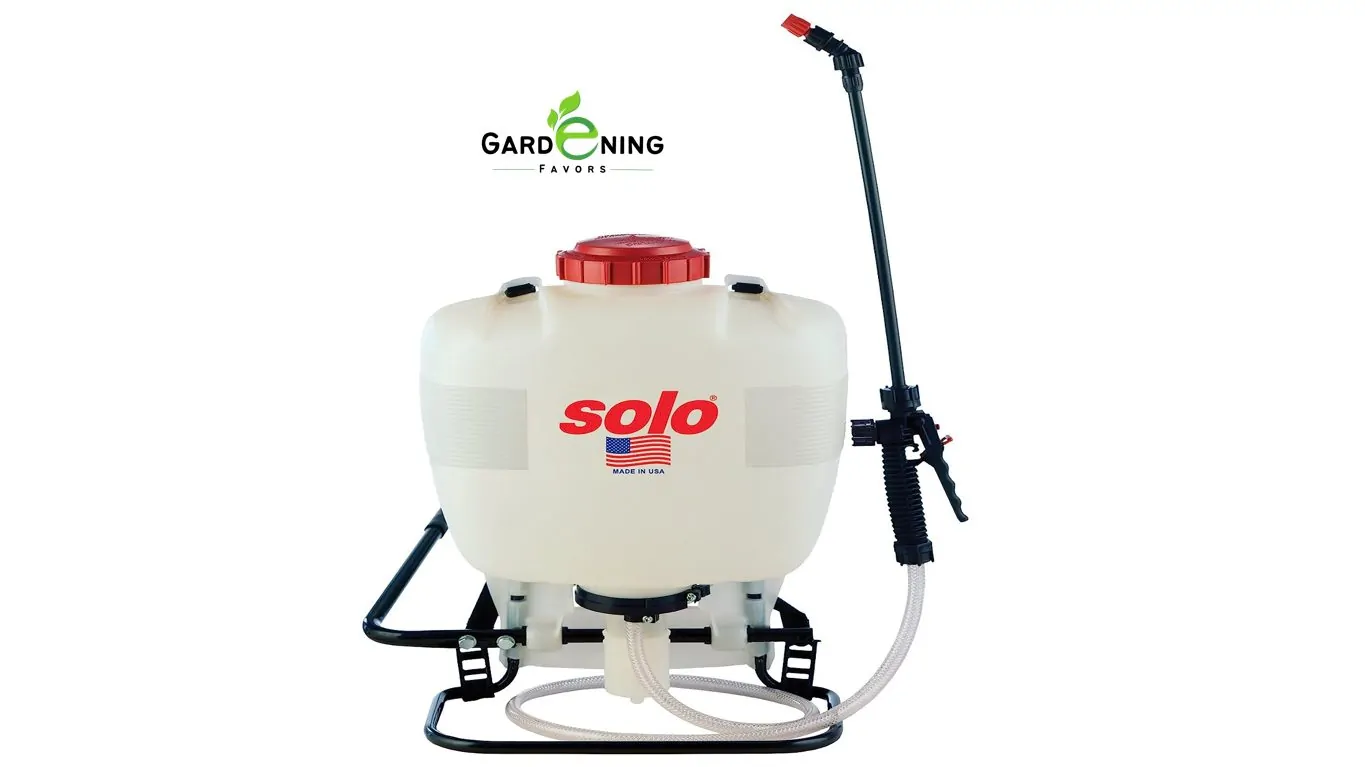 | SOLO 425 4-Gallon Piston Backpack Sprayer, Wide Pressure |
| 4.1 Check Price |
Match Your Backpack Sprayer to Garden Work
Before buying, I wrote down what I needed the sprayer to do. Short spot applications around vegetables were different from sustained passes over a lawn. Tomato stakes and narrow paths called for easy trigger stopping and controlled wand positioning, while open ground called for repeatable delivery. I wanted equipment that matched those tasks rather than the largest tank available.
If you treat a few containers or isolated plants occasionally, keep a small hand sprayer in consideration. A backpack becomes more useful when repeated carrying and refilling disrupt a regular round. For bulk watering, choose a hose, watering can or drip arrangement; a treatment sprayer is an inefficient way to meet the root-zone water needs of a lawn or thirsty vegetable beds.
- Estimate the area and longest regular treatment session.
- Identify intended formulations and necessary spray patterns.
- Check paths, refill access and reachable foliage.
I also considered seasonal changes. Warm-season chilies and tomatoes eventually filled space that looked generous when they were small. Cool-season peas and leafy vegetables brought different canopy shapes and access needs. If your garden changes similarly, prioritise manoeuvrability and interchangeable suitable nozzles rather than expecting one fixed pattern to serve every planting.
Young fruit trees added a clear boundary: I wanted to reach accessible leaves while standing securely on the ground. If your main task involves mature canopies, investigate equipment and methods suited to that height instead of relying on an advertised jet distance. This first decision gave my search a realistic target: a manageable backpack for deliberate garden treatment, with sensible limits.
5 Best Backpack Garden Sprayers: Which One Should You Choose?
Today, I want to share my experience with the 5 best backpack sprayers that I have tested and used. Every sprayer has different features and advantages, so choose the one that matches your gardening needs and start your gardening journey with confidence.
Editor's Pick
 4.5
Field King
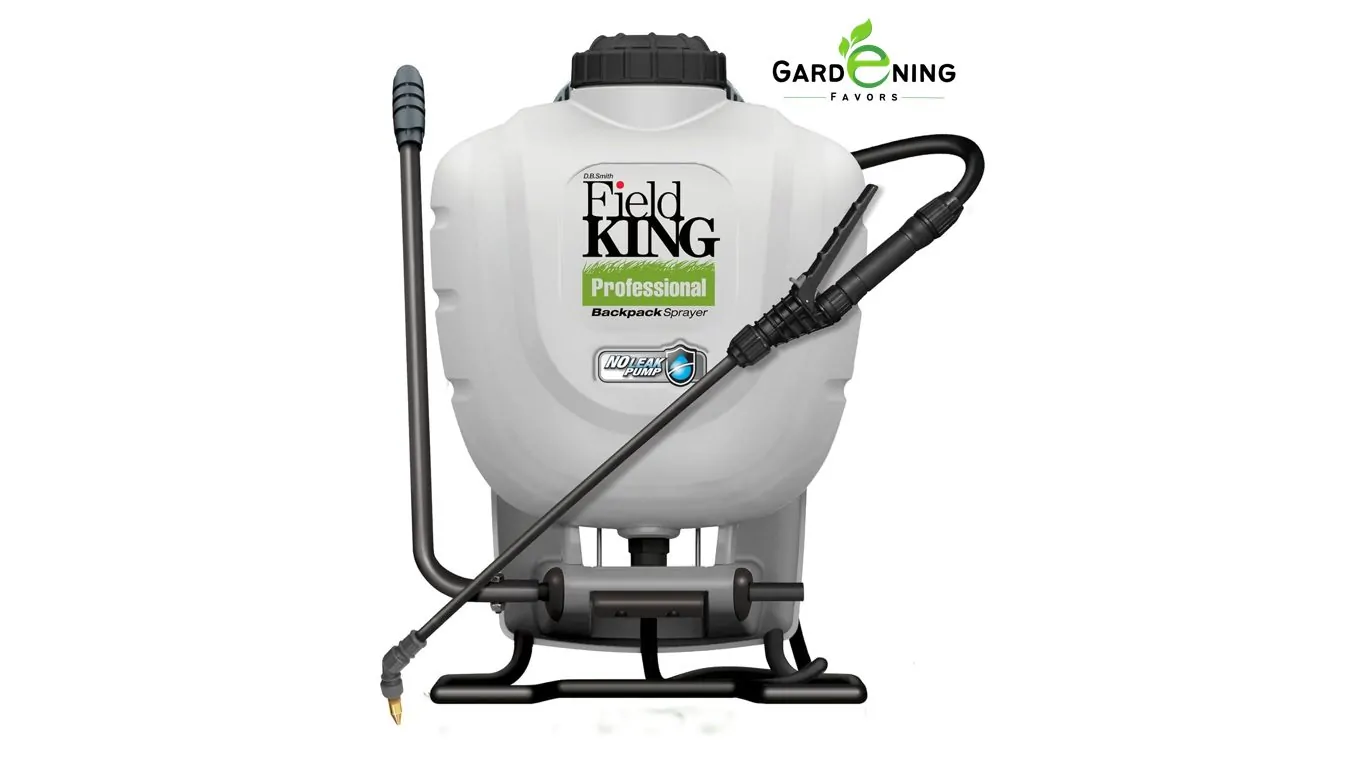
Professional 190328 No Leak Pump 4-Gallon Backpack Sprayer
- The Field King Professional 190328 No Leak Pump 4-Gallon Backpack Sprayer’s adjustable brass nozzle helped me control watering around newly transplanted okra and eggplant.
- Its interchangeable nozzles gave me different patterns for crop-approved insecticide spraying, while the lockable trigger saved me continuous squeezing during longer passes.
- The four-gallon tank saved me refill stops around guava trees, but I used smaller fills because a full tank added about 15 kg of water.
Features
| Feature | Details |
|---|---|
| Sprayer type | Backpack sprayer |
| Capacity status | Tank capacity known |
| Capacity in litres | 15.14 L |
| Capacity | 4 US gal / approximately 15.14 L |
| Pressure | Up to 150 PSI; 25 PSI with regulator (manufacturer specifications) |
| Coverage / range | Spray reach and area coverage not provided; depend on nozzle, pumping and application rate |
| Model | 190328; manual pump model, not 190348 Max or a battery model |
| ASIN | B000AYHKUO |
| Manufacturer | The Fountainhead Group, Inc.; Amazon lists Fountainhead Sprayers |
| Tank capacity | 4 US gallons; 15.14 litres calculated conversion |
| Power source | Manual pump handle; battery, charger, motor and charging time: not applicable |
| Pump | Internal No Leak Pump with piston mechanism and internal agitator; manufacturer design claim |
| Maximum pressure | Up to 150 PSI; manufacturer-rated maximum, not a measured operating result |
| Low-pressure regulator | 25 PSI regulator; maintain pressure by pumping as needed |
| Flow rate | Not provided as a single pump specification; varies with nozzle, pressure and pumping |
| Spray reach | Not provided; 150 PSI does not establish a fixed reach or area coverage |
| Wand | 21-inch / 53.34 cm fixed poly wand; not telescoping |
| Hose | 9/16-inch x 50-inch reinforced hose; approximately 1.27 m long, manufacturer specification |
| Tank material | Poly tank; exact resin grade not provided |
| Seals | Viton seals; chemical resistance does not establish compatibility with every liquid |
| Shut-off | Lockable trigger, brass components and removable in-line filter |
| Filtration | Tank-neck filter basket and shut-off in-line filter |
| Nozzle compatibility | Accepts TeeJet nozzles; select tips appropriate for pressure and treatment |
| Nozzle package | Accessible Amazon same-ASIN listing: four tips, adjustable brass, two flat fans and foaming; current manufacturer package: six tips. Exact US seller package requires confirmation |
| Current manufacturer six-tip set | Adjustable brass; brown high-volume wide fan; red low-volume wide fan; yellow low-volume narrow fan; orange jet stream; black foaming |
| Controls | Pump handle builds pressure; trigger controls discharge; adjustable brass tip changes pattern; optional regulator limits low-pressure spraying |
| Suitable garden jobs | For applying suitable water-based insecticides, fungicides, liquid fertilizers and herbicides according to their labels. In okra, eggplant, sunflowers or guava, the crop, pest, growth stage, dose and application method must all be approved by the treatment label. It can deliver water around newly transplanted plants, but does not replace bed irrigation, soil loosening, mulching, manure application or pest monitoring. |
| Chemical compatibility | The accessible Amazon listing states support for liquids, water-soluble solutions and wettable powders, with internal paddles helping keep mixtures suspended. This does not permit dry powder spraying or manure slurry. Bleach compatibility is not confirmed for this model; do not assume that Viton seals make it bleach-safe. The manufacturer manual prohibits flammable liquids, caustics, acids and hot water; compatibility with other solvents and oil-based products is not verified. Follow both sprayer and chemical labels and keep herbicide equipment separate from edible-crop care where contamination cannot be eliminated. |
| Included items and separate purchases | Sprayer tank/internal pump, pump handle, shoulder harness, hose, shut-off, 21-inch poly wand and nozzle assortment are documented; 25 PSI regulator is described in the same-ASIN Amazon listing. Amazon describes four tips, while the current manufacturer package lists six, so exact seller contents need confirmation. No battery or charger is needed. Treatment liquid, protective equipment, optional TeeJet tips and replacement/service parts are separate purchases; basic assembly tools may be required. |
| Nozzle selection and output | The adjustable brass nozzle changes between a concentrated stream and cone spray; fan tips suit overlapping passes across labelled treatment areas. The foaming tip is for compatible foaming applications. The manufacturer six-tip kit additionally includes a jet-stream tip and another wide fan. Tip colour and flow descriptions differ between old and current packages, so use the instructions supplied with the actual tips rather than assuming an old flow figure. Use the 25 PSI regulator for suitable low-pressure applications and calibrate with clean water before treating plants. |
| Cleaning, maintenance and storage | After each use or change of treatment, rinse the tank with cool clean water and flush the pressure chamber, hose, shut-off and nozzle for at least 30 seconds, repeating until clean. Dispose of rinse water according to the chemical label and local requirements. Clean the filter basket, in-line filter and nozzle; inspect hose connections and seals before use. The internal pump allows tool-free seal service as a manufacturer feature. Release all pressure and empty every part before storing, remove the cap to dry and keep the unit in a dry place away from direct sun and frost. |
| Practical limitations | Manual pumping is required during spraying, and output depends on pump strokes, nozzle and pressure. A full water load adds about 15.14 kg before the empty sprayer weight. The 21-inch fixed wand does not extend and no verified height-reach figure is provided. No-leak refers to the internal pump design, not a guarantee against damaged hoses, loose connections or worn seals. Exact current US offer contents, price, image and return terms remain unverified. |
Expert Take
Growing okra, eggplant and sunflowers meant checking leaves regularly and spraying when treatment was justified. Previously, my small compression sprayer required repeated stops for pumping. I tried the Field King Professional 190328 to see whether pumping while walking made application easier around vegetable beds and guava trees.
How I Used and Tested This Manual Backpack Sprayer
The manufacturer confirmed a four-gallon tank, 21-inch poly wand, reinforced hose, Viton seals and six nozzles. This was the manual base model, with no battery or charger. Its listed pressure capability reached 150 PSI, with 25 PSI regulated operation.
I began with six litres of clean water, checked connections and tried each nozzle over empty soil. For established eggplants with whiteflies and sunflowers with aphids, I used Safer Brand Insect Killing Soap Concentrate. Its outdoor directions specified 2.5 US fluid ounces per gallon, approximately 78 ml per four litres of mixing water. I tested a small plant area first and kept farmyard manure out of the tank.
My Experience and Performance Results
The adjustable brass nozzle helped me change delivery, while careful wand positioning reached eggplant leaf undersides. After checking for visible injury, I treated affected established plants. At follow-up, fewer marked plants carried visible pests, although this did not measure mortality or prove lasting control. On okra, I continued monitoring jassids without automatically treating every plant.
During three one-minute water collections with the red fan and regulator, I measured approximately 0.8, 0.9 and 0.9 litres. Their calculated average was about 0.87 L/min, with pumping rhythm affecting delivery.
| Listed Claim | Practice Observation | Limit |
|---|---|---|
| Up to 150 PSI | More pumping increased delivery | No gauge measurement |
| 25 PSI regulator | Steadier fan delivery with continued pumping | Exact pressure unverified |
| Internal No Leak Pump | Back-contact area stayed dry | Other fittings still required checks |
Two six-litre fills covered eighteen active spraying minutes within fifty-five working minutes. The smaller load felt manageable, whereas ten litres made bending harder. Guava water checks reached outer leaves but missed sheltered foliage, showing that distance alone did not establish coverage.
| Comparable Follow-Up | Previous Season | Current Season |
|---|---|---|
| Eggplants with visible whiteflies | 6 of 10 | 4 of 10 |
| Sunflowers with aphid colonies | 5 of 6 | 3 of 6 |
| Four-week okra harvest | 4.8 kg | 5.4 kg |
Treatment, weather, manure, mulching and picking frequency influenced these comparisons. Continued sunflower flowering and improved okra harvest therefore could not be credited to the sprayer alone.
What I Liked and What Could Be Better
After five sessions, the tank, cap, harness stitching and hose showed no visible damage. The poly wand flexed against foliage but returned without an obvious bend. A retailer reviewer disliked its plastic wand, while another verified purchaser reported leak-free operation; both comments guided my checks.
Initial nozzle seepage stopped after reseating its gasket. Later, cleaning debris from the inline filter restored even spraying. Following soap exposure, accessible seals showed no visible swelling and exposed brass showed no new staining, although this short check did not prove universal chemical resistance.
I released pressure before maintenance, followed label precautions and flushed after use. After seven days in dry, shaded storage, a water restart check showed normal delivery without new leaks.
- Useful nozzle choice and accessible filtration.
- Less stopping, but continued pumping effort.
- Heavier fills increased carrying strain.
How It Compares With Other Options: Is It Worth the Price?
My small sprayer needed two pumping stops during a six-plant pass; the Field King allowed pumping while moving. However, the smaller tool remained easier for isolated treatments. A watering can still suited new transplants and lawn-patch watering, while battery-powered equipment would remove pumping but introduce charging.
The supplied listing showed $89.29, excluding a confirmed Pakistan-delivered cost. Regular applications could justify its convenience, particularly with manufacturer-listed replacement parts. Nevertheless, I would confirm local support and warranty arrangements before buying.
The Field King 190328 suited repeated garden applications, with useful control and serviceable components. For occasional spot treatment, my smaller sprayer remained simpler. Its value depended on application frequency, comfortable carrying loads and proper cleaning.
Pros & Cons
| Pros | Cons |
|---|---|
 Manual operation needs no battery or charger |  Requires repeated manual pumping while spraying |
| Internal pump design reduces the route for pump leaks down the back | Full water load adds approximately 15.14 kg before sprayer weight |
| Viton seals and genuine service parts support repairability | Fixed 21-inch wand does not extend |
| Adjustable brass and interchangeable nozzles suit different spray patterns | Exact nozzle kit differs between Amazon and current manufacturer documentation |
| Lockable trigger and in-line filter support controlled application | No verified fixed spray reach or single flow-rate specification |
Best Budget
4.2Chapin
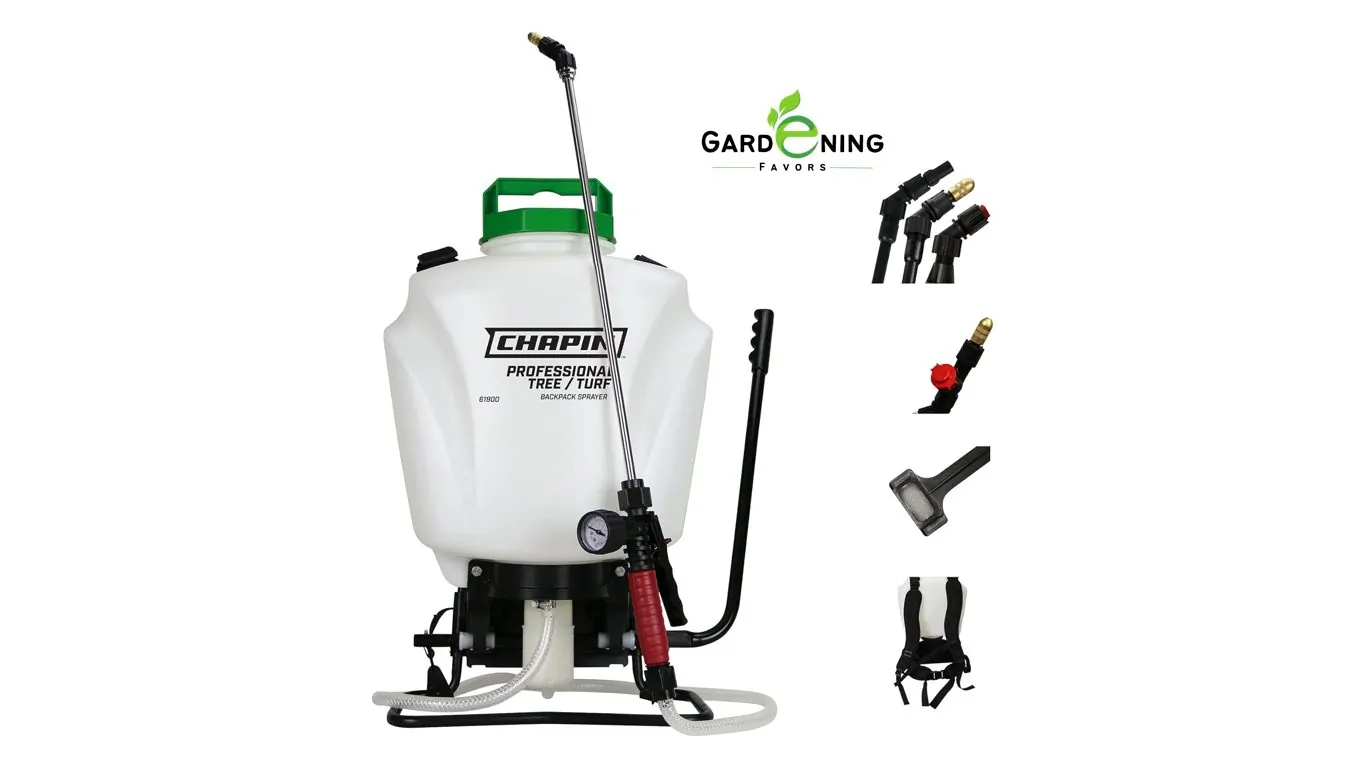
61900 4-Gallon Tree and Turf Pro Commercial Backpack
- The Chapin 61900 4-Gallon Tree and Turf Pro Commercial Backpack Sprayer with Stainless Steel Wand gave me three nozzle options for foliar feeding on marigolds.
- Its adjustable brass nozzle and 20-inch wand helped me direct gentle watering around my tomato plants and newly transplanted chili seedlings.
- During spring lawn preparation, three-stage filtration helped keep debris out, while the translucent four-gallon tank helped me check liquid levels between spraying passes.
Features
| Feature | Details |
|---|---|
| Sprayer type | Backpack sprayer |
| Capacity status | Tank capacity known |
| Capacity in litres | 15.14 L |
| Capacity | 4 US gal / approximately 15.14 L |
| Pressure | 21 PSI CF valve in model manual; maximum pump pressure not provided in selected listing |
| Coverage / range | Verified spray reach and area coverage not provided; calibrate for treatment rate |
| Model | 61900 |
| ASIN | B001FA09S2 |
| Selected variant | Backpack; translucent white; new item sold and shipped by Amazon.com in supplied listing |
| Manufacturer | Chapin International, Inc., Batavia, New York, USA |
| Country of manufacture | Made in the USA with global materials; listing claim |
| Capacity | 4 US gallons; approximately 15.14 L calculated conversion. Manufacturer manual uses rounded 4G/15L label |
| Tank | Translucent poly tank; exact current resin grade not stated |
| Tank opening | 5 inches / 12.7 cm with filter-cap basket |
| Pump | Manual piston pump; pump handle can be mounted on either side according to manual |
| Power source | Manual; motor, battery, charger, charging time and battery runtime: not applicable |
| Wand | 20-inch / 50.8 cm stainless-steel extension; fixed length, not telescoping |
| Hose | 48-inch / 121.92 cm reinforced PVC hose |
| Shut-off | Poly cushioned grip with lock-on trigger; pressure gauge listed in manufacturer table within supplied Amazon text |
| Filtration | Three removable filters: cap basket, in-tank filter near pump and shut-off filter |
| Included nozzles | Three: adjustable brass, adjustable poly cone and poly fan |
| Nozzle patterns | Brass and poly cone tips change from coarse stream to shower/cone; poly fan gives a flat fan pattern |
| Control-flow valve | Supplied listing image describes control-flow valve. Manufacturer manual 010802-2 R0915 identifies CF Valve at 1.5 bar / 21 PSI for use with fixed nozzle |
| Fan nozzle flow | 0.4 US GPM at 40 PSI, approximately 1.51 L/min, in manufacturer manual; this is a nozzle rating at stated pressure, not universal pump output or output through the 21 PSI valve |
| Maximum pressure | Not provided in supplied selected-variant listing; do not infer from fan-tip rating or customer reviews |
| Spray reach | Not provided as a verified selected-model specification; varies with tip, pressure and conditions |
| Suitable garden work | Use suitable labelled liquid fertilizers, pesticides and herbicides for lawn and garden applications. Three nozzle patterns suit foliar feeding and directed plant treatments around chilies, tomatoes and marigolds when approved by the treatment label. Crop and pest monitoring, mango flowering care and spring lawn work need their own management decisions: the sprayer does not identify pests, aerate lawns, install traps or apply solid compost. Avoid spraying flowering mango trees in ways that expose pollinators or conflict with the product label. Water-only use near transplanted plants is listed, but this is not a replacement for normal bed irrigation. |
| Chemical compatibility | Current listing describes chemical-resistant seals for professional fertilizers, pest and weed products and general cleaning solutions. The model manual explicitly prohibits bleach, chlorine, flammable, caustic, acidic and other corrosive liquids, and chemicals that generate heat, pressure or gas. Solvent compatibility is not established; do not assume approval from the stainless-steel wand or old Viton catalog label. The manual warns that powders mixed into liquid can be abrasive: dissolve thoroughly as instructed and flush completely after use. Do not use dry powder, compost slurry or undissolved fertilizer. Treat the crop and liquid label as essential compatibility requirements. |
| Nozzles, pressure and controls | The adjustable brass and adjustable poly-cone tips allow a coarse stream or wider shower/cone pattern, while the poly fan suits overlapping passes across suitable lawn or bed treatment areas. The trigger controls discharge and its lock-on setting holds it open; manual pumping is still required. The pressure gauge helps observe operating pressure. The control-flow valve is used with a fixed nozzle; the older model manual identifies a 21 PSI valve and separately rates the fan tip at 0.4 GPM at 40 PSI. Neither number establishes a verified maximum pump pressure. Calibrate with clean water and the actual fitted nozzle before measuring treatment output. |
| Carrying and preparation | Adjust the padded shoulder straps, chest strap and waist belt to your load, and use the lumbar support described for this model. Four US gallons of water add about 15.14 kg to the listed approximately 4.99 kg empty sprayer. A partial fill reduces the calculated carrying load. Fit the pump handle on the preferred side and check hose clamp, hose nut, nozzle, wand, pump clamp and handle hardware before pressurizing. The 5-inch tank opening and cap basket help filling while keeping larger debris out. |
| Cleaning and maintenance | Empty the tank after use, pump the remaining contents and air out through the nozzle, then half-fill with clean water and flush, repeating as needed according to the manual. Follow the chemical label for rinse-water disposal. Clean all three filters and nozzle tips; the manual allows mild soap but warns against strong cleaners and abrasives. Release pressure before opening or servicing the pump, inspect seals and hose connections, and use the manufacturer-approved lubricant and replacement parts specified for the fitted assembly. Avoid transferring herbicide residue into plant-feeding work; equipment previously used with toxic crop chemicals must not be used for household cleaning. |
| Storage, warranty and limitations | Store empty, clean, depressurized and dry, away from direct sun and freezing conditions, and out of reach of children. Stainless steel improves the wand construction but does not make every component resistant to every chemical. Repeated manual pumping is needed, and high-tree reach is not guaranteed by a verified range figure. Current Amazon description states a 5-year limited warranty and the selected Amazon.com new offer states a 30-day refund/replacement window; retain the receipt and check applicable exclusions. Replacement-part availability and exact warranty terms must be confirmed with Chapin. |
Expert Take
Growing chilies and tomatoes meant checking leaf undersides, while flowering mango trees needed careful hopper monitoring. Previously, I used a small compression sprayer that required frequent pumping stops. I tried the Chapin 61900 Tree and Turf Pro to see whether its backpack design, gauge and filtration improved my application routine.
How I Used and Tested This Manual Backpack Sprayer
The supplied listing specified a four-gallon translucent tank, 20-inch stainless steel wand, 48-inch reinforced hose, piston pump, lockable shut-off and three-stage filtration. Its three nozzles were adjustable brass, adjustable poly cone and poly fan. This manual model needed no battery; I cross-checked its assembly against the Chapin manual.
I began with six litres of water and thirty-second nozzle trials. For whiteflies on established chilies, I used Safer Brand Insect Killing Soap Concentrate at its labelled outdoor rate: 2.5 US fluid ounces per gallon, approximately 78 ml per four litres of mixing water. I tested a small area first and avoided newly transplanted seedlings.
Coverage, Pumping and Garden Response
The cone pattern helped me reach chili leaf undersides, whereas the fan covered a wider band. During three one-minute fan collections, I measured 1.3, 1.4 and 1.4 litres while the supplied gauge indicated approximately 40 PSI. The calculated average was 1.37 L/min; neither my collection nor the gauge was independently calibrated.
| Documented Feature | Practice Result | Limit |
|---|---|---|
| Fan rated 0.4 US GPM at 40 PSI | Approximately 1.37 L/min versus 1.51 L/min rated | Pumping and measurement differed |
| Three-stage filtration | Cleaning trapped debris restored even spray | Filters could still clog |
| Four-gallon capacity | Two six-litre partial fills | Full capacity unmeasured |
Those fills covered approximately sixteen active spraying minutes within fifty working minutes, including inspection and cleaning. Six litres felt manageable during twenty minutes of carrying, although ten litres made bending beside beds harder.
After the small-area check showed no visible injury, I treated affected established chilies. Sticky traps and leaf inspections supported follow-up monitoring. I checked tomato thrips and mango hoppers separately rather than assuming this treatment suited every pest.
| Comparable Observation | Previous Season | Current Season |
|---|---|---|
| Chilies with visible whiteflies at follow-up | 7 of 10 | 4 of 10 |
| Tomato harvest from five plants over four weeks | 6.2 kg | 6.7 kg |
Compost, moisture and weather influenced these differences, so the sprayer did not explain yield alone. Marigold flowering continued without a measured improvement. A water-only foliar rehearsal helped me practise coverage, but did not justify adding nutrients without an identified need. Around flowering mangoes, I avoided spraying blooms and limited checks to reachable foliage.
Component Checks, Cleaning and Storage
Across five sessions, the tank, cap, frame, hose, harness stitching and buckles showed no visible damage. Twenty trigger starts and stops produced no continuing stream, while the wand stayed straight. I checked pump-arm bolts after supplied reviewer Philip reported handle failures followed by replacement support; mine remained secure during this shorter trial.
After two soap applications, accessible seals showed no obvious swelling, while the wand and brass nozzle showed no new corrosion. Initial nozzle seepage stopped after reseating its gasket. Cleaning debris from the shut-off filter restored delivery, demonstrating why filtration still required maintenance.
I followed manual precautions, wore protective clothing, released pressure before maintenance and avoided prohibited bleach, acidic or corrosive solutions. After flushing and seven days of empty, dry, shaded storage, a water restart produced normal delivery without new leaks.
How It Compares With Other Options: Is It Worth the Price?
My small sprayer required two pumping stops during a six-plant pass; the Chapin allowed pumping while walking. However, supplied reviewer Stair Climber found prolonged lawn spraying demanding, matching the effort I noticed during longer rounds.
A battery-powered sprayer would remove pumping, while my watering can remained better for transplant watering. Lawn aeration and weed removal still needed ordinary tools.
Your listing showed $134.99 and a five-year limited warranty. That US snapshot price excluded confirmed Pakistan delivery costs. The wand, gauge and cleanable filters offered practical value, although local parts and warranty access needed checking. For regular applications, these features could justify the cost; occasional spot treatment required less equipment.
The Chapin 61900 improved controlled application across my vegetable beds, but heavier loads and repeated pumping remained limitations. I would consider it for regular spraying with manageable fills and proper cleaning, while keeping simpler tools for watering and isolated treatments.
Pros & Cons
| Pros | Cons |
|---|---|
| Three nozzle options suit different labelled applications | Requires repeated manual pumping |
| Three removable filters help limit clogging | Full water load adds approximately 15.14 kg before empty weight |
| Stainless-steel wand and reinforced hose provide durable components | Fixed 20-inch wand does not extend |
| Translucent tank makes the remaining liquid visible | Bleach, chlorine and corrosive liquids are prohibited |
| Manual operation needs no battery charging | No verified maximum pressure or spray-reach figure in supplied current listing |
Best Premium
4.4Roundup
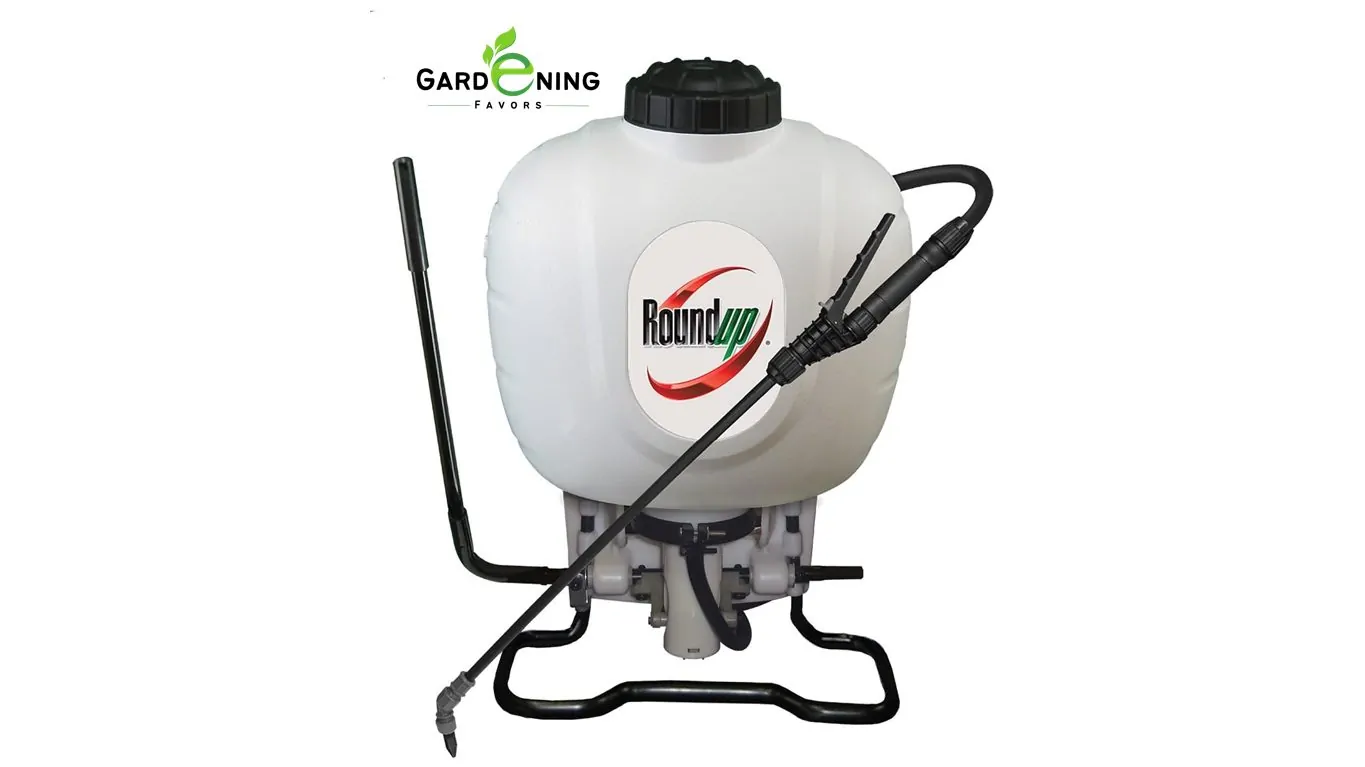
190314 Backpack Sprayer for Fertilizers, Herbicides, Weed Killers
- The Roundup 190314 Backpack Sprayer for Fertilizers, Herbicides, Weed Killers & Insecticides, 4 Gallon helped me direct suitable insecticide sprays around eggplant and bitter gourd.
- Its high-volume and low-volume fan tips gave me different spray patterns while applying suitable liquid fertilizer, helping me match the spray to each area.
- During water-only pathway cleaning, its in-line filter helped catch debris, while the lock-on trigger saved me continuous squeezing, although manual pumping remained necessary.
Features
| Feature | Details |
|---|---|
| Sprayer type | Backpack sprayer |
| Capacity status | Tank capacity known |
| Capacity in litres | 15.14 L |
| Capacity | 4 US gal / approximately 15.14 L |
| Pressure | 150 PSI maximum listed by Amazon; not corroborated by accessed manufacturer specifications |
| Coverage / range | Verified spray reach and area coverage not provided |
| Model | 190314; selected Backpack Sprayer variant, not concentrate liquid |
| ASIN | B00FN3MS8Q |
| Manufacturer | The Fountainhead Group, Inc.; Roundup-branded sprayer |
| Tank capacity | 4 US gallons / approximately 15.14 L, calculated unit conversion |
| Tank material | Polyethylene (PE), Amazon specifications |
| Colour | White |
| Power source | Manual piston pump; motor, battery, charging and battery runtime not applicable |
| Pump | Large manual piston pump; handle reverses for left- or right-handed use |
| Maximum pressure | Amazon specification table lists 150 PSI; not independently tested and not corroborated by the accessed manufacturer product specification page |
| Pressure control | Pump strokes build and maintain pressure; trigger opens discharge. No built-in variable-pressure dial verified |
| Flow rate | Not provided as a verified numerical model specification; depends on nozzle, pressure and pumping |
| Spray reach | Not provided as a verified numerical model specification; fixed wand length does not establish tree-height reach |
| Coverage area | Not provided; depends on treatment rate, nozzle selection and calibration |
| Wand | 21-inch / 53.34 cm heavy-duty poly wand; fixed length, non-corrosive material |
| Hose | Reinforced hose documented; exact length not verified for selected offer |
| Seals | Viton seals and gaskets throughout pump and shut-off |
| Shut-off | Comfort grip, lock-on trigger for continuous discharge and removable in-line filter |
| Filters | Tank-opening basket filter and removable shut-off in-line filter; manufacturer manual also identifies pressure-cylinder filter |
| Nozzles in selected listing | Three: poly adjustable, high-volume flat fan and low-volume flat fan |
| Nozzle package conflict | Manufacturer page and Amazon manufacturer panel also mention a fourth foaming tip; its inclusion in selected seller package is not certain |
| Suitable garden activities | For suitable labelled liquid fertilizers, herbicides and insecticides in lawn and garden work. Around eggplant, bitter gourd and portulaca, choose only treatments approved for the plant, pest, timing and application method. Pest monitoring and trap checks inform whether treatment is needed; spraying does not replace them. Observe harvest intervals before picking bitter gourd or mangoes. The sprayer does not deep-water beds efficiently, mow lawns, train vines, harvest fruit or remove infested produce. |
| Chemical compatibility | Viton improves seal chemical resistance but does not approve every liquid. The manufacturer manual prohibits flammable liquids, caustics, acids and hot water. Bleach compatibility is not verified for this model; do not assume it is bleach-safe. Compatibility with other solvents and powder-based mixtures is not established in the accessed selected-model documentation. Do not load dry powders or undissolved fertilizer. Follow the liquid label and manufacturer compatibility guidance, and avoid herbicide contamination when returning to edible-plant spraying. |
| Nozzles and operating controls | The selected Amazon bullets specify three tips: poly adjustable, high-volume fan and low-volume fan. Manufacturer material additionally mentions a foaming tip, so confirm package contents before depending on it. Twist the adjustable tip for stream or finer spray, use fan tips for suitable overlapping passes, and maintain pressure with the reversible hand pump. The lock-on trigger holds discharge open but does not eliminate pumping. The manual lists optional low-pressure optimizers; their inclusion is unconfirmed. Amazon lists a 150 PSI maximum, but the accessed manufacturer page does not corroborate that figure; calibrate the actual unit rather than treating it as a measured operating result. |
| Preparation and carrying | Fit the wand and chosen nozzle, inspect hose connections, adjust the padded straps, waist belt and chest strap, then test with clean water. Keep the basket filter fitted when adding liquids. The listed 10 lb empty unit plus a full 4 US gallons of water weighs about 19.68 kg; a partial fill lowers that calculated load. Carry using the integrated handle and store the wand in its holder. Harness comfort depends on fit and fill level; no personal comfort test has been supplied. |
| Cleaning, maintenance and storage | Empty and rinse after use, flush cool clean water through the pressure cylinder, hose and shut-off for at least 30 seconds, and repeat until clean. Handle rinse-water disposal according to the treatment label. Clean filters and nozzle openings, inspect seals and straps, and follow the model manual for piston lubrication and repair. Release pressure before servicing. Store empty, dry and depressurized, away from direct sunlight and frost; do not leave chemicals in the tank. |
| Warranty and practical limitations | The manufacturer page states both three- and five-year limited warranty terms, so confirm the applicable coverage with proof of purchase. The selected Amazon.com new offer gives a 30-day refund/replacement option subject to conditions. Manual pumping, full-tank weight and the fixed 21-inch wand limit convenience. Flow rate, spray reach, exact hose length and tank-opening diameter remain unverified. Replacement parts are listed by the manufacturer, but stock and shipping availability may vary. |
Expert Take
Growing eggplant and bitter gourd meant regular pest inspections alongside mango harvesting and portulaca care. Previously, my small compression sprayer required frequent pumping stops. I tried the Roundup 190314 to see whether its backpack arrangement made longer applications easier.
How I Used and Tested This Manual Backpack Sprayer
The manufacturer confirmed a four-gallon manual sprayer with a poly wand, Viton seals, inline filter and padded harness. Your listing described three nozzles, while the manufacturer listed four, including foaming; I based my trials on the adjustable tip and two fans consistently listed. No battery was required.
I began with six litres of water and thirty-second nozzle checks. For established eggplants with whiteflies, I used Safer Brand Insect Killing Soap Concentrate at its outdoor rate: 2.5 US fluid ounces per gallon, approximately 78 ml per four litres of mixing water. I checked a small treated area before wider application.
My Experience and Performance Results
The lower-volume fan helped me reach eggplant leaf undersides without flooding one position. Two days after treatment, four of ten marked plants still showed visible whiteflies, compared with seven before application. This required further monitoring rather than a claim of complete control.
Three one-minute water collections measured 0.6, 0.7 and 0.6 litres, giving a calculated average of approximately 0.63 L/min. Pumping rhythm affected delivery.
| Listed Feature | Practice Observation | Limit |
|---|---|---|
| Four-gallon capacity | Two six-litre fills | Full capacity unmeasured |
| Efficient piston pumping | Pumping continued while walking | No pressure measurement |
| Inline filtration | Cleaning debris restored even spray | Blockages remained possible |
The twelve-litre session involved nineteen active spraying minutes within fifty-eight working minutes. Cornelius Q’s supplied review praised uninterrupted pumping, which matched my experience, although I did not reproduce their estimated speed improvement.
| Comparable Observation | Previous Season | Current Season |
|---|---|---|
| Eggplants with whiteflies at follow-up | 6 of 10 | 4 of 10 |
| Infested bitter gourds removed over two weeks | 8 fruits | 5 fruits |
| Four-week eggplant harvest | 5.8 kg | 6.4 kg |
Weather, nutrition and watering affected harvest. Bitter gourds received no eggplant treatment, so sanitation and pest pressure influenced their comparison. Mango trap checks and portulaca flowering also continued without unsupported sprayer-related improvement claims.
What I Liked and What Could Be Better
After five sessions, the tank, cap, frame, hose, pump attachment and harness showed no visible damage. The poly wand flexed but returned without an obvious bend, while twenty trigger checks produced no continuing stream after release.
Initial nozzle seepage stopped after reseating its gasket. Following soap exposure, accessible seals showed no obvious swelling. In a separate feeding trial, I used Jack’s Classic 20-20-20 at its outdoor rate of one tablespoon per gallon; dried external residue wiped away without visible corrosion.
Reviewer adwalkley reported full-tank leakage, so I checked with water before chemicals. Sean R’s strap-failure report prompted attachment inspections. My partial fills remained dry, but ten litres felt less comfortable than six.
I kept treatments separate, followed protective instructions and released pressure before maintenance. After flushing and seven days in shaded storage, a water restart showed normal delivery without new leaks.
- Convenient pumping and useful nozzle choices.
- Heavier loads and regular cleaning required effort.
How It Compares With Other Options: Is It Worth the Price?
My smaller sprayer needed two pumping stops during a six-plant pass; the Roundup allowed pumping while moving. However, the smaller tool remained easier for isolated treatments. A hose handled deep watering, while vine training, mowing and pathway cleaning required other tools.
Your listing showed $79.98, excluding confirmed Pakistan delivery costs. Regular spraying could justify its convenience, but I would check replacement support. The manufacturer’s conflicting three-year and five-year warranty wording needed clarification before purchase.
The Roundup 190314 suited repeated applications with manageable fills and careful cleaning. For occasional spot treatment, my smaller sprayer remained simpler. Neither equipment convenience nor short trials proved improved yield or years of reliability.
Pros & Cons
| Pros | Cons |
|---|---|
| Runs without batteries or charging | Requires manual pumping during spraying |
| Viton seals support resistance to compatible chemicals | Full water load adds approximately 15.14 kg before empty weight |
| Adjustable and fan tips suit different spray patterns | Fixed 21-inch wand does not extend |
| Reversible pump handle supports either-handed operation | Foaming-tip inclusion differs across package descriptions |
| In-line filter and lock-on shut-off support practical spraying | Manufacturer warranty term is inconsistent and needs confirmation |
Best for Heavy Duty Use
3.9Chapin
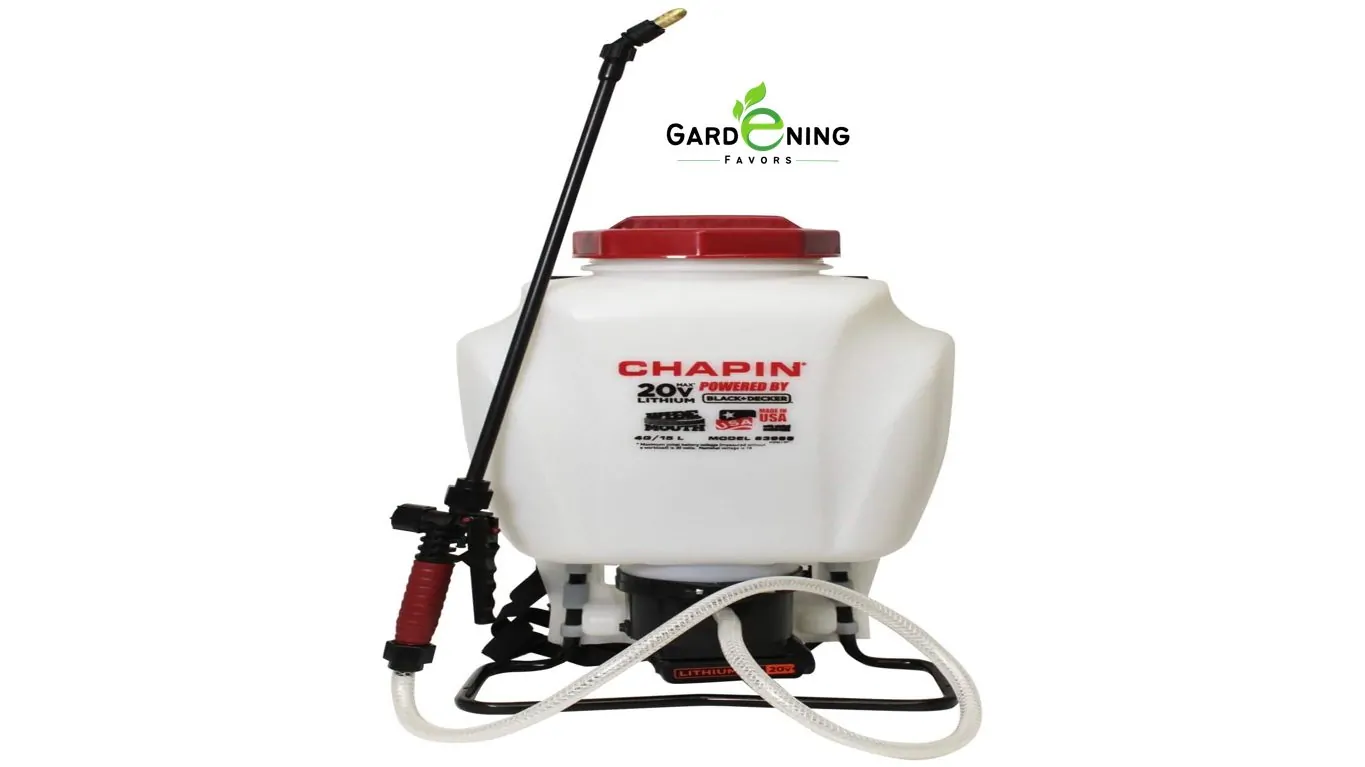
International 63985 20V Wide Mouth Battery Backpack Sprayer,
- The Chapin International 63985 20V Wide Mouth Battery Backpack Sprayer, Powered by Black & Decker, 4 gal, Translucent White gave me nozzle choices for cabbage.
- Its 20V battery pump saved me hand pumping during autumn lawn spraying, although I still needed to squeeze the trigger throughout application.
- The six-inch opening helped me fill and rinse the tank, while three-stage filtration caught debris during water-only spraying around my transplanted cauliflower seedlings.
Features
| Feature | Details |
|---|---|
| Sprayer type | Backpack sprayer |
| Capacity status | Tank capacity known |
| Capacity in litres | 15.14 L |
| Capacity | 4 US gal / approximately 15.14 L |
| Pressure | 35–40 PSI operating range (manufacturer claim) |
| Coverage / range | Up to 35 ft horizontal / 27 ft vertical stream (listing claims); area coverage not provided |
| Model | 63985; Black & Decker 20V model, not Chapin 60124, 63924 or 63925 |
| ASIN | B00Q03MMDO |
| Availability | Currently unavailable in supplied Amazon listing; restock date not provided |
| Manufacturer | Chapin International, Inc., Batavia, New York, USA |
| Country of manufacture | Made in the USA with global materials; listing claim |
| Tank capacity | 4 US gallons / approximately 15.14 L calculated conversion; manual rounds to 4G/15L |
| Tank material | Plastic / polypropylene (PP) in supplied listing |
| Colour | Translucent white |
| Power source | Black & Decker 20V lithium-ion rechargeable battery |
| Battery and charger | Battery pack and charging station included in original listing package |
| Battery capacity | Amp-hour capacity and exact pack model not provided in verified selected listing |
| Battery compatibility | Manual restricts operation to Black & Decker 20V lithium-ion battery. Exact replacement models and larger-pack fit limits not verified; do not assume DeWalt or Chapin 24V compatibility |
| Runtime | Up to 1.75 hours continuous spraying; manufacturer claim, depends on battery and operating conditions |
| Output per charge | Up to 50 US gallons / approximately 189 L; manufacturer claim, not an independent test |
| Charging time | Approximately 3.5–4 hours depending on pack, manufacturer manual 013723 R0115; supplied charger specification not separately verified |
| Charging temperatures | Manual: charge above 4.5 degrees C and below 40.5 degrees C; best charging range 18–24 degrees C |
| Pressure | 35–40 PSI operating range stated in Amazon and Chapin catalog; no user-adjustable pressure dial verified |
| Flow rate | 0.4–0.5 US GPM / approximately 1.51–1.89 L/min; manufacturer panel in supplied listing |
| Horizontal reach | Up to 35 ft / 10.67 m maximum horizontal stream; seller/manufacturer claim, conditions affect reach |
| Vertical reach | Up to 27 ft / 8.23 m maximum vertical stream; listing claim, not independently measured |
| Suitable gardening jobs | For suitable labelled liquid fertilizers and plant-protection treatments in vegetable, flower and lawn work. Around cauliflower, cabbage and marigolds, choose treatments approved for the crop, pest and stage, and follow harvest intervals. Monitoring caterpillars, diamondback moths and guava fruit flies remains separate from treatment decisions. The sprayer does not install netting, spread solid compost, mulch beds or replace ordinary bed irrigation. Use a water-only unit for watering where appropriate and avoid contamination from previous chemicals. |
| Chemical compatibility | The model manual prohibits flammable, caustic, acidic, chlorine, bleach and other corrosive liquids, and chemicals that generate heat, gas or pressure. Do not assume solvent compatibility from the Viton catalog label; unverified solvents should not be used. Powder-based chemical mixtures may be abrasive; follow the product label, dissolve as required and flush thoroughly after use. Do not load dry powder, undissolved fertilizer or compost slurry. Check both sprayer and chemical instructions before using any formulation. |
| Package and controls | The original package describes sprayer, 20V Black & Decker battery and charging station, three nozzles, poly wand, reinforced hose, serviceable shut-off, filters and harness. The 35–40 PSI operating range is not a verified variable-pressure adjustment. Switch the electric pump on, squeeze the trigger to spray and release it to stop. The selected listing explicitly states that this shut-off has no lock-on or lock-off feature. Battery operation removes manual pumping; it does not prove unlimited continuous runtime. |
| Battery care and carrying | Use only the compatible Black & Decker 20V lithium-ion system specified by the manual. Charge fully before first use; pack model, Ah rating and oversized-pack clearance are unverified. Keep the charger dry and use the correct electrical supply. The original manual gives approximately 3.5–4 hours charging depending on battery. Adjust straps to the load and consider a partial fill: four US gallons of water add about 15.14 kg before the sprayer and battery weight. Do not assume the catalog 12 lb is a confirmed empty-unit measurement. |
| Cleaning, maintenance and storage | Switch off, remove the battery and release pressure before servicing. Empty after use and rinse the tank and spray path with clean water, repeating until chemical residue is removed. Clean removable filters and nozzles and inspect hose connections, seals and wiring for damage. Follow the chemical label for rinse-water disposal. Store empty and dry away from heat, freezing conditions and sunlight, and protect the battery and charger from water. The model manual supplies replaceable filter, nozzle, wand, hose and seal part numbers. |
| Availability and limitations | The exact Amazon ASIN is currently unavailable and shows no purchasable price. Prices for recommended Chapin 60124, 63924 and other sprayers do not belong to this model. Runtime, flow and maximum reach are manufacturer/listing claims, not measured results. The fixed poly wand does not extend, no trigger lock is present, and replacement battery fit, warranty terms and current part stock require confirmation. |
Expert Take
Growing cabbage and cauliflower meant checking caterpillars beneath leaves and inspecting insect netting. Previously, my manual sprayer needed repeated pumping. I tried the Chapin 63985 battery-powered backpack sprayer to make necessary applications easier while continuing guava inspections, mulching and soil-moisture checks.
How I Used and Tested This Battery-Powered Backpack Sprayer
The supplied listing and Chapin catalogue described a four-gallon tank, BLACK+DECKER 20V lithium-ion battery and charger, 20-inch poly wand, reinforced hose and three nozzles. Battery capacity in Ah was unconfirmed. The listing specified no trigger lock, so I did not assume continuous spraying could be hands-free.
I first checked connections with six litres of water. For cabbage-worm treatment on established brassicas, I selected Safer Brand Caterpillar Killer II containing Bt. Its vegetable directions gave one tablespoon per US gallon, approximately 15.6 ml per four litres. I mixed separately, agitated regularly and avoided assuming that adult diamondback-moth sightings justified this treatment.
Coverage, Battery Use and Garden Response
The cone pattern reached leaf undersides, while the fan covered wider areas. I inspected twenty marked cabbage leaves before application and checked fresh feeding damage afterwards, because Bt needed to be eaten rather than producing an immediate knockdown.
Two six-litre fills covered eight active spraying minutes within thirty-five working minutes. Dividing twelve litres by eight minutes gave approximately 1.5 L/min, although rounded quantities and residual liquid limited accuracy.
| Listed Claim | Practice Observation | Limit |
|---|---|---|
| Up to 1.75 hours; 50 US gallons | Eight spraying minutes without stopping | Partial battery test only |
| 0.4–0.5 US GPM | Approximately 1.5 L/min | Rounded session calculation |
| 35–40 PSI | Visually steady delivery | No pressure measurement |
Six litres felt manageable during twenty minutes of carrying, whereas ten litres made bending harder. Todd W. Carnes’s supplied review praised powered operation but noted lid difficulties, prompting careful water checks before chemical use.
| Comparable Observation | Previous Season | Current Season |
|---|---|---|
| Marked cabbage leaves with fresh feeding damage at follow-up | 9 of 20 | 4 of 20 |
| Marketable cabbage heads from ten plants | 7 | 8 |
Bt treatment, netting, weather and pest pressure influenced these differences. Compost, watering and mulch also affected growth, so equipment alone did not explain yield. Guava fruit-fly checks continued separately, while marigold flowering showed no measured sprayer-related improvement.
Component Checks, Cleaning and Storage
After five sessions, the tank, hose, wand, straps and buckles showed no visible damage. Twenty trigger checks stopped delivery normally, while battery contacts remained dry. Initial nozzle seepage stopped after reseating its gasket; cleaning debris from the serviceable filter restored an uneven pattern.
After two Bt applications, accessible seals showed no obvious swelling, and exposed fittings showed no new corrosion. The poly wand could not rust like steel, but that did not prove resistance to ageing. I kept Bt separate from cleaners and fertilizers rather than inventing compatibility results.
Owner Mike reported failure and bottom leakage after roughly a year; my shorter trial could not resolve that durability concern. I followed protective instructions, switched off and released pressure before maintenance, flushed after use and removed the battery for dry storage. A seven-day water restart showed normal delivery without new leaks.
- No manual pumping and useful spray patterns.
- Heavy fills and lid sealing needed attention.
How It Compares With Other Options
My manual sprayer needed two pumping pauses during a short cabbage pass; the Chapin did not. However, the manual tool remained simpler for isolated plants. A watering can still suited transplanted cauliflower, while lawn maintenance and damaged-leaf removal required other tools.
Your listing showed the 63985 as unavailable, with no current price. I would check replacement batteries, charger condition and parts before considering remaining stock. Prices for the suggested 60124 or 63924 were not prices for this model.
The Chapin 63985 made repeated brassica applications easier, but lid concerns and mixed owner durability reports mattered. I would consider a sound unit with verified support; occasional users might prefer a simpler manual sprayer.
Pros & Cons
| Pros | Cons |
|---|---|
| Battery operation removes manual pumping | Exact Amazon model is currently unavailable |
| Original package includes battery and charger | Trigger has no lock-on feature |
| Six-inch opening helps filling and cleaning | Full water load adds approximately 15.14 kg before unit weight |
| Three-stage filtration helps limit nozzle clogging | Fixed poly wand does not extend |
| Three nozzle options suit different labelled applications | Replacement battery fit and warranty terms are not verified |
Best for Beginners
4.1SOLO
425 4-Gallon Piston Backpack Sprayer, Wide Pressure Range
- The SOLO 425 4-Gallon Piston Backpack Sprayer, Wide Pressure Range up to 90 psi helped me direct light watering around spinach and coriander seedlings.
- Its four nozzles gave me different spray patterns for work around my petunias and lemon trees, depending on the task I planned.
- The 4.25-inch opening helped me fill and rinse the tank during autumn garden work, while the manual pump still needed regular operation.
Features
| Feature | Details |
|---|---|
| Sprayer type | Backpack sprayer |
| Capacity status | Tank capacity known |
| Capacity in litres | 15.14 L |
| Capacity | 4 US gal / approximately 15.14 L |
| Pressure | Up to 90 PSI (base-model manufacturer rating) |
| Coverage / range | Verified spray reach and area coverage not provided; calibrate for treatment rate |
| Model | SOLO 425 base US model; not 425-101, 425-PROF, 425-Deluxe or diaphragm 475 |
| ASIN | B00002N6BW |
| Selected style | Sprayer; white; new item sold and shipped by Amazon.com in supplied listing |
| Capacity | 4 US gallons / approximately 15.14 L calculated conversion |
| Tank | High-density polyethylene with UV inhibitors |
| Opening | 4.25 inches / approximately 10.8 cm |
| Power source | Hand-powered piston pump; battery, motor, charging and battery runtime not applicable |
| Pressure | Up to 90 PSI; selected listing and SOLO US base-model bulletin. Older Amazon manufacturer panel says 60 PSI |
| Pressure regulator | Not included on base 425 according to SOLO US comparison bulletin; do not transfer regulator settings from PRO or Deluxe variants |
| Flow rate | Not provided as a single pump figure; depends on nozzle and maintained pressure |
| Spray reach | Verified horizontal/vertical distance not provided |
| Area coverage | Not provided; depends on dose, nozzle, pressure and calibration |
| Wand | 20-inch / 50.8 cm fixed polypropylene extension; manufacturer describes it as unbreakable. Amazon imagery also uses 28-inch overall wand wording |
| Hose | 48-inch / 121.92 cm nylon-reinforced high-pressure hose |
| Included nozzles | Four: plastic adjustable, flat fan, hollow cone and jet stream |
| Nozzle compatibility | TeeJet-compatible; confirm tip and fitting for the intended application |
| Shut-off | Commercial valve locks on or off; locking on does not remove the need to pump |
| Pump handle | Standard fixed handle reverses for left- or right-handed operation |
| Seals | Viton seals in key locations; not necessarily Viton throughout every component |
| Frame | Rugged metal support frame; liquid-contact parts described as corrosion-resistant plastics |
| Suitable garden tasks | For suitable liquid fertilizers, herbicides, insecticides and fungicides approved for the plant and application. Around spinach, coriander and petunias, select the crop-approved formulation and observe edible-leaf harvest intervals. Citrus leaf-miner and aphid monitoring do not automatically require spraying. Light water-only application near seedlings is possible with an appropriate pattern and pressure, but this is not a substitute for bed irrigation. It does not measure pH, install nursery trays, sow seeds, remove leaves or spread solid organic fertilizer. |
| Chemical compatibility | SOLO instructs users not to use acids, including citrus acids, or caustic chemicals. The manual directs bleach users to diaphragm models such as 475-B; do not treat this piston 425 as bleach-safe. Avoid flammable products. Wettable powders are abrasive and should be avoided in this piston model; the manual recommends diaphragm models for them and specifies extra cleaning, piston lubrication and leak inspection if powders have been used. Do not spray dry powder, undissolved fertilizer or compost slurry. Other solvent compatibility must be confirmed with SOLO and the treatment label; Viton seals alone are not approval. |
| Patterns and operating control | The plastic adjustable tip changes spray pattern for directed work; the fan tip supports overlapping passes, the hollow cone gives a cone pattern and the jet tip gives a concentrated stream. Match the tip and pressure to the treatment label, then calibrate with clean water. The pump handle builds and maintains pressure and the shut-off locks open or closed. The base 425 has no pressure regulator according to SOLO’s US comparison bulletin, so do not describe it as having the PRO model’s regulated settings. The 20-inch extension is fixed rather than telescoping. |
| Preparation and carrying | Assemble the supplied wand and nozzle, secure the hose and straps, and mount the pump handle on the preferred side. Use the filler strainer and test for leaks with plain water before chemicals. Four US gallons of water add about 15.14 kg to the empty unit, making the manufacturer-based total approximately 20.13 kg. A partial fill lowers that calculated load. Standard padded straps are documented; do not assume the base model includes Deluxe or PRO harness features. Do not climb while wearing the filled sprayer. |
| Cleaning, maintenance and storage | After spraying, drain, rinse and flush clean mild-soapy water through the spray path until clean; follow chemical-label disposal requirements. Clean strainers and nozzle openings, inspect the piston, seals, hose, straps and valve, and lubricate with Solo Superior Grease or petroleum jelly as instructed. Release pressure before servicing. Store empty and dry away from direct sunlight, and drain the hose and pressure chamber before freezing weather. Follow SOLO’s model parts diagram rather than fitting parts only because a similar model uses them. |
| Limitations and warranty | Manual pumping is required, full-tank weight is substantial and the fixed wand gives limited physical extension. A maximum 90 PSI rating is not a guarantee of tree-height coverage or a measured flow rate. Piston seals need cleaning and lubrication, and abrasive mixtures can accelerate wear. The base US model carries a one-year limited warranty; confirm claim eligibility and keep proof of purchase. Wand-length, older pressure-panel and empty-weight differences in the listing are disclosed in specifications. |
Expert Take
Growing spinach and coriander meant checking young leaves while preparing nursery trays and maintaining lemon trees. Previously, my small compression sprayer needed repeated pumping stops. I tried the SOLO 425 to see whether pumping while walking improved necessary applications without disturbing delicate plants.
How I Used and Tested This Manual Backpack Sprayer
The manufacturer identified a four-gallon piston-pump sprayer capable of up to 90 PSI. The listed package included four nozzles: adjustable plastic, fan, hollow cone and jet. Wand descriptions differed between 20 and 28 inches, so I would confirm the supplied assembly. This manual model required no battery.
I began with six litres of water and thirty-second nozzle checks. For aphids on established spinach, I used Safer Brand Insect Killing Soap Concentrate at its outdoor vegetable rate: 2.5 US fluid ounces per gallon, approximately 78 ml per four litres of mixing water. I tested a small area before wider application.
Coverage, Pumping and Plant Response
The broader pattern dampened established foliage more gently than the jet, which disturbed loose soil during my empty-bed trial. Therefore, a watering can remained better for newly sown nursery trays, while careful wand positioning helped reach spinach leaf undersides.
Three one-minute fan collections measured approximately 0.6, 0.7 and 0.7 litres, averaging 0.67 L/min. Two six-litre fills involved eighteen active spraying minutes within fifty working minutes, including inspection and cleaning.
| Listed Feature | Practice Observation | Limit |
|---|---|---|
| Up to 90 PSI | Additional pumping strengthened delivery | No pressure gauge |
| Four nozzle choices | Fan and cone suited closer foliage work | Patterns required adjustment |
| Four-gallon capacity | Two six-litre partial fills | Full capacity unmeasured |
In a separate organic-feeding trial, I used Neptune’s Harvest Fish & Seaweed Blend around established petunias. Its outdoor directions specified one US fluid ounce per gallon, approximately 31 ml per four litres. I kept fertilizer and insecticide separate and checked for runoff.
| Comparable Observation | Previous Season | Current Season |
|---|---|---|
| Spinach plants with visible aphids at follow-up | 8 of 20 | 4 of 20 |
| Spinach harvested from a comparable bed | 2.1 kg | 2.4 kg |
Weather, nutrition and moisture influenced these differences. I monitored coriander spotting and citrus leaf-miner tunnels without inventing diagnoses or treatments. Petunia flowering continued, but no matched bloom count supported an improvement claim.
Component Checks, Cleaning and Storage
After five sessions, the tank, cap, metal frame, pump attachment, hose and straps showed no visible damage. Twenty trigger checks stopped delivery normally, while the plastic wand flexed without permanent bending. Six litres felt manageable during twenty minutes of carrying; ten litres made bending harder.
Supplied reviewer A. Holland reported a loose hose connection and occasional trigger-lock trouble. Consequently, I checked clamps and released the lock between plants. Initial nozzle seepage stopped after reseating its gasket, while cleaning debris from the filter restored even spraying.
Following soap and fertilizer exposure, accessible seals showed no obvious swelling and exposed metal showed no new rust. Dried fertilizer residue rinsed away, although this did not prove compatibility with other chemicals. I followed protective instructions, released pressure before maintenance and flushed after use. A seven-day dry-storage restart showed normal delivery without new leaks.
- Useful nozzle selection and accessible filtration.
- Continued pumping and heavier loads required effort.
How It Compares With Other Options
My smaller sprayer needed two pumping stops during a six-plant pass; the SOLO allowed pumping while moving. However, the smaller tool remained easier for isolated treatments. Neither replaced nursery watering, soil-pH checks, bed cleaning or ordinary lawn tools.
Your listing showed $89.95, excluding confirmed Pakistan delivery costs. Regular applications could justify its capacity and replaceable components. However, supplied reviewer FL-Reviewer found the straps uncomfortable during longer work, so fit and local parts availability deserved checking.
The SOLO 425 suited repeated garden applications with manageable fills and careful cleaning. For occasional spot treatment or nursery watering, simpler tools remained preferable. Its convenience supported plant care, but did not independently prove better yield or lasting durability.
Pros & Cons
| Pros | Cons |
|---|---|
| UV-resistant HDPE tank supports outdoor durability | Repeated manual pumping is required |
| Four nozzles suit different labelled applications | Full water load adds approximately 15.14 kg before empty weight |
| Viton seals protect key areas against compatible chemicals | Fixed poly extension does not telescope |
| Reversible handle supports either-handed pumping | Wettable powders should be avoided in the piston pump |
| Large opening and lock-on/off valve aid practical operation | Base model lacks the Deluxe harness and PRO pressure regulator |
Choose Manual or Powered Spraying Wisely
Next, I researched the mechanism. In a common manual backpack sprayer, a lever operates a pump that draws liquid through an inlet and one-way valves into a pressure chamber. Liquid then travels through the hose, trigger valve, wand and nozzle. The main reservoir is not necessarily pressurised like a compression hand sprayer, although designs vary. The exact manual matters.
A piston pump moves a piston in a cylinder; a diaphragm pump flexes a membrane. Formulation suitability can affect the choice. SOLO warns that abrasive wettable powders wear piston components in specified models and recommends suitable diaphragm models for that work. This does not approve every diaphragm sprayer for every powder, solvent or bleach mixture. SOLO’s formulation guidance explains the model-specific distinction.
| Type | Consider it when | Verify before buying |
|---|---|---|
| Manual piston | Rounds are shorter and formulations are approved. | Pumping effort, wear restrictions and repair kits. |
| Manual diaphragm | Approved suspensions suit the specified design. | Membrane compatibility, pressure and agitation needs. |
| Battery-powered | Sustained pumping would interrupt or tire you. | Regulation, loaded weight, charger and battery support. |
| Engine-powered | The workload requires specialised powered equipment. | Noise, fuel, servicing and application method. |
For occasional vegetable and flower rounds, I recommend starting with a serviceable manual option if pumping is comfortable. For longer sessions, battery power can remove lever effort, but it adds electrical components and future battery expense. Do not pay for powered operation simply because it looks more advanced; identify the difficulty it actually solves.
I wanted control at the nozzle, so I checked flow at a stated operating pressure rather than combining unrelated maximum figures. A motor-speed dial, pressure switch and regulator do different jobs. Compare battery chemistry, capacity, runtime conditions and replacement arrangements too; amp-hours alone cannot predict runtime across different pumps. Engine-powered hydraulic sprayers and air-assisted mist blowers also require separate assessment because their application methods differ.
Match Capacity to Comfortable Carrying Weight
Before choosing capacity, I calculated the load I might carry. Water adds approximately one kilogram per litre. Four US gallons equal about 15.1 litres, adding roughly 15.1 kilograms before the equipment, battery and accessories. These are calculations for water; other mixtures may have different densities. Check whether a listing means US gallons, imperial gallons or rounded litres.
I set a manageable partial fill as my target rather than assuming every round would begin with a full tank. If your refill point is nearby, carrying less can be a reasonable trade-off. Where refilling is inconvenient, extra capacity may help, provided you can lift and carry the intended load safely. Tank size does not establish treatment coverage without calibration.
- Compare empty weight plus your intended fill.
- Look for adjustable straps and secure attachment points.
- Consider a smaller unit or cart where appropriate.
During a permitted inspection of empty equipment, I checked strap edges, padding, stitching, buckles, frame connections and lifting points. I wanted adjusters that stayed secure and a base that stood steadily. However, I could not establish loaded comfort from that inspection. Ask whether a brief supervised fit demonstration is available; otherwise verify return conditions before relying on a harness you have not carried.
A well-designed waist belt can assist support, but its presence alone does not prove effective weight transfer. If you have difficult terrain or lifting limitations, prioritise handling over maximum capacity. My decision was to leave room for extra liquid without making a full tank the standard working load.
Check Build Quality Before Comparing Extra Features
Inspect Materials Along the Liquid Path
I then compared the parts that would contact liquid. I looked for a specified tank polymer, secure cap threads, a replaceable gasket, accessible screens and documented pump materials. HDPE and other suitable polymers avoid metal tank rust, but remain vulnerable to incompatible chemicals, impact and sunlight. Readable graduations help filling; they are not automatically accurate measuring instruments.
If you expect to use different approved formulations, ask about compatibility across the complete system. FKM, often sold under the Viton brand, EPDM and nitrile seals have different properties. A premium seal name does not certify the hose, diaphragm, trigger spring and other wetted parts. Seek approval for the exact formulation and labelled concentration rather than experimenting with a chemical soak.
- Request material and formulation information for wetted parts.
- Inspect cap seating and accessible inlet screens.
- Check whether pump and valve wear parts are replaceable.
Where a shop allowed an empty inspection, I examined threads and gasket seating without forcing anything. Rough threads, distorted sealing surfaces and inaccessible wear parts raised questions. Better construction meant sound joints and understandable servicing, not simply a higher price. An inexpensive unit can be adequate for occasional approved work; an expensive unit with undocumented compatibility remains uncertain.
I reserved leakage, corrosion and wear observations for after purchase. Before paying, the evidence was documentation, condition and repair support. That distinction stopped me treating an attractive display unit as if I had already proved its durability.
Choose Useful Controls, Nozzles and Reach
For hoses and controls, I wanted flexible routing, pressure suitability, secure couplings and a trigger that was easy to release. A trigger lock can reduce continuous squeezing, but convenient stopping matters around neighbouring plants. Stainless steel, brass, aluminium and polymer wands each need formulation approval; a metal finish alone does not establish corrosion resistance or strength.
Choose a flat-fan arrangement suited to labelled lawn or ground applications, and an approved foliage pattern for vegetables and shrubs. Adjustable cones offer flexibility but can change output when adjusted. For reachable young trees, prioritise comfortable positioning over maximum jet throw. A longer wand improves access while increasing leverage on the wrist.
- Match nozzle pattern and droplets to treatment requirements.
- Verify flow within the stated working pressure range.
- Check screen access and standard replacement-tip compatibility.
TeeJet explains that doubling flow through a fixed nozzle generally requires four times the pressure. Pressure also influences pattern and droplet characteristics, so select a suitable orifice instead of using excessive pressure to compensate. Ask what regulation is fitted and where any gauge measures pressure.
Filtration completes that choice. A filling basket intercepts larger debris, an inlet screen protects the pump and a nozzle screen protects the orifice where fitted. Mesh must suit the tip and approved formulation; finer is not always better. Suspensions may require specified agitation, which a strainer cannot replace. I prioritised these practical details above a large accessory count. Check tip material too: plastic, brass, stainless steel and ceramic designs have different wear characteristics. After purchase, assess nozzle condition through output and pattern checks, because a clean-looking orifice can still be worn.
Buy With Clear Returns and Repair Support
With my requirements established, I compared where to buy. Local garden suppliers could relate equipment to garden tasks; equipment shops could explain servicing. In-store inspection was useful for straps, joints and controls, but any demonstration depended on permission. Manufacturer sites helped confirm the exact model and manual, while reputable online sellers offered another route if their identity and policies were clear.
For an online order, verify the seller separately from the marketplace. Request the exact model suffix, pump type, tank capacity, wand material, supplied nozzles and battery-and-charger contents. Similar photographs do not establish an identical package. If the seller cannot resolve a material difference, choose a source that can before paying.
| Check | Evidence to obtain |
|---|---|
| Exact package | Model code, current manual and included components. |
| Delivered cost | Shipping, taxes, import charges and essential accessories. |
| Returns | Deadline, permitted water testing and return freight. |
| Regional warranty | Eligible territory, service route and component exclusions. |
| Repairs | Correct part numbers and a realistic supply route. |
I favoured documented support over a small headline saving. Imported equipment can have different regional warranty conditions, and batteries or wear parts may have separate coverage. Check charger input voltage and frequency; a plug adaptor does not establish suitability. Include protective equipment, replacement tips, seals, servicing and potential downtime in ownership cost.
At the purchase stage, I checked the proposed order against my requirements and planned delivery inspection within the return window. My purchase plan included keeping the model information, actual invoice and written seller commitments with the equipment. The learning journey names no seller, price or transaction record. My choice balanced manageable weight, suitable delivery and support rather than pretending one feature settled everything.
Test Fit and Delivery After Your Purchase
After delivery, I first checked the package, documented condition and assembled the unit according to its manual. A fifteen-minute clean-water check covered the cap, pump connections, hose, valve and wand joints. I opened and released the trigger twenty times, watching for delayed stopping or leakage. A dry exterior and responsive valve supported initial operation, not long-term compatibility.

I then compared eight- and twelve-litre fills during two ten-minute walks through the garden. Using a stable support helped with putting the backpack on. The larger fill made turns and uneven ground more demanding, while the smaller fill was easier to control. Choose your working fill from this kind of careful after-purchase practice, within your own physical limits.
- Report missing parts or leaks within return deadlines.
- Test manageable fills before attempting heavier loads.
- Check straps, hose movement and trigger stopping together.
During these walks, I watched for slipping buckles, rubbing padding, frame movement and hose restriction. Adjusting the harness improved positioning, but greater padding did not remove the weight. If repeated adjustment fails to produce secure carrying, address the fit problem before chemical use rather than accepting it as normal.
I also checked accessible screens, lever movement, gauge response and any electrical controls as instructed. On a powered unit, battery retention, dry contacts and compartment closure deserved inspection. These checks cannot certify gauge accuracy, waterproofing or battery endurance; uncertain behaviour needs manufacturer advice or service. This was the point where my buying targets began turning into actual observations.
Calibrate Before Testing Coverage on Your Plants
Next came water calibration. I fitted the intended nozzle and screen, primed the pump and collected delivery for sixty seconds three times at the same operating setting. The purpose was to detect inconsistent output before treatment. NC State Extension recommends inspecting equipment and comparing nozzle discharge with manufacturer information before relating output to a known area. Its calibration guidance explains this process.
In the learning trial, two litres covered a measured 100-square-metre lawn strip. The calculation was 2 divided by 100, giving 0.02 litres per square metre, equivalent to 200 litres per hectare. Eight litres would theoretically cover 400 square metres at that carrier volume. This calculated coverage is not a recommended chemical rate, and overlap or difficult corners can change practical use.
- Maintain a repeatable pace, pressure and nozzle position.
- Measure effective coverage rather than theoretical spray width.
- Recalibrate after changing tips or delivery settings.
For tomatoes and chilies, I ran two five-minute foliage exercises with water-sensitive cards at exposed and sheltered positions. Sheltered cards received fewer marks, so I approached from another accessible side instead of increasing pressure. Cards indicate deposition, not chemical dose or pest mortality. Near marigolds, stopping between targets kept unnecessary spray away from flowers.

A separate five-minute young-tree exercise showed that raising the wand increased arm strain and a narrow jet wetted less foliage. If useful coverage requires climbing or overhead application, reconsider the equipment. These trials helped refine technique after purchase; they did not claim crop improvement. For real mixing, follow the label’s area-based or concentration-based instruction and all accompanying limits.
Protect Yourself Before Mixing Any Treatment
No exact crop-approved chemical label was supplied, so the trials remained water-only. Before actual application, verify the crop or site, target, formulation, permitted equipment, rate and protection requirements. In Pakistan, follow locally authorised products and applicable labels; US guidance supports the illustrated settings without replacing local requirements. A shared active ingredient does not establish interchangeable formulations.
After buying, I rehearsed filling for ten minutes using clean water and dedicated measuring utensils. A stable surface made the filler accessible and spills visible before lifting. Chemical work requires label-specified mixing order, agitation and protection of the water supply from backflow. Wear the specified chemical-resistant gloves, eye protection and clothing; ordinary gardening gloves are not automatic substitutes.
- Read the full label before mixing or spraying.
- Check weather, nearby plants and exclusion requirements.
- Keep washing water and emergency information accessible.
If a respirator is required, obtain the correct equipment, fitting and training before proceeding. Check wind direction, rainfall restrictions and buffers; very still air can accompany a temperature inversion and is not automatically safe. Observe pollinator precautions around flowers and blossom, and keep herbicide equipment separate from sprayers for sensitive vegetables. The EPA-hosted applicator manual explains drift and handling.
During a five-minute water drill, I practised releasing the trigger before turning and setting the unit down safely. For chemical work, exclude people and pets as directed, stop immediately if leakage wets clothing, and never loosen pressurised fittings. Wash afterward and respect re-entry and pre-harvest intervals. For exposure, follow label first aid and seek professional advice promptly; severe breathing difficulty or collapse requires emergency help. EPA safety advice and exposure guidance explain these precautions.
Maintain Your Sprayer Beyond the First Trials
After each water session, I spent about ten minutes flushing the tank, pump, hose, trigger and nozzle, then rinsed accessible screens while depressurised. Easy removal and drainage made maintenance practical. With chemicals, follow both the treatment label and equipment instructions; visible cleanliness does not prove residues are removed. SOLO recommends thorough cleaning and cautions against aggressive cleaners.
Across four weekly water sessions, I photographed couplings, fasteners and wand joints, dried them afterward and checked for stains, cracks, rough threads, hose hardening and loose anchors. Their condition showed only short-term wear and storage behaviour. If you need evidence of chemical resistance or service life, seek formulation approval and longer-term records rather than extending these observations beyond what they establish.
- Flush every liquid-carrying component and inspect screens.
- Use approved cleaners, lubrication and replacement parts.
- Store securely and check condition before restarting.
Never assume bleach or solvents are universal cleaners, never mix cleaning chemicals and never clear a nozzle by mouth or by enlarging it with wire. Handle leftover mixture and rinsate according to the label and local rules. Release pressure and isolate powered equipment before servicing. During four weeks of storage, I checked weekly for moisture, distorted hose and damp padding, keeping the cleaned unit away from sunlight and freezing and following battery instructions.
Store pesticides in original labelled containers away from children, pets, food and feed. For repairs, match pump, trigger and hose parts to the exact model; a published kit does not establish local stock. SOLO maintenance guidance, its illustrated parts list and EPA storage advice provide useful reference points. Repairability can make a modest unit better value than unsupported expensive equipment.
Choose the Upgrade That Solves Your Problem
My original frustration was interrupted work, so I judged the upgrade against that problem. Manageable capacity reduced refill interruptions, appropriate controls helped direct delivery, and calibration made the method repeatable. Hidden leaves still needed better access, carrying weight still mattered and cleaning still took time. Those limitations belonged in the buying decision, not as surprises after purchase.
- Choose for your regular workload and manageable fill
- Verify compatibility, package contents and support before paying.
- Evaluate fit and performance after delivery with water.
If you spray occasionally, start with a sound manual option; if sustained pumping is the obstacle, compare suitable battery equipment with dependable support. In either case, take your garden requirements to the seller and resolve uncertainties before payment. After delivery, inspect, practise, calibrate and maintain the sprayer. That sequence turns a purchase into useful help while keeping treatment decisions and realistic expectations firmly under your control.
Conclusion
My original problem was never simply that a small sprayer held too little liquid. It was that falling pressure, tired hands and repeated mixing made my application less careful at exactly the moment when vegetables, flowers, lawns and young trees each needed a different kind of care.
The upgrade helped where I had hoped it would, in steadier coverage, fewer interruptions, safer reach from the ground and a working pace I could calibrate and repeat, and it remained limited where honesty requires me to say so, in filled weight, in the reach of a breaking pattern on higher branches and in the discipline of cleaning and seal care that no design can remove. Those benefits and limits together, rather than a maximum pressure figure, are what made the purchase feel considered instead of impulsive.
references:
1. Konthonbut, P., Kongtip, P., Nankongnab, N., Tipayamongkholgul, M., Yoosook, W., & Woskie, S. (2020). Paraquat exposure of backpack sprayers in agricultural area in Thailand. Human and Ecological Risk Assessment: An International Journal, 26(10), 2798-2811.
2. Blanco, L. E., Aragón, A., Lundberg, I., Lidén, C., Wesseling, C., & Nise, G. (2005). Determinants of dermal exposure among Nicaraguan subsistence farmers during pesticide applications with backpack sprayers. Annals of Occupational Hygiene, 49(1), 17-24.
3. Steenland, K., Cedillo, L., Tucker, J., Hines, C., Sorensen, K., Deddens, J., & Cruz, V. (1997). Thyroid hormones and cytogenetic outcomes in backpack sprayers using ethylenebis (dithiocarbamate)(EBDC) fungicides in Mexico. Environmental health perspectives, 105(10), 1126.
4. Ahmmed, M. M., Hossain, M. A., Hossen, M. A., & Rahman, F. (2026). Development and Performance Assessment of a Solar-Powered Backpack Sprayer under Field Conditions.
5. Singh, A. K., Manes, G. S., Dixit, A., Singh, S. K., & Singh, M. A. N. J. E. E. T. (2019). Development and evaluation of multi nozzle backpack type power sprayer.
6. Marangoni, A., & da Costa Ferreira, M. (2019). Influence of working pressure and spray nozzle on the distribution of spray liquid in manual backpack sprayers. Arquivos do Instituto Biológico, 86, e0442018.
7. Mohammed, R., & Duran, H. (2025). Exposure of Operators to Pesticides in Pesticide Application with Backpack Sprayer. International Journal of Innovative Approaches in Agricultural Research, 9(2), 93-109.
8. An, X., Liu, X., Jiang, J., Lv, L., Wang, F., Wu, S., & Zhao, X. (2020). Exposure risks to pesticide applicators posed by the use of electric backpack sprayers and stretcher-mounted sprayers in orchards. Human and Ecological Risk Assessment: An International Journal, 26(8), 2288-2301.

