
5 Best Garden Hose End Sprayers in 2026: Reviews, Buying Guide & Tips
- A garden hose end sprayer uses water pressure to automatically mix and distribute fertilizers, pesticides, and other liquid solutions, making garden care faster and easier.
- These sprayers save time and effort by providing quick coverage, simple operation, and adjustable spray settings for different gardening needs.
- Proper water pressure, correct dilution, regular cleaning, and safe handling are essential for getting the best performance and longer life from a hose end sprayer.


When I planned spraying work around my vegetable beds, flower borders, lawn and young fruit trees, I wanted equipment that could cover larger areas without requiring repeated pumping or carrying a heavy tank. A normal watering nozzle was useful for irrigation, but it could not accurately introduce a measured quantity of liquid fertilizer or another approved concentrate into the water. A pump sprayer gave me more control over individual plants, although refilling and maintaining pressure became less convenient when treating larger areas.
That difference made garden hose end sprayers worth investigating. These attachments connect directly to a garden hose and, depending on their design, draw liquid concentrate from a small container into the moving water. The mixture then leaves through the spray nozzle. There is no separate pump to operate because the garden water supply provides the pressure.
However, I soon recognised that the best garden hose end sprayer was not necessarily the one with the largest bottle or the most dial settings. Accurate dilution, stable water flow, chemical compatibility, secure connections and safe operation mattered more than appearance. A sprayer that distributed an incorrect amount of concentrate could waste material, damage sensitive plants or leave an application ineffective.
| Product | Title | Features | Explore |
|---|---|---|---|
 | Ortho Dial N Spray Multi-Use Hose-End Sprayer |
| Check Price |
 | Chapin International G362 All-Purpose Hose-End Sprayer |
| Check Price |
 | Gilmour 362 Professional Hose-End Sprayer |
| Check Price |
 | Chapin International G6015 Wet/Dry Hose-End Sprayer, Translucent |
| Check Price |
 | Solo 420-1G Handheld Broadcast Spreader |
| Check Price |
Why Choose a Hose End Sprayer?
The main reason to consider a hose end sprayer is convenience over a relatively large treatment area. A conventional handheld pump sprayer carries its own diluted solution, while a hose end sprayer uses water supplied continuously through the hose. This can reduce refill stops when the garden has an accessible water connection.
For example, a 4-gallon pump sprayer contains approximately 15.1 litres of liquid when filled to its rated capacity. The water alone weighs about 15.1 kg, excluding the sprayer and other contents. A hose end sprayer with a 32-fluid-ounce concentrate container holds approximately 946 mL, making the liquid load considerably smaller. Nevertheless, the hose still needs to be pulled around beds and trees.
I considered that trade-off important because a lighter attachment is not automatically easier to use in every garden. A long hose can catch against pots, drag across young plants and restrict movement around raised beds.
- For larger lawns: A hose end sprayer may reduce refill stops when the product label permits broadcast application.
- For vegetable beds: A controllable spray pattern and verified application rate are essential.
- For flower borders: Gentle coverage and protection against unintended drift deserve priority.
- For young fruit trees: Hose reach and accurate targeting matter more than maximum advertised distance.
I would favour this equipment for permitted, relatively broad applications where the water supply was dependable. For treating a few aphid-infested shoots, delicate seedlings or a single diseased leaf, a small pump sprayer could remain the more accurate choice.
5 Best Garden Hose End Sprayers for Easy Lawn Care In 2026
Selecting the right garden hose end sprayer can greatly improve the way you maintain your lawn or garden. With many choices available in 2026, finding a sprayer that offers excellent performance, long-lasting durability, and simple operation can be difficult. The best hose end sprayers help save valuable time, provide uniform application of water or liquid solutions, and work for different gardening activities.
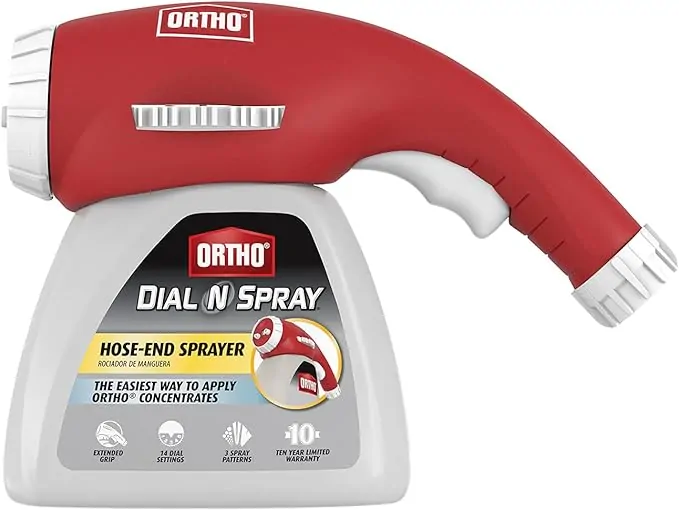
1. Ortho Dial N Spray Multi-Use Hose-End Sprayer
The Ortho Dial N Spray features 14 automatic dilution settings, three spray patterns, anti-backflow protection, and a two-gallons-per-minute flow rate for accurate chemical application. Its ergonomic trigger, extended grip handle, rotating hose connector, and lightweight structure provide comfortable use and better lawn coverage. From my experience, it provided reliable mixing, powerful spraying performance, reduced effort, and made weed, insect, and fertilizer applications much easier.
expert start
What Is It and Its Features
The Ortho Dial N Spray Hose-End Sprayer is a hose-end sprayer created for applying liquid concentrates including weed killers, insect killers, fungicides, and fertilizers. You do not need to mix chemicals separately before use. Simply add the concentrate into the container, select the required dilution setting, connect the hose, and begin spraying. The sprayer automatically combines the product with water during application.
Why It Matters
The most valuable feature of this sprayer is its 14 built-in dilution settings. These settings cover a range from 1 teaspoon to 8 ounces per gallon of water. This is important because different gardening products need different mixing ratios. Instead of measuring chemicals manually every time, you can select the correct dial setting according to the product instructions, and the sprayer handles the mixing automatically.
Another useful feature is the three spray patterns:
- Broadcast for covering large lawn areas
- Jet for reaching high or difficult areas (up to 25 feet)
- Shower for gentle watering of flowers and sensitive plants
The sprayer weighs approximately 11.5 ounces and comes with a 2-gallon liquid capacity. It can deliver around 2 gallons of water per minute, making it suitable for quickly treating larger garden spaces.
My Set-Up and My Experience
When I used the Ortho Dial N Spray Hose-End Sprayer for the first time, I connected it directly to my regular garden hose. The installation process was very easy. I filled the container with liquid concentrate, selected the required dilution setting, and attached the hose. There was no need for separate chemical mixing, which helped minimize product waste.
The dial adjustment system provides clear clicks when changing settings. It took me one or two uses to become familiar with the dilution controls. In my container garden, I also used it for adjusting soil pH by applying a pH-lowering solution. The sprayer produced a consistent mixture, which helped maintain the required pH level for healthy plant growth.
Performance
The Ortho Dial N Spray Hose-End Sprayer performs very well during regular garden use. The water pressure from my normal household tap was enough to produce a strong and effective spray. The jet setting is particularly powerful and can reach up to 25 feet, which is helpful for tall shrubs and trees.
The broadcast setting allows quick coverage of wider lawn areas, while the shower setting provides gentle spraying for flowers without damaging fragile leaves. The 14 dilution settings delivered consistent application, and I did not experience uneven mixing or poor spray patterns. One minor drawback is the rigid pickup tube. A flexible tube would make the overall design more convenient.
Practical Tips for Using Ortho Dial N Spray Hose-End Sprayer
- Always read the product label and select the correct dilution setting.
- Secure the hose connection properly to avoid water leakage.
- Keep the sprayer in an upright position so the pickup tube works correctly.
- Clean the sprayer with fresh water after every application.
- Never remove or alter the anti-backflow device because it helps maintain safety.
- Test the spray on a small area before applying it across the complete lawn.
expert end
pro start
| Pros | Cons |
|---|---|
| ✔️ No need for pre-mixing chemicals. | ❌ Plastic construction feels slightly less durable. |
| ✔️ Provides 14 precise dilution settings. | ❌ User instructions could be more detailed. |
| ✔️ Includes three practical spray patterns. | ❌ May drip if the connection is not properly tightened. |
| ✔️ Produces strong water pressure. | ❌ Pickup tube lacks flexibility. |
| ✔️ Comfortable ergonomic handle design. | ❌ Jet spray mode can produce more noise. |
pro end
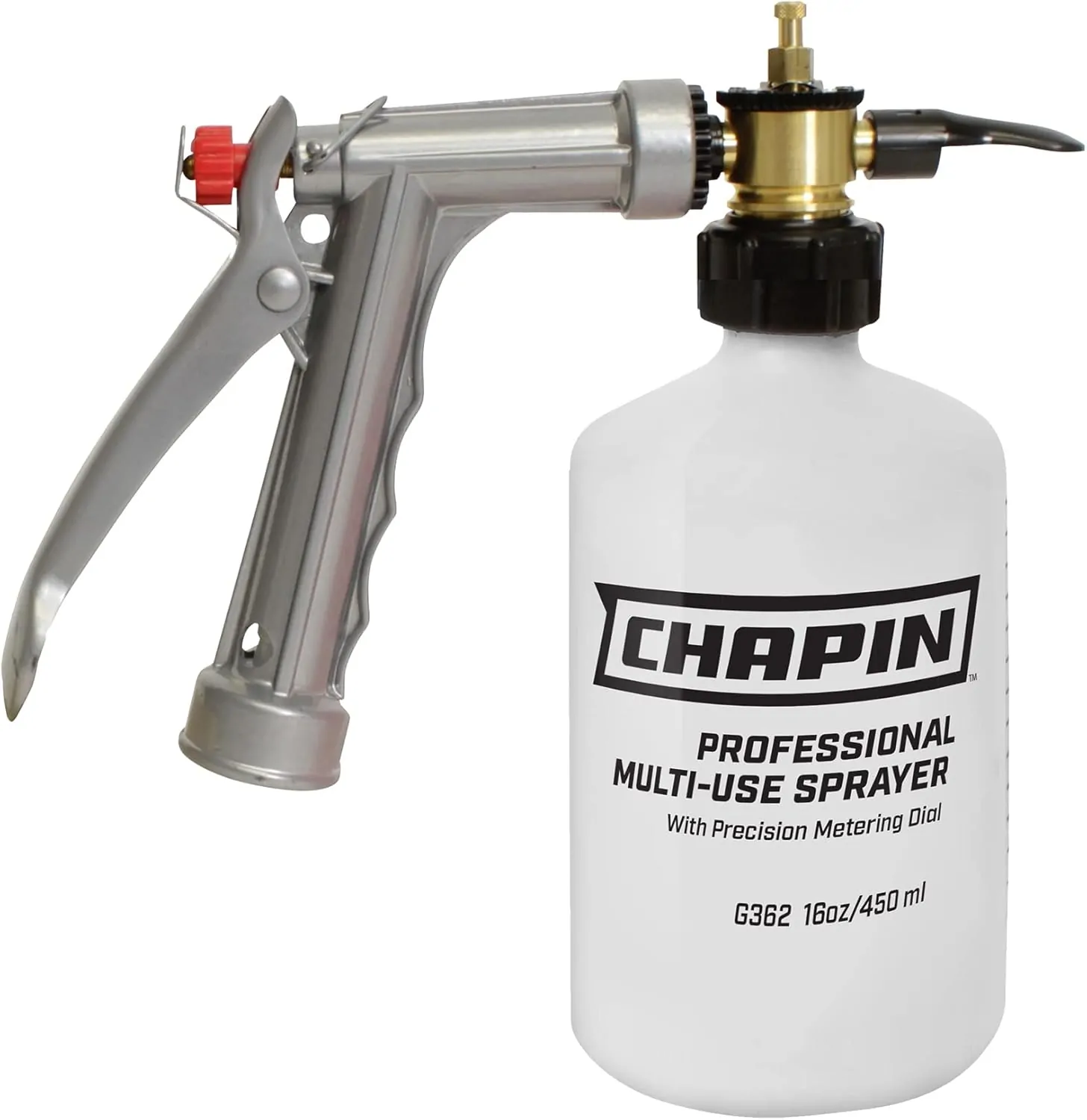
2. Chapin International G362 All-Purpose Hose-End Sprayer
The Chapin G362 Hose-End Sprayer comes with a strong brass mixing head, 16 mixing ratios, anti-siphon protection, and a universal hose connection system. Its 16-ounce chemical-resistant tank, adjustable fan nozzle, and accurate metering dial allow professional-level spraying for fertilizers, pest control products, and weed treatments. Based on my experience, the G362 is dependable, simple to operate, and delivers consistent performance while handling hundreds of gallons without leaks or blockages.
expert start
What is Chapin G362 and Its Features
The Chapin G362 Hose-End Sprayer is a professional-grade all-purpose garden sprayer that attaches directly to a standard garden hose. Its main advantage is the precision metering dial with 16 mixing ratios, which allows you to control the amount of concentrate mixed with water during spraying. This feature helps apply chemicals accurately, reduces unnecessary product usage, and prevents plants from receiving excessive treatment.
Why It Matters
The brass mixing head improves strength and durability, while the built-in anti-siphon feature helps prevent backflow and protects the water supply from possible contamination. The sprayer also includes a quick-change fan nozzle that allows wider coverage or a continuous stream for targeted applications.
Its simple three-step operation—fill, set, spray—makes the sprayer convenient for regular gardening tasks and easy enough for beginners to use.
This sprayer is important because it combines time-saving operation, accurate chemical application, and durable construction for repeated seasonal use. Gardeners looking for a reliable and efficient spraying tool can benefit from the balanced performance of the Chapin G362.
My Set-Up and My Experience
Setting up the Chapin G362 was quick and uncomplicated. I connected it to my regular garden hose, filled the 16-ounce tank with liquid fertilizer, adjusted the metering dial according to the required ratio, and started spraying. The chemical-resistant polypropylene tank gave me confidence that it could handle different garden chemicals safely.
The first thing I noticed was the smooth trigger operation. The ergonomic handle made extended spraying more comfortable and reduced hand fatigue.
I tested both the fan nozzle for wider coverage and the continuous stream setting for focused applications. Both options performed effectively, although I noticed that spraying at shoulder height reduced the fan spray distance to around 3–4 feet. This range works well for home gardens but may feel limited for larger agricultural areas.
Overall, the sprayer felt strong, well-built, and more dependable compared with many lightweight plastic sprayers I had used previously. Even after applying hundreds of gallons over several weeks, it continued working smoothly without leaks or clogging problems.
Performance
The Chapin G362 delivers excellent performance considering its compact size. It mixes liquid concentrates with water accurately and maintains a consistent flow during operation. The metering dial provides good precision, and after a few adjustments to understand the correct settings, it produced even spraying results.
The anti-siphon system performed effectively and provided additional confidence when applying fertilizers and pesticides. I also liked the spray deflector because it allowed easy switching between a fan pattern for wider coverage and a direct stream for more precise treatment.
The spraying range is moderate but suitable for small and medium-sized gardens. Compared with inexpensive plastic hose-end sprayers, the G362 provides more professional results with less effort.
Practical Tips
- Calibrate the sprayer before use by spraying into a measured container to understand the actual mixing ratio.
- Avoid placing the sprayer horizontally because a full container may leak; store it upright.
- Wear protective clothing, rain gear, or a wide-brimmed hat to prevent accidental splashes, especially when spraying trees.
- For larger areas, remove the fan nozzle and use the continuous stream option for faster coverage.
- Wash the tank and nozzle after each use to remove chemical residue and increase the sprayer’s lifespan.
expert end
pro start
| Pros | Cons |
|---|---|
| ✔️ Strong metal and polypropylene construction. | ❌ Small 16-ounce tank needs frequent refilling for larger areas. |
| ✔️ Offers 16 mixing ratios for accurate applications. | ❌ Fan spray coverage is limited to about 3–4 feet. |
| ✔️ Built-in anti-siphon system protects the water source. | ❌ Bottle threads may feel loose when over-tightened. |
| ✔️ Compatible with universal hose connections. | ❌ Requires some practice to understand the correct mixing ratios. |
| ✔️ Simple fill, set, and spray operation. | ❌ Handle design may not work perfectly with some thicker hoses. |
pro end
3. Gilmour 362 Professional Hose-End Sprayer
Durable Metal Construction & Adjustable Spray: The Gilmour nozzle comes with a strong metal body and a one-turn adjustable head that provides flexibility for watering and cleaning tasks. Swivel Connection & Thumb Control: The built-in swivel connection helps prevent hose twisting, while the thumb control allows smooth adjustment of water flow from start to stop. My Experience: After using it regularly, I found the nozzle dependable, the swivel function worked effectively, and it caused very little hand tiredness even during longer spraying sessions.
expert start
What is Gilmour 362 and Its Features
The Gilmour 362 No Pre-Mix Sprayer is a hand-operated garden sprayer that easily connects with any standard garden hose. Its main feature is the no pre-mix system, which automatically combines chemical concentrate with water during spraying. This removes the need for manual measuring or preparing mixtures before use, helping save time and reducing application errors. It comes with a brass mixing head and a thumbwheel dial that lets you choose different dilution rates, measured in tablespoons or teaspoons per gallon. The sprayer also has a removable deflector that allows you to switch between a fan spray and a direct stream, giving better control over spray coverage.
Why It Matters
This sprayer is important because it makes lawn and garden care easier, faster, and more accurate. Gardeners who apply fertilizers, weed treatments, or tree care products need proper dilution to get safe and effective results. The combination of brass components and strong plastic parts improves durability compared with many low-quality sprayers, making it a reliable tool for long-term use.
My Set-Up and My Experience
Setting up the Gilmour 362 was simple and quick. I filled the container with concentrate, selected the required dilution setting using the thumbwheel dial, and connected the sprayer to my garden hose. The handle felt comfortable in my hand, and the overall design made it easy to use for longer periods. I tested it on a 3,500 square-foot lawn while preparing the area for new sod, and it performed much better than several other sprayers I had used, including the Roundup 2-Gallon Premium Sprayer, which did not spray correctly.
During use, the sprayer worked smoothly, and I could clearly feel the dial locking into specific dilution settings. However, it does not offer extra settings between 7 and 10 tablespoons per gallon. Even with this small drawback, it provided consistent liquid distribution and worked well for spraying tall trees and shrubs. I also liked the build quality because the brass mixing head and zinc-coated nozzle gave it a professional feel and improved durability.
Performance
The performance of the Gilmour 362 was impressive. It mixed chemicals and water accurately while maintaining a consistent spray output. The fan nozzle covered larger areas evenly, while the direct stream mode helped with targeted spraying in smaller or difficult locations. Compared with traditional pump sprayers, it allowed faster application over larger spaces.
I noticed a minor leak near the hose connection, but it did not significantly impact the overall operation. The sprayer delivered products efficiently and made garden maintenance quicker and easier. After repeated uses, it continued working without clogging issues, showing good reliability and strong construction.
Practical Tips
- Always confirm the thumbwheel dial setting before starting chemical application.
- Choose the fan nozzle for wider coverage and the direct stream for focused spraying.
- Keep the sprayer stored upright to reduce the chance of leaks and increase its lifespan.
- Clean the tank and nozzle after every use to prevent chemical residue buildup.
- When spraying tall plants or large bushes, adjust the spray angle for better coverage.
expert end
pro start
| Pros | Cons |
|---|---|
| ✔️ No pre-mix system saves preparation time and reduces chemical waste | ❌ Plastic deflector can feel delicate and may damage if handled roughly |
| ✔️ Brass mixing head provides durability and accurate dilution | ❌ Missing intermediate dial settings between 7 and 10 tablespoons |
| ✔️ Simple dial system makes dilution adjustment easy | ❌ Minor leaks may appear around the hose connection |
| ✔️ Comfortable handle with user-friendly ergonomic design | ❌ Smaller tank capacity may require more refilling for large areas |
| ✔️ Removable deflector supports both fan and stream spraying | ❌ Not ideal for very thick or highly concentrated liquids |
pro end
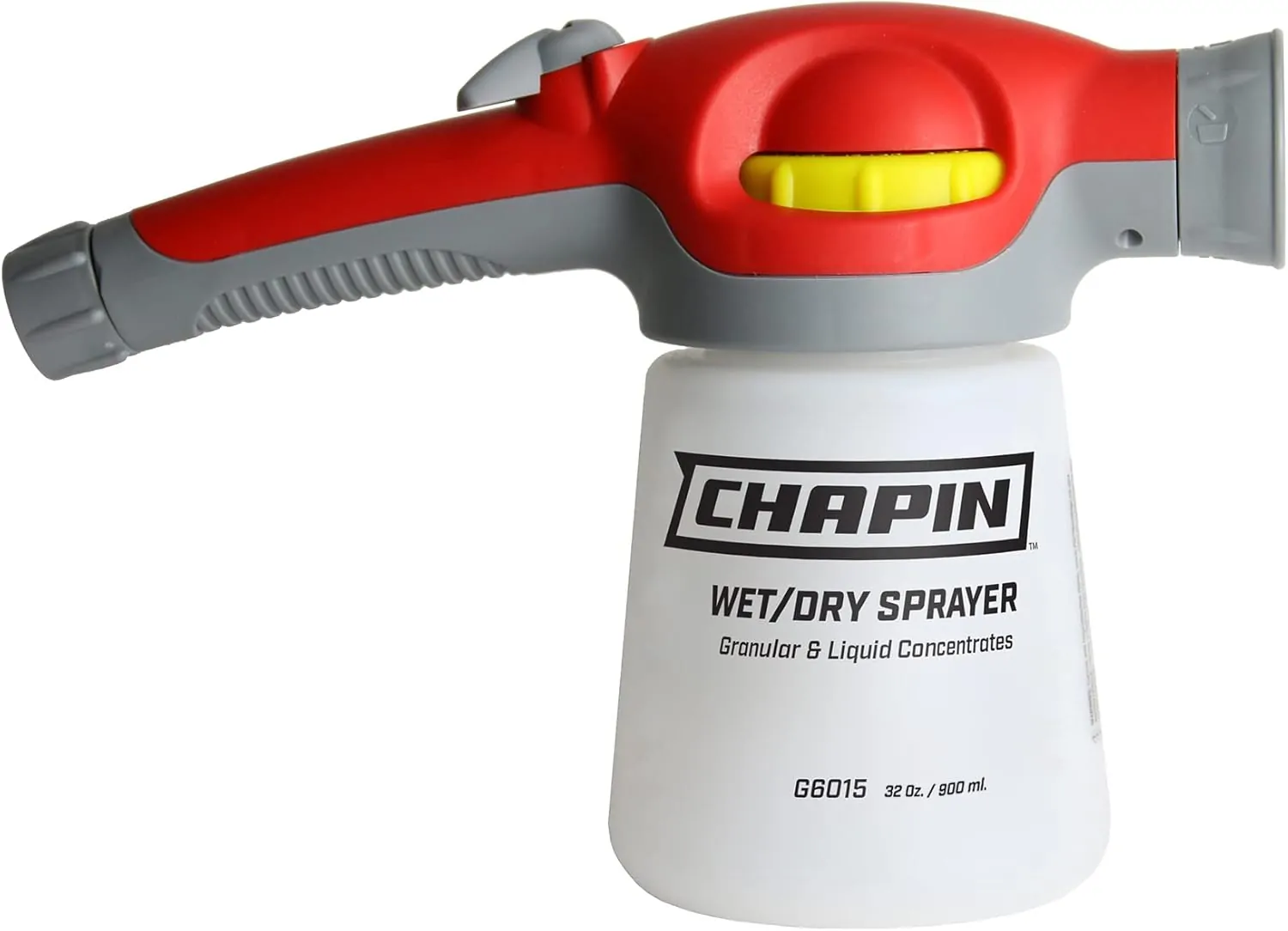
4. Chapin International G6015 Wet/Dry Hose-End Sprayer, Translucent
The Chapin G6015 sprayer works with both liquid and water-soluble chemicals and provides accurate mixing through its adjustable dial and nozzle system. It includes a 32-ounce translucent tank, backflow preventer, thumb lever control, filter basket, and four spray patterns for flexible and efficient spraying. In my experience, it performed well for car washing and fertilizer application, although I noticed occasional leaks and dripping that required careful use.
expert start
What is it and its Features
The Chapin G6015 Wet/Dry Hose-End Sprayer is a versatile hose-end sprayer designed to work with both liquid and water-soluble granular chemicals. This ability makes it convenient because users do not need to prepare separate mixtures before spraying. Simply connect it to a standard garden hose, choose the recommended measurement in ounces, tablespoons, or teaspoons using the dial, and the sprayer automatically mixes the product with water. Some important features include:
- 32-ounce translucent tank – allows users to easily check the remaining liquid level.
- Chemical-resistant construction – designed to handle fertilizers, herbicides, pesticides, and other garden chemicals.
- Adjustable 4-position nozzle – provides different spray options including fan spray, cone spray, jet, and mist for various applications.
Why it Matters
These features are valuable because they improve convenience, accuracy, and safety during spraying tasks. The sprayer is especially useful for gardeners who want better control over chemical application while reducing product waste. Its flexible design allows it to be used for fertilizers, weed control products, vehicle cleaning, outdoor washing, and vinyl siding maintenance. Additional useful features include:
- Backflow preventer – helps protect the potable water supply from possible contamination.
- Thumb control on/off lever – provides quick and comfortable spray control.
- Filter basket – helps maintain even mixing when applying granular chemicals.
My Set-Up and My Experience
Setting up the Chapin G6015 Wet/Dry Hose-End Sprayer was easy and required only a few steps. I first tested it with liquid car wash soap, and the results were better than expected. The fan spray setting helped spread soap evenly over my truck without creating excessive buildup in one area. The thumb lever also made it convenient to stop and restart the water flow while cleaning.
For gardening applications, I tested both dry water-soluble fertilizer and liquid herbicide. The dial adjustment system was simple to understand and allowed me to select the measurement recommended by the product instructions. The sprayer mixed the chemical with water automatically during spraying, which saved time and helped reduce unnecessary product use.
However, I experienced a few minor problems. During my first use with granular fertilizer, I noticed a small leak around the hose connection. Later, one valve started dripping instead of producing a consistent spray, which made fertilizer application less convenient. Despite these issues, I liked the practical design features, especially the anti-backflow system and filter basket, which helped prevent clogging while using granular materials.
Performance
The Chapin G6015 Wet/Dry Hose-End Sprayer provides good performance for most household and gardening tasks. The venturi system in wet mode helps create proper suction and accurate mixing of liquid concentrates. The adjustable 4-position nozzle gives users control over spray patterns depending on the job requirements. For outdoor cleaning, it produces a steady fan spray that works well for tasks such as washing vehicles and spraying vinyl siding. In dry mode, it can handle water-soluble granules, but users may need to operate it carefully to avoid dripping when materials dissolve slowly.
Practical Tips
- Wear gloves and protective clothing whenever working with chemicals.
- Use wet mode when applying thick liquids or granules that dissolve slowly.
- Clean and use the filter basket properly to reduce clogging with dry fertilizers.
- Select the correct nozzle setting: fan for wider coverage and jet for focused spraying.
- Inspect the hose connection before spraying to avoid leaks during operation.
expert end
pro start
| Pros | Cons |
|---|---|
| ✔️ Clear dial system allows accurate chemical mixing | ❌ Hose connection may leak during initial use |
| ✔️ Supports both liquid and water-soluble chemicals | ❌ Dry mode may drip when granules dissolve slowly |
| ✔️ Strong chemical-resistant materials improve durability | ❌ Minor leaks may occur when switching hose flow on or off |
| ✔️ Adjustable nozzle provides four different spray patterns | ❌ 32-ounce tank size may require frequent refilling for large areas |
| ✔️ Thumb lever provides convenient on/off operation | ❌ Some users may experience valve durability issues over time |
pro end
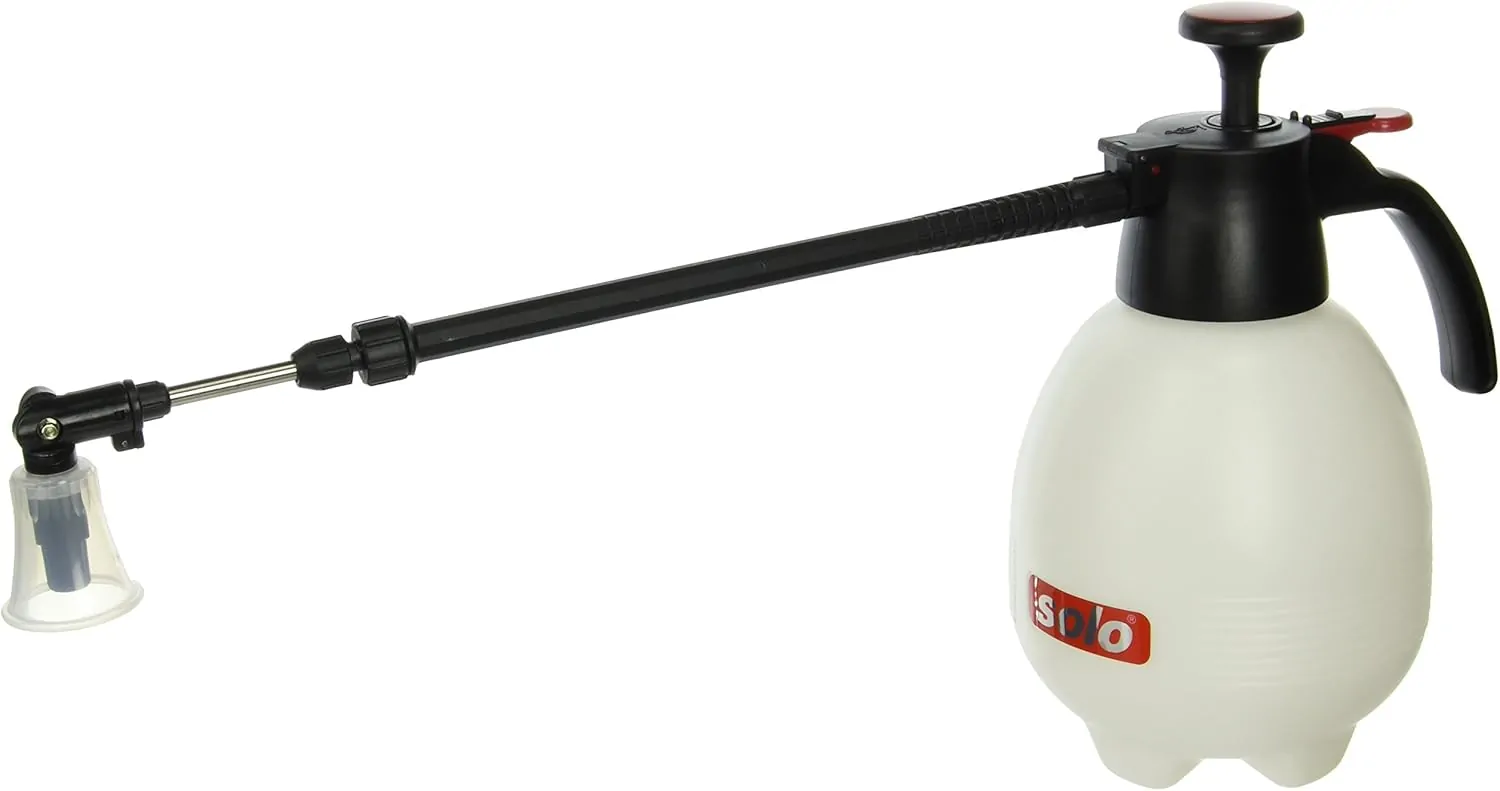
5. Solo 420-1G Handheld Broadcast Spreader
The Solo 420 sprayer comes with a 2-liter tank, telescoping wand, adjustable multi-position nozzle, and chemical-resistant Viton seals. Key and Technical Feature: The adjustable nozzle includes a built-in drift/drip guard that helps deliver accurate spraying from different angles while reducing liquid waste and improving overall efficiency. My Experience: Its lightweight design and simple one-hand operation gave me excellent control while spraying indoor plants, outdoor plants, weeds, and essential oil solutions.
expert start
What is it and its Product Features
The Solo 420 2-Liter One-Hand Pressure Sprayer is a manual sprayer designed for applying different types of liquids, including water, pesticides, herbicides, fungicides, and essential oil mixtures. Its 2-liter tank is manufactured from UV-resistant polyethylene, which helps maintain durability during long-term outdoor exposure. The sprayer uses a high-efficiency piston pump with Viton seals that allows quick pressurization and provides resistance against chemical corrosion.
Why It Matters
A major advantage of this sprayer is its telescoping wand, which can extend from 12 inches to 24 inches. This feature makes it easier to spray low plants without constant bending and helps reach areas that are difficult to access. The adjustable nozzle allows users to switch between a fine mist and a concentrated jet spray, while the multi-position design makes spraying possible from different angles. The built-in drift/drip guard improves control by reducing unwanted spray movement and liquid loss. For delicate tasks, such as applying essential oils to plants or treating areas where pets are nearby, these features provide better safety, accuracy, and convenience. The main value of this sprayer is its practical design and efficient performance.
My Set-Up and My Experience
I usually prepare mixtures of essential oils, diluted pesticides, or natural solutions inside the 2-liter tank. The sprayer weighs only around 16 ounces, making it comfortable to carry throughout the garden or use indoors. For smaller plants and weeds, I extend the wand fully, while I shorten it for indoor use or higher targets. The locking trigger is a useful addition because it helps reduce hand tiredness during longer spraying sessions. In my experience, the sprayer maintained pressure effectively, produced a steady spray pattern, and provided excellent control without unnecessary dripping or mess. I also found it useful for indoor plants and sensitive areas because it reduced the risk of spills.
Performance
The piston pump creates pressure quickly and maintains it efficiently, allowing larger areas to be covered without frequent pumping. The multi-position nozzle makes it easy to spray underneath leaves, around branches, and into narrow spaces, which is especially helpful when treating spider mites or weeds. The chemical-resistant Viton seals allow the sprayer to work reliably even after repeated use with essential oils and diluted chemicals without leaking or wearing out. For outdoor applications, its adjustable reach and nozzle settings make it suitable for many tasks, including plant watering, herbicide application, and cleaning areas affected by mold, such as basements or attics.
Practical Tips for Using the Solo 420 Sprayer
- Release remaining air pressure from the tank after each use to increase product life.
- Change the wand length according to the spraying requirement.
- Use the locking trigger feature to make long spraying tasks more comfortable.
- Check the nozzle on a small area before applying the solution everywhere.
- Wash the tank and nozzle properly after spraying chemical solutions.
expert end
pro start
| Pros | Cons |
|---|---|
| ✔️ Lightweight design makes it easy to carry and operate with one hand. | ❌ The tank can become unstable when almost empty. |
| ✔️ Telescoping wand extends from 12” to 24” for flexible spraying. | ❌ The spray width adjustment cup could be larger. |
| ✔️ Viton seals provide strong chemical resistance and durability. | ❌ Not designed for very large spraying areas. |
| ✔️ Multi-position nozzle supports spraying from multiple angles. | ❌ Manual pumping may become tiring during extended use. |
| ✔️ Drift/drip guard helps achieve accurate spot spraying. | ❌ Fine mist settings may need careful adjustment for even coverage. |
pro end
How Garden Hose End Sprayers Work
Understanding the working principle helped me separate useful features from marketing descriptions. Most concentrate-dispensing hose end sprayers operate through water-powered suction and proportioning. Water enters the mixing head from the hose, and a pressure difference draws concentrate through a siphon tube. The concentrate mixes with the moving water before the solution exits the nozzle.
Many designs use a Venturi-type arrangement, where water moving through a restricted passage creates a pressure difference that assists concentrate pickup. Other designs use different metering arrangements. The exact mechanism depends on the model.
The important components work together in a sequence. The hose connector supplies water, the mixing head controls water movement, the metering system regulates concentrate pickup, and the nozzle determines the outgoing spray pattern.
Understanding Every Working Component
The concentrate container holds the liquid product. A siphon tube extends into the container and carries concentrate towards the mixing head. The metering dial or fixed orifice determines the intended pickup rate, while the mixing chamber combines the concentrate and water.
The spray nozzle then distributes the solution. Depending on the design, it may produce a fan, shower or stream pattern. A removable deflector can alter coverage, although removing it may increase the risk of directing concentrated spray into unintended areas.
As a real specification example, the Chapin G362D uses a 32-fluid-ounce concentrate container, a brass mixing head, 16 mixing settings, nitrile seals and a built-in anti-siphon feature. Its manufacturer identifies a standard 3/4-inch garden hose connection and states that operating pressure and spray distance depend on the water supply.
These specifications helped establish what I wanted to compare, but they did not prove that every dial setting would deliver the same accuracy under different household water conditions.
- Metering system: Controls intended concentrate pickup.
- Siphon tube: Must remain properly positioned and unobstructed.
- Mixing head: Influences water movement and concentrate mixing.
- Seals and connectors: Prevent leakage and unwanted air entry.
- Anti-siphon protection: Helps reduce the risk of contaminated liquid flowing backwards.
For my buying decision, the important question was not simply whether a sprayer mixed automatically. I wanted to know whether its mixing arrangement was suitable for the intended formulation and whether its actual delivery could be checked.
Which Hose End Sprayer Type Wins?
Garden hose end sprayers are not all built for the same purpose. I found it more useful to compare their mixing arrangements and intended applications than to judge them only by container size.
| Sprayer Type | Main Advantage | Main Limitation | Best Buying Situation |
|---|---|---|---|
| Adjustable dial | Multiple selectable dilution settings | Requires correct calibration and setting | Different compatible concentrates |
| Fixed-ratio | Simple operation with fewer adjustments | Limited dilution flexibility | Repeated use at one specified rate |
| Siphon-type | Draws concentrate into flowing water | Pickup can depend on flow and design | Broad applications with verified delivery |
| Prefilled ready-to-spray | Product-specific convenience | Limited reuse and formulation choice | Occasional labelled applications |
Adjustable Versus Fixed Mixing Systems
An adjustable dial sprayer attracted my attention because one attachment could potentially serve several approved products requiring different mixing settings. Some dials are marked in teaspoons, tablespoons or ounces per gallon, while others use different ratio systems.
However, more settings do not guarantee greater accuracy. A poorly calibrated dial may introduce an incorrect amount of concentrate even when the selected number appears suitable.
A fixed-ratio sprayer removes much of the adjustment process. This can be convenient when repeatedly applying one compatible product at its prescribed rate. The limitation is obvious when another product requires a different concentration.
Prefilled ready-to-spray attachments are another practical option. They usually connect directly to the hose and use a mixing arrangement designed for their particular formulation. I would not assume that an empty prefilled bottle could safely be refilled with another chemical or fitted to a different product.
My preference would be an adjustable model for varied, explicitly compatible applications, while a fixed or product-specific system could be better when simplicity and correct matching were more important than flexibility.
Start With Your Garden’s Actual Needs
Before comparing brands, I considered the area and shape of the garden. A hose end sprayer that worked well across an open lawn might be awkward around closely planted tomatoes, chilies and marigolds.
For example, a rectangular lawn measuring 10 metres by 15 metres covers 150 square metres. If an approved product specifies a quantity per 100 square metres, I would calculate the required product quantity for the full 150 square metres before choosing the equipment. I would not assume that emptying one concentrate bottle over the lawn automatically delivered the correct application.
Vegetable beds introduced another consideration. During the growing season, tomato foliage can become dense, while young chili seedlings may remain sensitive to excessive spray volume. Broad coverage that is convenient for a lawn is not always suitable for individual plants.
- Open lawn: Prioritise consistent coverage and suitable spray width.
- Raised vegetable beds: Prioritise control and reduced overspray.
- Flower borders: Check droplet size, drift and nozzle handling.
- Young fruit trees: Consider reachable foliage rather than advertised maximum distance.
I also considered hose access. A 20-metre hose does not necessarily provide a practical 20-metre working radius because it must travel around corners, paths and obstacles.
For gardens with numerous isolated beds, I would compare the time spent moving the hose against the convenience of carrying a small pump sprayer. The best choice should reduce work without sacrificing control.
How Accurate Are Dilution Settings?
Dilution accuracy was one of my highest buying priorities. A hose end sprayer may display an adjustable setting, but the actual amount of concentrate delivered can depend on its design, water pressure, flow rate, concentrate properties and component condition.
I first wanted to understand the difference between a mixing ratio and an application rate. A dilution ratio describes how much concentrate is introduced into a given volume of water. An application rate describes how much product is delivered to a particular area or plant. Both matter. A correctly diluted solution can still apply too much product if I spray an area repeatedly or move too slowly.
Calculating Dilution Without Guesswork
Consider a mathematical example in which an approved product instruction calls for 2 fluid ounces of concentrate per gallon of water. One US gallon equals 128 US fluid ounces, so the nominal concentrate-to-water ratio is 2:128, or 1:64.
If the sprayer is designed to meter fluid ounces of concentrate per gallon of water, the appropriate dial marking would need to match the manufacturer’s instructions. Other sprayers may use different units or require premixing.
For another example, suppose an approved product label specifies 30 mL per litre of water. For 5 litres of water, the calculated concentrate requirement would be:
30 mL × 5 = 150 mL.
These calculations explain the units; they are not recommendations for applying any particular fertilizer, herbicide or pesticide. I would also distinguish between the nominal amount of water passing through the mixing head and the final mixture volume, because the added concentrate increases the total volume slightly.
Checking Actual Concentrate Pickup
After purchase, I would perform a clean-water calibration using the exact method approved by the sprayer manufacturer. Where the design permits a safe water-only pickup test, the container could be filled with a measured amount of clean water and the output collected separately for comparison.
Suppose a test delivered 4 litres of carrier water and drew 80 mL from the concentrate container. The measured pickup would be 20 mL per litre of carrier water. That is a calculation from hypothetical test readings, not a verified performance result.
I would repeat the measurement at the intended operating conditions and compare it with the required rate. A single successful reading would not establish accuracy across every dial setting or formulation.
- Measure water flow: Record the volume delivered over a fixed time.
- Check concentrate pickup: Use an approved clean-water method.
- Repeat the test: Look for meaningful variation.
- Check area coverage: Match output to the required application rate.
- Recalibrate: Repeat after changing settings or operating conditions.
If the measured delivery differed significantly from the required application, I would investigate the problem before using chemicals. I would not compensate by guessing a stronger concentrate or making unsupported changes to the product label rate.
Water Pressure Changes Sprayer Performance
A hose end sprayer relies on water pressure from the connected supply. Unlike a battery-powered or manually pressurised tank sprayer, it does not independently generate spraying pressure.
This means the performance can change when other taps are opened, the hose becomes kinked or the water supply fluctuates. The effect depends on the sprayer’s metering design.
Pressure and flow are related but are not identical measurements. Pressure is commonly expressed in pounds per square inch (PSI) or bar, while flow is measured in litres or gallons per minute.
For reference, 1 bar is approximately 14.5 PSI. A supply pressure of 3 bar is therefore approximately 43.5 PSI. This conversion does not establish that 3 bar is suitable for a particular sprayer.
I would check the manufacturer’s permitted pressure range and use a pressure gauge where appropriate. I would also measure actual flow at the hose end, since a long or narrow hose can restrict flow even when the supply pressure appears adequate.
For a simple calculation, collecting 10 litres of water in 60 seconds gives a flow rate of 10 litres per minute. If the same volume takes 90 seconds, the flow rate falls to approximately 6.7 litres per minute.
Such differences may affect spray coverage and concentrate pickup, so I would not assume the same dial setting always delivers identical results under changing conditions.
- Check the specified pressure range before purchase.
- Inspect hose kinks, restrictions and connector leaks.
- Measure flow under normal operating conditions.
- Repeat calibration when water conditions change materially.
For a garden with unstable water pressure, I would prefer a sprayer with clear operating requirements and reliable calibration guidance rather than relying on advertised spraying distance.
Choose the Right Hose Connections
Hose compatibility seems simple until a new sprayer arrives with a connector that does not match the existing equipment. Many hose end sprayers intended for the North American market use 3/4-inch garden hose thread. However, other markets commonly use different hose fitting standards, and the nominal size alone does not guarantee thread compatibility.
I would confirm the actual connection standard, whether an adapter was required and whether the adapter was suitable for the intended water pressure.
Connection quality also matters. A metal connector may resist certain forms of thread wear better than a lightweight plastic fitting, but metal is not automatically superior in every chemical environment. Poorly manufactured threads can leak or damage the hose fitting regardless of material.
During inspection, I would look for clean threads, a properly seated washer, an undamaged connector body and a shut-off mechanism that operated smoothly.
A leak at the hose connection wastes water and may make handling unpleasant. A leak near the concentrate container or mixing head deserves even greater attention because it may involve the chemical product. For my own buying decision, I would select a sprayer that connected securely to the existing hose without requiring several uncertain adapters.
Which Materials Actually Last Longer?
Durability was another important concern because a hose end sprayer contains several small components that must remain functional together. A strong-looking bottle is of limited value if its seals deteriorate or the metering mechanism becomes blocked. I compared materials according to their purpose rather than treating one material as universally better.
| Component | Material or Feature | What I Would Check |
|---|---|---|
| Concentrate container | Chemical-resistant polymer | Compatibility, markings, cracks and closure |
| Mixing head | Brass or engineered polymer | Corrosion resistance and serviceability |
| Seals | Nitrile, EPDM or other specified elastomer | Compatibility with the exact formulation |
| Siphon tube | Flexible chemical-compatible tubing | Fit, blockage and cracking |
| Metering dial | Polymer or metal components | Readable markings and secure settings |
| Nozzle | Plastic or metal | Spray pattern, wear and replacement |
| Hose connector | Metal or reinforced polymer | Thread quality, washer and leakage |
Seals, Corrosion and Chemical Resistance
The seals deserved special attention because they prevent unwanted leakage and air entry. Nitrile and EPDM are commonly used elastomer materials, but their resistance varies with the exact chemical formulation, concentration, temperature and exposure duration.
I would not assume that a sprayer suitable for one liquid fertilizer was automatically suitable for concentrated oils, solvents, pesticides or acidic products.
Similarly, brass components can offer useful mechanical durability, but corrosion resistance depends on the chemical environment. Certain formulations can attack metals or leave deposits that interfere with the mixing mechanism.
Before purchase, I would ask the manufacturer whether the sprayer was approved for the exact product category I intended to use. Where the information was unavailable, I would avoid assuming compatibility.
After purchase, routine inspections would include checking the seals for swelling, hardening or cracks, looking for deposits around the mixing head and confirming that the siphon tube remained flexible.
- Container: Check for cracks, staining and deformation.
- Seals: Inspect for swelling, brittleness and leakage.
- Metal parts: Look for corrosion or unusual deposits.
- Dial: Check that settings remain readable and secure.
- Nozzle: Check for blockage, damage and uneven discharge.
One clean-water trial would establish only basic function. I would need repeated inspections over months of appropriate use to form a meaningful opinion about long-term durability.
Spray Patterns Affect Garden Coverage
The nozzle determines how the outgoing mixture is distributed, making it one of the most important parts of a garden hose end sprayer. A broad fan or shower pattern can be convenient for a lawn or a wide planted area. A narrower stream can reach farther, but increased reach does not guarantee suitable coverage, and a concentrated stream may damage delicate plants or cause unwanted runoff.
For vegetable beds, I would prefer a pattern that allowed controlled coverage without directing spray onto nearby plants that were not listed for treatment. Around marigolds and petunias, I would pay particular attention to drift and the possibility of excessive wetting.
Droplet size also matters. Fine droplets may improve surface coverage for some approved treatments but can drift more easily in moving air. Larger droplets generally reduce drift risk, although the correct droplet characteristics depend on the product label and intended target.
To evaluate coverage after purchase, I would begin with clean water on a suitable test surface. Water-sensitive paper can help assess droplet distribution where appropriate. I would compare the pattern at a consistent distance and angle rather than relying on how far the spray travelled.
For reachable young mango, lemon or pomegranate trees, I would avoid using an extended stream merely to reach upper foliage if doing so reduced accuracy or created drift. A different sprayer could be safer and more effective. My recommendation was to choose controllable coverage over maximum reach, particularly in gardens containing different crops close together.
Can One Sprayer Handle Every Chemical?
Chemical compatibility is a major limitation that buyers should understand before selecting a hose end sprayer. Liquid fertilizers, soluble nutrients, horticultural oils, insecticides, fungicides and herbicides can have very different formulation properties. A sprayer capable of dispensing one product may not be suitable for another.
Some products are specifically labelled for hose end application, while others require controlled tank mixing, agitation or a different application system.
For example, a thick suspension may not pass through a narrow metering opening consistently. An oil-based formulation may interact differently with seals than a water-based liquid fertilizer. Products containing suspended particles may also require agitation or filtration that a simple hose end attachment cannot provide.
I would therefore check three separate requirements: the product label, the sprayer manufacturer’s compatibility instructions and the actual application conditions.
- Confirm that hose end application is permitted.
- Check the exact formulation, not only the active ingredient.
- Verify the required dilution and area application rate.
- Confirm that the sprayer can maintain the necessary delivery.
- Never mix different products unless their labels explicitly permit it.
For my vegetable garden, I would be particularly cautious with treatments near harvest. Product labels may specify permitted crops, application intervals and pre-harvest intervals. A sprayer’s ability to distribute a chemical does not establish that the chemical is appropriate for a particular crop.
I would also avoid using the same equipment for herbicides and sensitive crop treatments unless the manufacturer and product labels explicitly supported the changeover and a validated cleaning procedure. Separate, clearly labelled equipment is often the more dependable choice.
Inspect Before Buying, Test After Delivery
A realistic buying process separates what can be checked in a shop from what requires proper testing after purchase. Before paying, I would inspect the bottle, lid, hose connection, metering dial, siphon tube and nozzle. I would also confirm the model number, supplied accessories, operating instructions and warranty.
If the seller permitted a clean-water demonstration, I could check whether the attachment connected properly and discharged water. However, a brief demonstration would not prove dilution accuracy, chemical resistance or long-term durability.
My Practical Post-Purchase Test Plan
After receiving the sprayer, I would first compare the delivered package with the manufacturer’s contents list. Missing seals, damaged threads or a disconnected siphon tube should be addressed before operation.
My first working session would use clean water only. I would check the hose connection, shut-off function, nozzle patterns and visible leakage. I would then measure water flow and, where supported by the manufacturer’s procedure, verify concentrate pickup using clean water.
For example, a timed test lasting 60 seconds could establish the delivered water volume under one operating condition. Repeating that test three times would help identify inconsistent readings. These tests would provide baseline measurements, not a guarantee of performance with every chemical formulation.
Next, I would examine the spray pattern over a measured test area. A 5-metre by 4-metre area covers 20 square metres. If a test used 4 litres of water over that area, the calculated application volume would be
0.2 litres per square metre, equivalent to 20 litres per 100 square metres.That figure would need to be compared with the approved product’s required application volume before any treatment. Only after successful calibration would I consider a labelled garden application. The first trial should be limited to a suitable area and conducted under the required weather and safety conditions.
I would record the actual duration, concentrate consumed, area treated, flow consistency and any leakage. Observing healthy plants immediately after spraying would not establish treatment effectiveness or long-term crop safety.
Using Hose End Sprayers Around Crops
Once the equipment had passed its basic checks, I would match its use to the specific gardening activity rather than treating every crop in the same way.
For a lawn, a hose end sprayer can be useful when a labelled liquid treatment requires relatively uniform application across a broad surface. I would measure the lawn area, calculate the permitted quantity of product and maintain a consistent walking speed and spray overlap.
For tomatoes and chilies, I would be more selective. Closely spaced foliage and nearby plants can make broad hose spraying unsuitable, especially when the product is not approved for every plant in the spray path. In such situations, a handheld pump sprayer with a more controllable nozzle may be preferable.
During flower-bed maintenance, I would consider the sensitivity of the flowers, the required spray coverage and the risk of droplets reaching neighbouring crops.
For young fruit trees, I would check whether the target foliage was safely reachable. I would not attempt to compensate for inadequate equipment by increasing pressure beyond the manufacturer’s limits.
- Lawns: Measure area and control application volume.
- Vegetables: Verify crop approval and avoid unintended contact.
- Flowers: Protect sensitive blooms and neighbouring plants.
- Fruit trees: Prioritise reachable, accurate coverage.
For seasonal work, I would also consider temperature, wind and rainfall restrictions. Foliar products should be used only under the conditions permitted by their labels. Spraying during unsuitable weather can increase drift, runoff or plant injury.
These considerations reinforced my view that the best hose end sprayer is the one that matches the actual treatment and garden layout, not simply the model capable of spraying the greatest distance.
Safety Matters Beyond Protective Clothing
Hose end sprayers introduce an additional safety concern because they connect chemical application equipment directly to a water supply. Backflow prevention is essential. Under certain pressure conditions, contaminated liquid can move backwards towards the supply. Some sprayers include anti-siphon features, but a built-in feature does not automatically satisfy every local plumbing or water protection requirement.
I would confirm that suitable approved backflow protection was installed and that the sprayer’s own anti-siphon components were intact. I would never rely on a visibly damaged or modified protection device.
Personal protection depends on the chemical label. Gloves, eye protection, protective clothing and other equipment may be required. A garden hose end attachment does not make concentrated chemicals harmless.
Before each application, I would check that children, pets and other people were away from the treatment area. I would also protect drinking-water sources, ponds, drains and neighbouring plants from contamination.
- Read the product label before handling concentrate.
- Use the specified personal protective equipment.
- Check backflow protection and hose connections.
- Prevent drift, runoff and unintended exposure.
- Follow re-entry and harvest restrictions.
I would avoid spraying into the wind or treating plants when conditions exceeded the product’s weather restrictions. If the hose connection began leaking chemical mixture, I would stop the operation and follow the appropriate safety and cleanup instructions.
For me, a good sprayer was not simply one that saved time. It also needed to support a controlled and repeatable application without increasing unnecessary exposure.
Cleaning and Storage Protect Sprayer Accuracy
Maintenance is directly connected to performance because a hose end sprayer depends on small passages and accurately functioning components.
Residue inside the siphon tube, metering opening or nozzle can interfere with concentrate pickup. A partially blocked passage may change the intended mixing rate even when the external spray still looks normal.
After use, I would follow the sprayer manufacturer’s cleaning instructions and the chemical product’s requirements for handling remaining solution and rinsate. I would never pour leftover pesticide mixture into a household drain or onto an unapproved area.
Where the instructions permitted clean-water flushing, I would check the nozzle and mixing mechanism for remaining deposits. I would also inspect the container closure, seals and hose washer before storage.
The sprayer should be allowed to dry as instructed and stored away from unnecessary sunlight, excessive heat and freezing conditions. Long exposure to sunlight can degrade some plastics, while freezing water trapped inside components can cause cracking. Storage inspections would focus on:
- Residual deposits inside the mixing head.
- Blocked or hardened siphon tubing.
- Damaged seals and hose washers.
- Cracked containers and faded dial markings.
- Corrosion or sticking moving parts.
I would also consider repairability before buying. A sprayer with replaceable seals, nozzles or containers may remain useful longer than one whose small damaged component requires replacing the entire attachment. However, repairability has limits. Safety-critical components should never be modified or replaced with unsuitable parts simply to extend the equipment’s life.
Where Should You Buy Your Sprayer?
After understanding the specifications, I would compare local garden suppliers, equipment shops, manufacturer websites and reputable online sellers.
Buying from a physical shop can make inspection easier. I could examine the container, check the dial markings, confirm the hose fitting and ask whether replacement parts were available.
Online buying provides access to a wider selection, but photographs and product titles are not enough to confirm compatibility. I would compare the exact model number against the manufacturer’s specifications and check what was included in the package.
For example, two sprayers may both advertise a 32-fluid-ounce container while differing in metering settings, connector materials, anti-siphon arrangements and warranty coverage. Before placing an order, I would verify:
- Exact model: Confirm the manufacturer and model number.
- Package contents: Check included nozzles, seals and accessories.
- Compatibility: Verify hose threads and intended formulations.
- Seller identity: Prefer traceable, reputable suppliers.
- Total cost: Include delivery, adapters and replacement parts.
- Warranty: Confirm regional coverage and claim requirements.
- Returns: Check the procedure for damaged or incorrect items.
I would retain the invoice, packaging details and warranty information. If the delivered model differed from the order or arrived with damaged components, I would resolve that problem before filling it with chemicals.
My buying preference would be a model with clearly documented specifications, suitable chemical compatibility and accessible support, even if a less documented option initially appeared more attractive.
Consider the Real Cost of Ownership
Purchase price alone does not establish value. A low-cost sprayer may be economical for occasional use, while a more expensive model may justify its cost through replaceable parts, better construction or more suitable adjustment options. I would compare the total cost of the attachment, required hose adapters, maintenance items and likely replacement parts.
Water consumption and concentrate waste also matter. If a sprayer delivers too much solution or cannot be calibrated reliably, the cost of wasted product can exceed the apparent saving on the equipment.
For example, if an approved application requires 100 mL of product for a measured area but an inaccurate setup delivers 125 mL, the excess is 25 mL, or 25%. This is a calculation demonstrating the importance of calibration, not a measured result from a particular sprayer.
At the same time, a premium price does not prove better dilution accuracy or chemical compatibility. I would expect the higher price to be supported by meaningful differences in construction, documentation, replacement parts or warranty.
For occasional lawn treatments, a straightforward compatible sprayer might be sufficient. For repeated use with several approved products, a serviceable adjustable model could offer better long-term flexibility.
My Final Garden Hose Sprayer Recommendations
After comparing the working mechanisms, dilution systems, materials and application requirements, I concluded that choosing the best garden hose end sprayer should begin with the job rather than the brand.
I would not choose a model simply because it claimed to spray hundreds of gallons from a small concentrate bottle. Such claims depend on the dilution setting and operating conditions. A larger total spray volume does not automatically mean better value or more effective treatment.
The strongest buying priorities remained correct dilution, suitable water pressure, secure hose connections, chemical-resistant components, backflow protection, controllable spray coverage and practical maintenance.
My advice to anyone choosing a garden hose end sprayer is to measure the intended treatment area, identify the products they actually need to apply, verify equipment compatibility and compare the manufacturer’s technical information before paying. After purchase, begin with clean-water checks and confirm the application rate before introducing any approved treatment.
That approach gives a much stronger basis for selecting equipment that suits the garden, controls unnecessary waste and remains useful beyond the first spraying session.
Frequently Asked Questions (FAQs)
Can I use concentrated solutions with these hose end sprayers?
Yes, most hose end sprayers with attached bottles are designed to work with concentrated solutions. However, you should always follow the manufacturer’s instructions about proper dilution ratios to achieve the best results. Many models, including the Ortho Dial N Spray, offer adjustable dials that help control the concentration level accurately.
How do I clean and maintain Garden hose end sprayer?
To clean and maintain a garden hose end sprayer, rinse it properly after every use. Empty any remaining solution from the bottle and clean the nozzle and other parts with water. For deeper cleaning, you can occasionally take apart the sprayer and follow the manufacturer’s maintenance instructions. Store the tool in a cool, dry location to prevent blockages and extend its working life. Regular maintenance helps ensure reliable performance and longer durability.
