
How Far Can a Pump Garden Sprayer Spray? Distance Guide by Type
- Pump sprayers typically reach 10–20 feet, making them ideal for most home gardening tasks.
- Proper pressure, nozzle selection, and safe spraying practices improve distance and accuracy.
- For very tall trees or large areas, powered sprayers provide better reach and coverage.
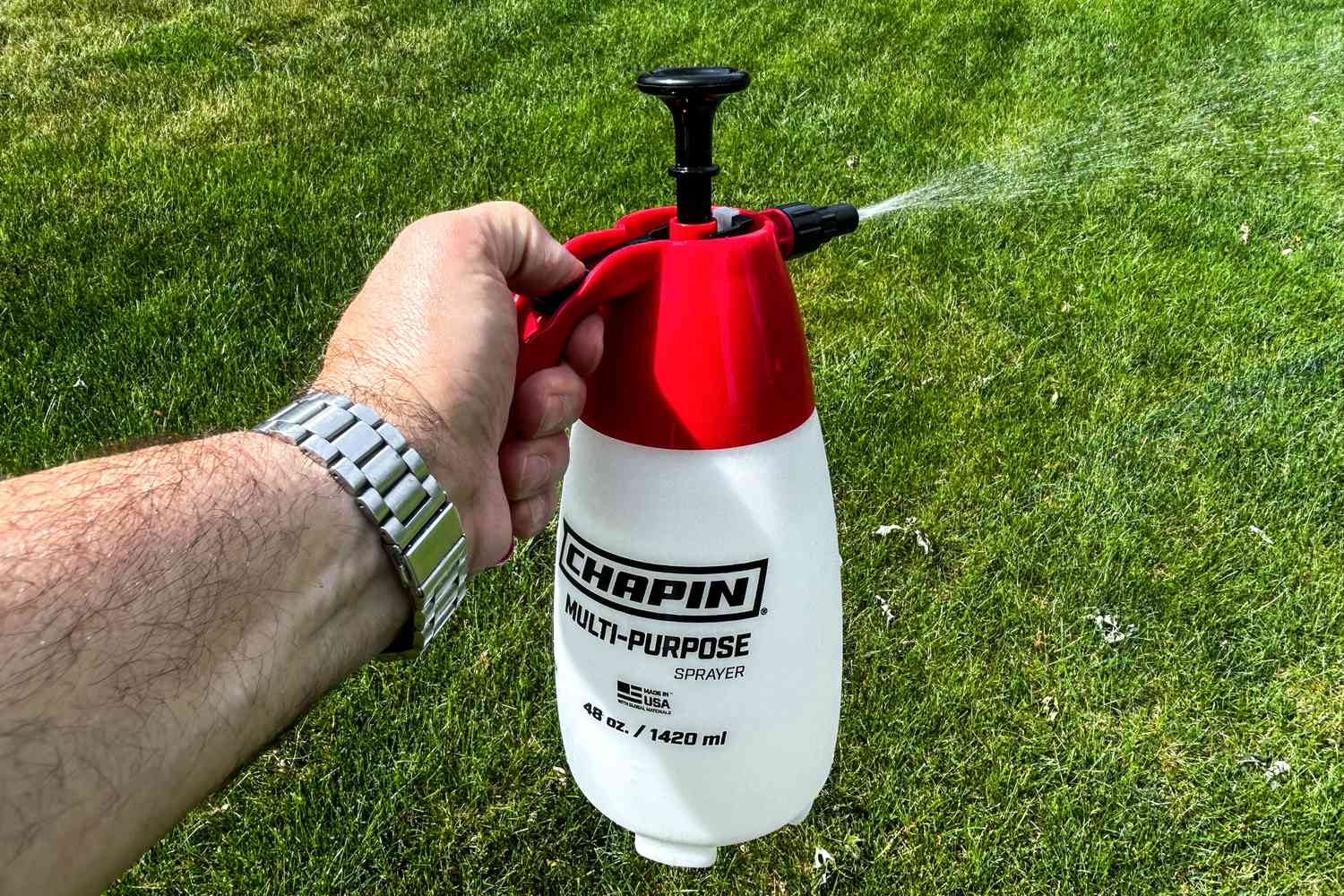

Pump garden sprayers are easy-to-use gardening tools made with a tank, pump handle, hose, and nozzle. They work by creating pressure inside the tank, which pushes water, fertilizers, or pest-control solutions through the nozzle for spraying. Spray distance means how far the liquid can reach from the nozzle, and it plays an important role in deciding how much area or plant height you can cover without changing your position.
An Overview Of Types Of Garden Sprayer Pump
| Product | Title | Features | Explore |
|---|---|---|---|
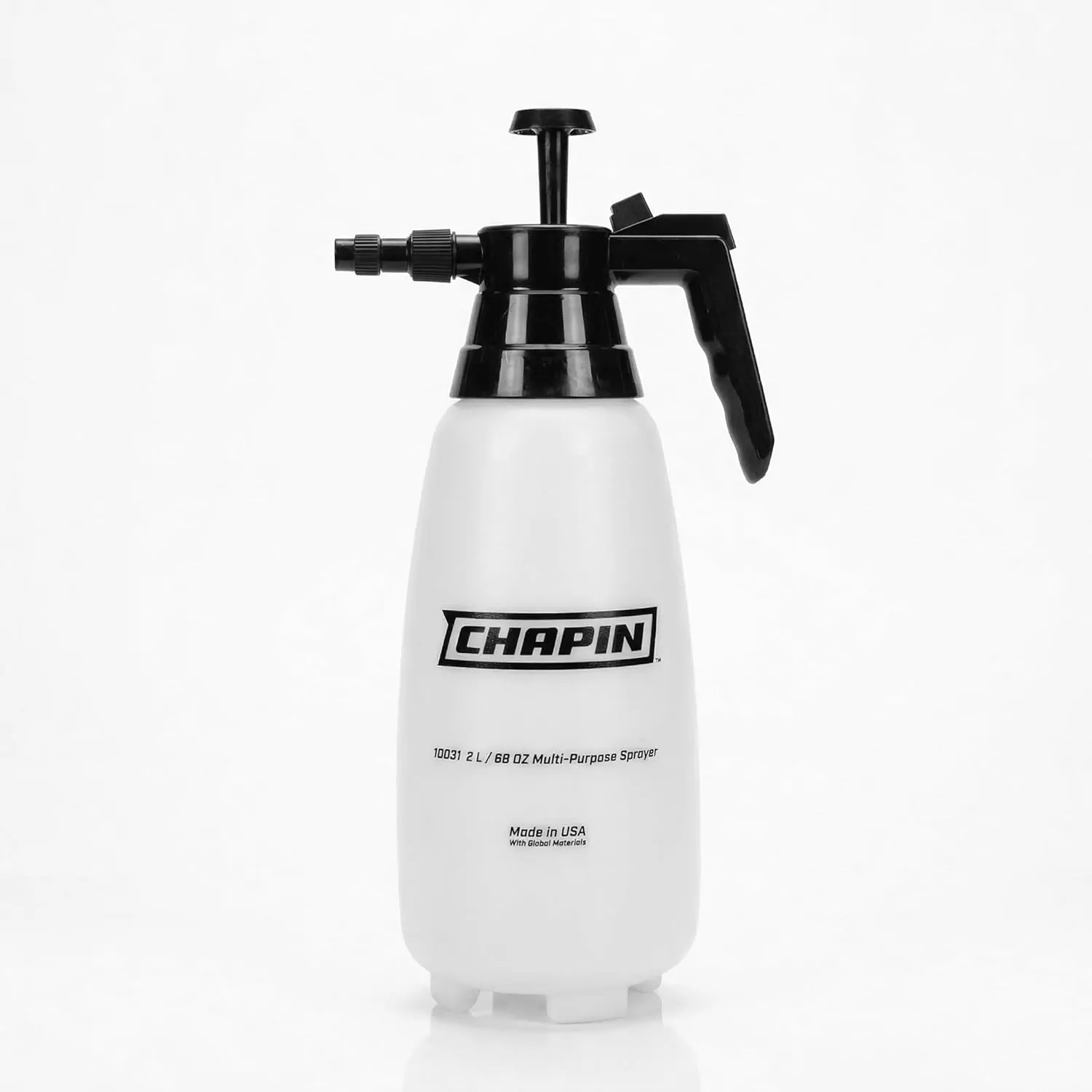 | Chapin 10031 Handheld Pump Sprayer |
| Check Price |
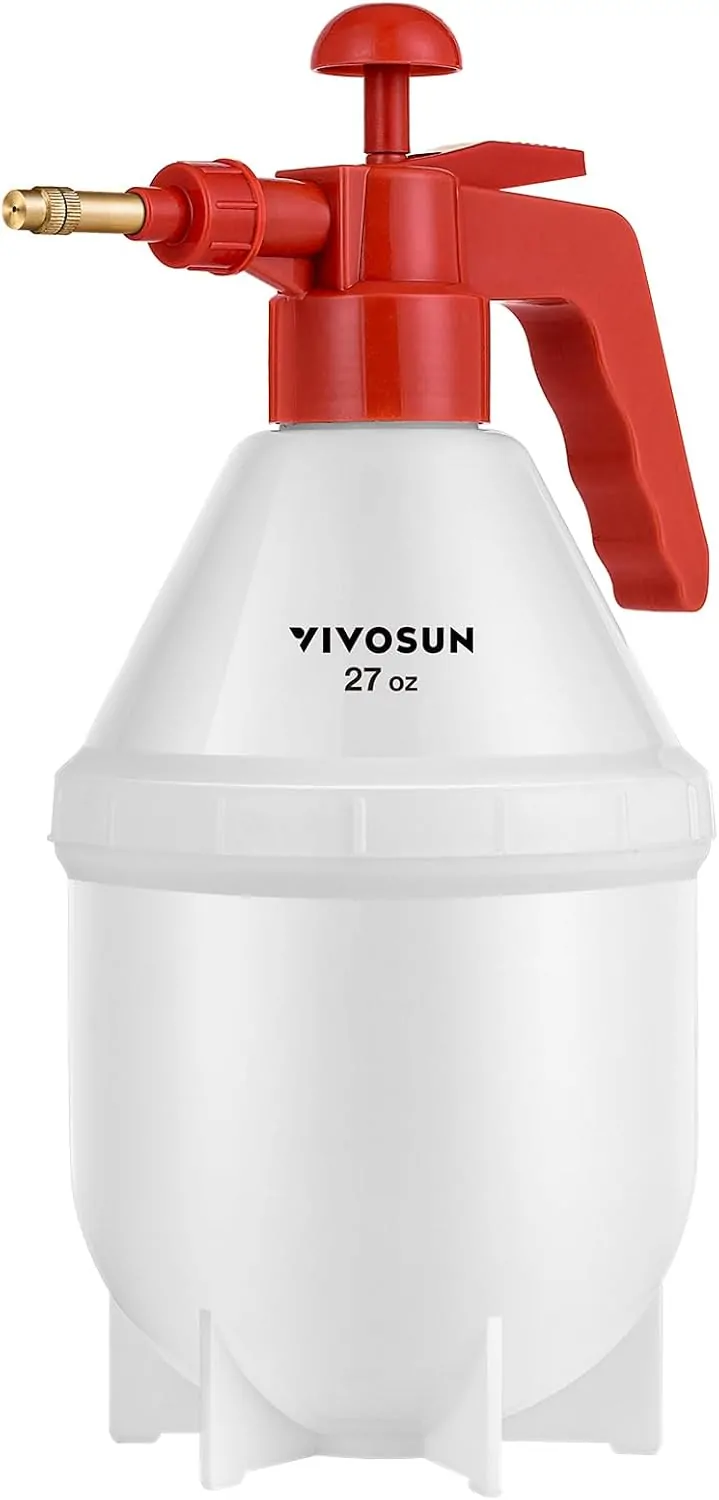 | VIVOSUN 27oz Handheld Garden Pump Sprayer |
| Check Price |
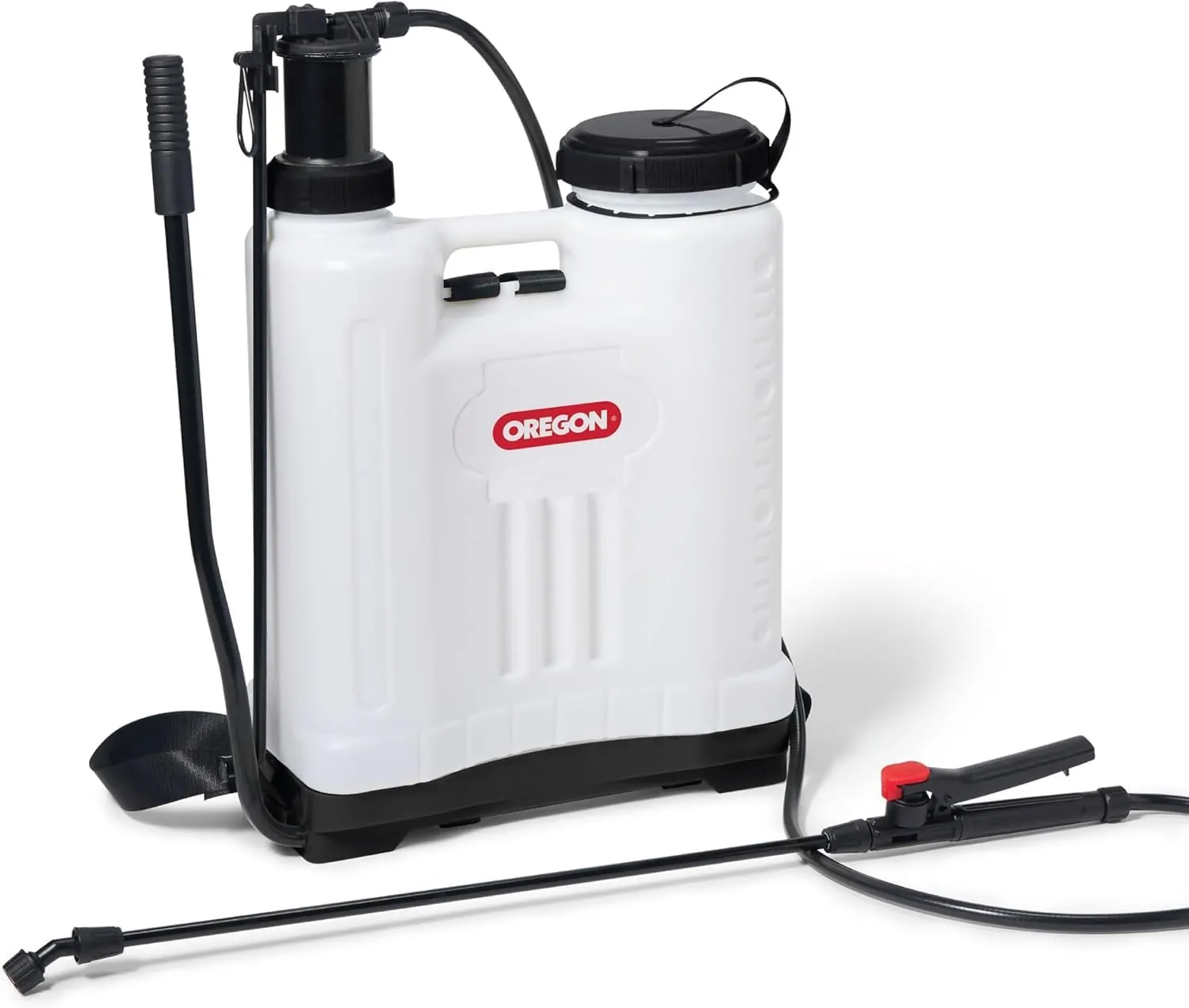 | Oregon Backpack Pressure Garden Sprayer |
| Check Price |
 | VAXMAY Battery Powered Backpack Sprayer |
| Check Price |
 | Scotts 190618W Wheeled Sprayer Pump |
| Check Price |
For example, when spraying tall shrubs or weeds that are located far away, having a longer spray reach helps you cover more area and height more effectively. However, many users expect more than a manual pump sprayer can actually provide. Unlike a garden hose that maintains continuous water pressure, manual pump sprayers have a limited spraying range. Knowing the normal spray distance and the factors that influence it helps gardeners select the right sprayer and use the correct spraying method.
For most home gardening tasks, a pump sprayer usually provides a practical spray distance of around 5–15 feet. Small 1–2 gallon handheld models generally reach about 10–15 feet horizontally, which is enough for nearby plants, flower beds, and shrubs. Larger capacity and professional-style sprayers can achieve greater distances. For example, a 4-gallon backpack sprayer with a strong piston pump can deliver a concentrated stream up to around 25 feet and reach approximately 20 feet vertically.
Generally, stream or jet spray patterns travel farther than fine mist settings. A focused “jet” spray can reach the maximum distance of a sprayer, while a fine mist spreads over a larger area but loses momentum faster and drops sooner. Also, horizontal spraying usually covers a greater distance than vertical spraying. For example, a typical 1-gallon sprayer may reach around 15 feet horizontally but only about 10 feet upward, while a powerful 4-gallon model may reach around 25 feet horizontally and approximately 20 feet vertically.
Typical Spray Distance of Pump Garden Sprayers
Pump sprayer manufacturers often provide estimated spray range information in their product specifications. For example, SOLO states that its 1-gallon sprayer can reach approximately 15 ± ft horizontally and around 10 ± ft vertically. Similarly, the SOLO 425 backpack sprayer (4 gal) is rated for about 25 ± ft horizontal reach and 20 ± ft vertical reach. In real gardening conditions, most standard 1–2 gallon hand pump sprayers can normally spray around 10–15 feet. A narrow stream setting can achieve the higher end of this range, while a wider fan or mist setting usually provides a shorter distance because it focuses more on coverage than reach.
Generally:
- Handheld models (1–2 gal): usually provide around 10–15 ft reach with a concentrated stream, while mist settings may reduce the distance to approximately 5–10 ft.
- Backpack sprayers (4–5 gal): can commonly reach around 20–25 ft horizontally when operating at full pressure. For example, the SOLO 425 backpack sprayer can spray approximately 25 ft.
- Wheeled/Cart sprayers (5+ gal): often provide around 20–30 ft of reach depending on pump strength. For example, one 25-gallon spot sprayer with a powered pump can reach about 20 ft horizontally and around 18 ft vertically.
These spray distances are measured under calm weather conditions and with ideal nozzle settings. When using a mist setting, the spray spreads more widely but usually travels only a few feet because smaller droplets lose energy quickly. On the other hand, stream or narrow cone nozzles concentrate the liquid flow, allowing the spray to travel farther. It is also important to remember that spraying at ground level is easier than spraying upward against gravity. For example, a 1-gallon sprayer may send a stream about 15 ft horizontally, but the same sprayer may only reach around 10 ft vertically because gravity and air resistance reduce upward movement.
Factors That Affect Spray Distance
Spray distance is an important consideration when using any type of sprayer, especially for gardening, cleaning, and pest control applications. The distance a liquid can travel depends on several factors, not only the sprayer model itself. Understanding these factors helps users adjust their equipment properly and achieve better coverage, accuracy, and efficiency. The main factors include:
1. Pump Pressure (Pumping): The pressure created inside the tank is the main force that determines spray distance. Manual pump sprayers depend on user pumping to build pressure, usually around 30–60 psi. Higher operating pressure generally creates a stronger spray and longer reach. For example, a sprayer designed to operate at 45 psi can usually spray farther than one limited to 15 psi. Regular pumping before spraying helps maintain maximum reach within the sprayer’s design limits.
2. Nozzle Type & Spray Pattern: The nozzle plays a major role in controlling spray distance. A narrow opening or jet nozzle creates a concentrated stream that pushes droplets farther. In contrast, a wide cone or fan nozzle produces a broader mist that covers more area but does not travel as far. A fine mist is useful for wider coverage, but it does not provide the same reach as a focused jet spray.
Nozzle condition is also important. Over time, worn nozzle openings can become larger, increasing liquid flow and reducing pressure control. Experts explain that damaged or worn nozzles may create uneven spray patterns and lower spraying performance.
3. Sprayer Size & Pump Quality: Larger sprayers often include stronger pumps, such as piston or diaphragm pumps, which can generate higher pressure and maintain it for longer periods. A high-quality pump reduces the need for frequent pumping and helps maintain a consistent spray distance compared with smaller basic models.
5. Hose/Wand Length: A longer hose or wand does not increase the actual spraying force, but it allows users to reach distant areas without moving the sprayer tank. For example, a 20 ft hose compared with a 10 ft hose allows you to work around obstacles and cover more garden space. It works like an extension of your arm—it improves access but does not increase the power of the spray itself.
6. Liquid Viscosity: The thickness of the liquid also affects spray distance. Thin liquids such as water or properly diluted solutions flow easily and travel farther. Thicker liquids, including oils and concentrated pesticides, move more slowly and may break into droplets closer to the nozzle. Following correct dilution instructions helps maintain proper spraying performance.
7. Environmental Conditions: Weather conditions, especially wind, can greatly influence spray distance. A gentle breeze may carry droplets farther in the wind direction, but it also increases spray drift. Strong wind can move the spray away from the target area, reducing accuracy and possibly affecting nearby plants, people, or surfaces.
For the best results, spraying should be done on calm days. Spray angle and height also affect performance. In many situations, aiming upward at around 30–45° provides better horizontal reach, while spraying directly upward gives maximum height but less forward distance.
Spray Distance by Pump Garden Sprayer Types
Spray distance is one of the most important things to consider when selecting a pump sprayer because it affects how far and how evenly the liquid can be applied. Different pump sprayer types provide different spray ranges depending on their design, pressure capacity, nozzle style, and tank size.
Understanding the spray distance of different pump sprayer types helps users choose the best option for their needs, whether they are caring for indoor plants, maintaining a home garden, controlling pests, or handling light cleaning work. This comparison explains how spray distance changes between different sprayer categories and why reach, accuracy, and efficiency are important factors.
1. Handheld Pump Sprayers
These 1–2 gallon sprayers are compact, lightweight, and easy to carry. They depend on manual pumping, which means they produce a moderate level of pressure compared with larger models. A typical 1-gallon handheld pump sprayer can usually spray around 10–15 feet horizontally when fully pressurized. During regular use, gardeners may need to pump again and adjust their aim to cover larger areas.
Handheld sprayers commonly include shorter wands (around 1–2 ft) and smaller hoses, which limits their effective reach to the distance users can comfortably aim by hand. They are most suitable for close-range applications such as hanging baskets, potted plants, small garden beds, and spot treatments. A popular example is the Chapin 1-gallon sprayer, which includes an adjustable nozzle that allows users to switch between stream and spray patterns. Even with the stream setting, these handheld models generally perform within the spray distances mentioned above.
Chapin 10031 Handheld Pump Sprayer
The Chapin 10031 Handheld Pump Sprayer comes with a 2-liter translucent tank, adjustable brass nozzle, built-in tank filter, and strong gaskets designed for versatile use. It provides reliable spraying performance with a thumb-trigger lock, comfortable handheld design, 60 PSI maximum pressure, and a smooth spray output for gardening and household applications. Based on my experience, it is lightweight, comfortable to operate, reduces leakage problems, and works very well for small gardens, indoor plants, and balcony gardening.
expert start
What Is It and Its Features
The Chapin 10031 Handheld Pump Sprayer is a manual 2-liter sprayer made from lightweight plastic with a translucent white tank and an easy-grip handheld design. It weighs only 0.82 pounds, making it comfortable to use without causing much hand fatigue. The tank includes a wide opening that makes filling easier and reduces spills, especially when using fertilizers, weed killers, or pest control solutions. One of its important features is the adjustable brass nozzle, which allows users to change the spray output from a fine mist to a direct stream according to the task. It also includes an in-tank anti-clog filter that helps prevent dirt and particles from blocking the spray system.
Another helpful feature is the thumb-trigger shut-off system with a locking option, which improves comfort during longer spraying sessions. The sprayer can reach up to 60 PSI, providing enough pressure for many small gardening and household tasks. It is designed for both indoor and outdoor applications, including plant maintenance, weed control, patio cleaning, general disinfecting, and other light-duty jobs. Chapin also mentions that the seals and gaskets are designed to handle common lawn and garden chemicals, which is useful for users who apply different solutions.
Why It Matters
These features are important because a small sprayer should be easy to operate, dependable, and comfortable, especially for users who spray regularly. In my experience, the Chapin 10031 Handheld Pump Sprayer performs well because it combines practical features in a compact and affordable design. The adjustable nozzle is especially useful because different tasks require different spray patterns. A fine mist works better for leaves, flowers, and delicate plants, while a concentrated stream is more suitable for weeds and cleaning applications.
The built-in filter is valuable because nozzle blockage is a common issue with many pump sprayers, and this feature helps maintain consistent performance. The thumb-trigger lock also improves comfort because continuously pressing a trigger can make your hand tired during longer jobs. I also found the translucent tank very useful because it allows quick checking of the remaining liquid level, helping prevent overfilling or incorrect mixing. For users who handle small gardening tasks, occasional pest control, and household spraying, these features make the sprayer more convenient and enjoyable.
My Set-Up And My Experience
For my setup, I used the Chapin 10031 Handheld Pump Sprayer mainly for balcony plants, container flowers, small lawn treatments, and some household cleaning applications. Before using it for the first time, I washed the tank properly because a noticeable plastic smell was present when it was new. I recommend cleaning it before use, especially when spraying around pets, edible plants, or indoor areas.
During my first few uses, I noticed a small amount of dripping after spraying. To solve this issue, I carefully tightened the two valves using channel locks, and the dripping stopped. I also applied a small amount of lubricant to the pump mechanism, which improved the smoothness of the pumping action.
After these minor adjustments, the sprayer performed much better and became a regular tool for my light spraying needs. The handle felt comfortable, and the thumb trigger required less effort compared with some inexpensive sprayers I had previously used. The locking feature was especially helpful during longer spraying sessions because it reduced pressure on my hand. After becoming familiar with the pumping process, I found it simple, practical, and convenient to use.
Performance
When it comes to performance, the Chapin 10031 Handheld Pump Sprayer works very well for small-scale spraying tasks. During the first use, it required around five to six pumps to create full pressure, which is normal for this type of manual sprayer. After building pressure, it maintained a steady spray output and provided reliable performance for regular home and garden applications.
The spray pattern was smooth and easy to manage, and I liked the ability to quickly switch between mist and stream settings. The mist option worked well for delicate leaves, flowers, and indoor plants, while the stronger stream setting was useful for targeted weed treatment and some cleaning jobs. The built-in tank filter also appeared effective because I did not experience nozzle blockage during my testing.
After adjusting and tightening the components, the sprayer maintained a proper seal and did not leak during normal operation, even when the tank was partially filled and tilted. This improved my confidence when carrying and using it around plants and other areas. Although it is not designed for large lawns or heavy commercial spraying, it performs excellently for urban gardeners, balcony plant care, small lawn treatments, reptile enclosure cleaning, and household disinfecting.
Overall, it feels like a practical and reliable tool that delivers professional-style results for everyday home use. My first impression is that it provides good value, especially for people who need a compact handheld sprayer rather than a larger backpack model.
Practical Tips
- Wash the tank properly before the first use to remove any plastic odor.
- Check and tighten all connections before starting your first spraying job.
- Pump the handle 5 to 6 times initially to build proper pressure.
- Clean the nozzle and tank after using chemical solutions.
- Store the sprayer empty, completely dry, and away from direct sunlight.
- Use the trigger lock when spraying for longer periods to reduce hand fatigue.
- Avoid filling the tank completely to make pumping and handling easier.
expert end
pro start
| Pros | Cons |
|---|---|
| ✔️ Lightweight design makes it easy to carry and use. | ❌ Required minor adjustments to completely stop dripping. |
| ✔️ Adjustable nozzle provides better spray control. | ❌ Strong plastic smell was noticeable when new. |
| ✔️ Translucent tank allows quick checking of liquid level. | ❌ Pump mechanism needed initial lubrication. |
| ✔️ Thumb-trigger lock helps reduce hand tiredness. | ❌ Plastic nozzle components may wear after long-term use. |
| ✔️ Suitable for small gardens and household applications. | ❌ Not recommended for large-scale spraying tasks. |
pro end
VIVOSUN 27oz Handheld Garden Pump Sprayer
The adjustable brass nozzle and manual hand pump system provide a steady spray pattern, while the translucent bottle with a measurement scale helps make solution mixing simple and accurate. Its compact 27oz tank, pressure release valve, and reinforced thick base provide better safety, stability, and durability for gardening, cleaning, and plant care activities. Based on my experience, this sprayer was lightweight, comfortable to handle, and delivered an even spray for weed control and routine plant maintenance.
expert start
What Is It and Its Features
The VIVOSUN 27oz Pump Sprayer is a handheld pressure sprayer made for small gardening applications and cleaning activities. It operates through a manual pump mechanism. Simply fill the bottle with water or your desired spray solution, pump the handle several times to create pressure, and press the trigger to release the spray. The adjustable brass nozzle allows you to change the spray output from a fine mist to a stronger stream according to the task.
One of its helpful features is the translucent bottle with a visible calibration scale. This design makes it easier to monitor the liquid level and measure the required amount of solution. The sprayer also includes a pressure release valve that helps safely remove extra pressure after use. Its thickened base improves stability and adds strength to the overall design. Although the sprayer has a compact size, its build quality feels durable, and the lightweight structure makes it convenient for extended use.
Why It Matters
A dependable small sprayer like the VIVOSUN 27oz Pump Sprayer can simplify many everyday gardening and cleaning activities. Instead of carrying heavy backpack sprayers or using large equipment, a handheld model is ideal for quick and targeted applications. It works well for tasks such as spraying indoor plants, applying diluted fertilizer, or treating small weed-affected areas.
The sprayer also helps you manage liquid usage more effectively. The adjustable brass nozzle provides better control over spray intensity, allowing you to use a gentle mist for sensitive plants or a stronger stream for cleaning purposes. The comfortable handle and locking trigger make one-handed spraying easier. This feature is especially useful when your other hand is needed to move leaves, support branches, or reach difficult areas. For small gardens, balconies, and indoor plant collections, this compact sprayer can become an essential gardening tool.
My Set-Up and My Experience
Setting up the VIVOSUN 27oz Pump Sprayer was very simple when I used it for the first time. The sprayer arrived almost ready for operation, and I only had to add my preferred spray solution into the bottle. I mainly used it for applying weed control solutions in my garden and providing water to indoor plants. The pump worked smoothly and created enough pressure after only a few pumps.
The feature I appreciated most was its lightweight and user-friendly design. The small bottle size made it easy to carry around without causing hand fatigue. I was able to hold the sprayer in one hand while using the other hand to move leaves and spray hard-to-reach areas. The translucent bottle was another useful feature because it allowed me to quickly check the remaining liquid. Cleaning the sprayer after every use was also easy, which is important when using different types of solutions.
Performance
The VIVOSUN 27oz Pump Sprayer delivered reliable performance for small spraying applications. The spray output remained consistent, and the adjustable brass nozzle provided flexibility between mist and stream settings. For watering plants and applying pest control solutions, the fine mist option worked effectively because it distributed liquid evenly across plant surfaces.
The pressure system also performed efficiently considering the sprayer’s compact design. Once pressurized, it maintained enough pressure to spray multiple plants before requiring additional pumping. The trigger and locking feature improved convenience during continuous spraying, especially when covering several plants. After repeated use, the sprayer continued working properly without major performance issues. For its affordable price and small size, it provides excellent value for common gardening tasks.
Practical Tips
- Clean the sprayer with fresh water after applying chemical solutions to avoid blockage.
- Select the fine mist setting when spraying delicate plants and young seedlings.
- Avoid filling the bottle completely; keep enough empty space for proper pressure formation.
- Pump gradually and consistently to maintain steady pressure inside the container.
- Use the safety valve to release pressure before opening the sprayer.
expert end
pro start
| Pros | Cons |
|---|---|
| ✔️ Lightweight design makes it easy to move around the garden. | ❌ Small capacity means more frequent refilling is needed. |
| ✔️ Adjustable brass nozzle offers different spray options. | ❌ Plastic construction may produce minor sounds during operation. |
| ✔️ Transparent bottle allows quick liquid level checking. | ❌ Not designed for large gardens or extensive spraying work. |
| ✔️ Manual pump system creates pressure quickly. | ❌ Additional pumping may be required during longer spraying sessions. |
| ✔️ Suitable for plants, cleaning tasks, and small applications. | ❌ Limited spray distance compared with larger sprayer models. |
pro end
2. Backpack Pump Sprayers
Designed to be carried on the back using padded shoulder straps, these 3–5 gallon sprayers usually come with more powerful pumps (piston or diaphragm) and longer spray wands (often 20–28 inches) with stronger hoses. These features help them maintain pressure for a longer time and improve spraying distance.
For example, the SOLO 425 (4 gal) backpack sprayer has a listed horizontal spray range of around 25 ± ft. During practical use, a properly pressurized backpack sprayer can often reach the upper parts of medium-sized shrubs and tall bedding plants. Although manual pumping is still required, these sprayers generally need fewer pumping actions and can maintain pressure for a longer period. Backpack sprayers also allow you to carry a larger amount of liquid, making them a good choice for bigger gardens or tasks covering several hundred square feet.
Oregon Backpack Pressure Garden Sprayer
The Oregon 16L Backpack Sprayer comes with a large tank, pressurized chamber, extended lance, and four adjustable nozzles for different spraying applications. Its ergonomic backpack design, semi-transparent tank, and flexible hose improve comfort, handling, and liquid visibility during use. In my experience, it provided even spray coverage over large areas and reduced working time, although I added extra padding to the shoulder straps to make it more comfortable.
expert start
What Is It and Its Features
The Oregon Backpack Pressure Garden Chemical/Weed Killer Sprayer is a 16-liter backpack sprayer designed for applying garden chemicals including herbicides, pesticides, fertilizers, and disinfectants. It uses a pressurized chamber system that pushes liquid through the hose and spray lance, producing a controlled and consistent spray. The sprayer includes four nozzle options, such as flat fan and adjustable cone nozzles, allowing users to change between fine mist spraying and focused spraying according to the requirement.
The sprayer weighs approximately 3.8 kilograms and comes with a long flexible hose and spray lance that together provide a reach of about 2 meters. This extended design helps you spray plants more easily without excessive bending. The tank shape is designed to sit comfortably against your back, while the shoulder straps help spread the weight when the tank is filled. It also comes with a spare seal kit, which can be useful for replacing worn seals and handling minor maintenance after extended use.
Why It Matters
A dependable sprayer like the Oregon 16L Backpack Sprayer can reduce both time and physical effort when controlling weeds or pests in gardens and small farms. Instead of using a small handheld sprayer that requires frequent refilling, its large 16-liter capacity allows you to cover more area before stopping. This makes it especially helpful for lawns, orchards, vegetable gardens, and pathways.
The adjustable nozzle system is another valuable feature for daily gardening work. Different tasks require different spray patterns. For example, plants may need a gentle mist, while weeds growing in cracks or difficult areas may require a stronger direct spray. Multiple nozzle options provide more flexibility and allow one sprayer to handle several types of jobs. From my experience, this versatility helps reduce the need for purchasing separate sprayers for different applications.
My Set-Up and My Experience
When I received the Oregon Backpack Pressure Sprayer, setting it up required some time. The instruction manual was not very detailed, and the small black-and-white images made the assembly process slightly difficult. However, after completing the setup correctly, the sprayer performed effectively.
I mainly used this sprayer for applying herbicide along garden paths and fence areas, along with light insecticide applications on plants. The 16-liter tank capacity allowed me to continue working for a long period without frequent refilling. I also found the semi-transparent tank helpful because it allowed me to quickly check the remaining liquid level.
During the first use, I noticed that the shoulder straps had limited padding. When the tank was filled completely, carrying it for a long time became slightly uncomfortable. I improved this by adding extra padding to the straps, which noticeably increased comfort. After this adjustment, the sprayer became much easier to use during longer spraying tasks.
Performance
The Oregon Backpack Sprayer delivers reliable performance for general garden spraying needs. Its pressurized chamber helps maintain a steady spray output with minimal pumping effort. After building pressure, the spray pattern remains consistent and can be controlled easily.
The included nozzles increase the sprayer’s usefulness because they provide different spray patterns. The flat fan nozzle worked well for covering wider areas such as lawns and weed patches, while the adjustable cone nozzle produced a fine mist suitable for plant spraying. Changing between nozzles was simple and quick.
The sprayer also provides good reach because of its approximately two-meter combined hose and lance length. This makes it easier to spray plants without frequent bending or moving the tank, improving comfort during extended work.
The large tank size improves efficiency as well. During testing, I was able to spray a large portion of my yard without needing repeated refills. Compared with smaller handheld sprayers, this significantly reduced the overall spraying time.
Practical Tips
- Always inspect the seals before filling the Oregon Backpack Sprayer to prevent leaks during operation.
- Choose the flat fan nozzle when applying weed control products over large areas.
- Use the adjustable cone nozzle for plant spraying and sensitive applications.
- Avoid filling the tank completely when working for extended periods to reduce shoulder pressure.
- Wash the sprayer with clean water after chemical applications to increase its lifespan.
expert end
pro start
| Pros | Cons |
|---|---|
| ✔️ Large 16-liter tank allows coverage of bigger areas with fewer refills | ❌ Assembly instructions are not very clear and can be difficult to understand |
| ✔️ Four adjustable spray nozzles support different spraying applications | ❌ Shoulder straps have limited padding and feel less comfortable |
| ✔️ Long hose and spray lance provide excellent reach during spraying | ❌ Becomes heavy when the tank is filled completely |
| ✔️ Semi-transparent tank makes checking the liquid level easier | ❌ Overall material quality feels average |
| ✔️ Provides stable spray performance with consistent pressure | ❌ Initial setup requires some time and patience |
pro end
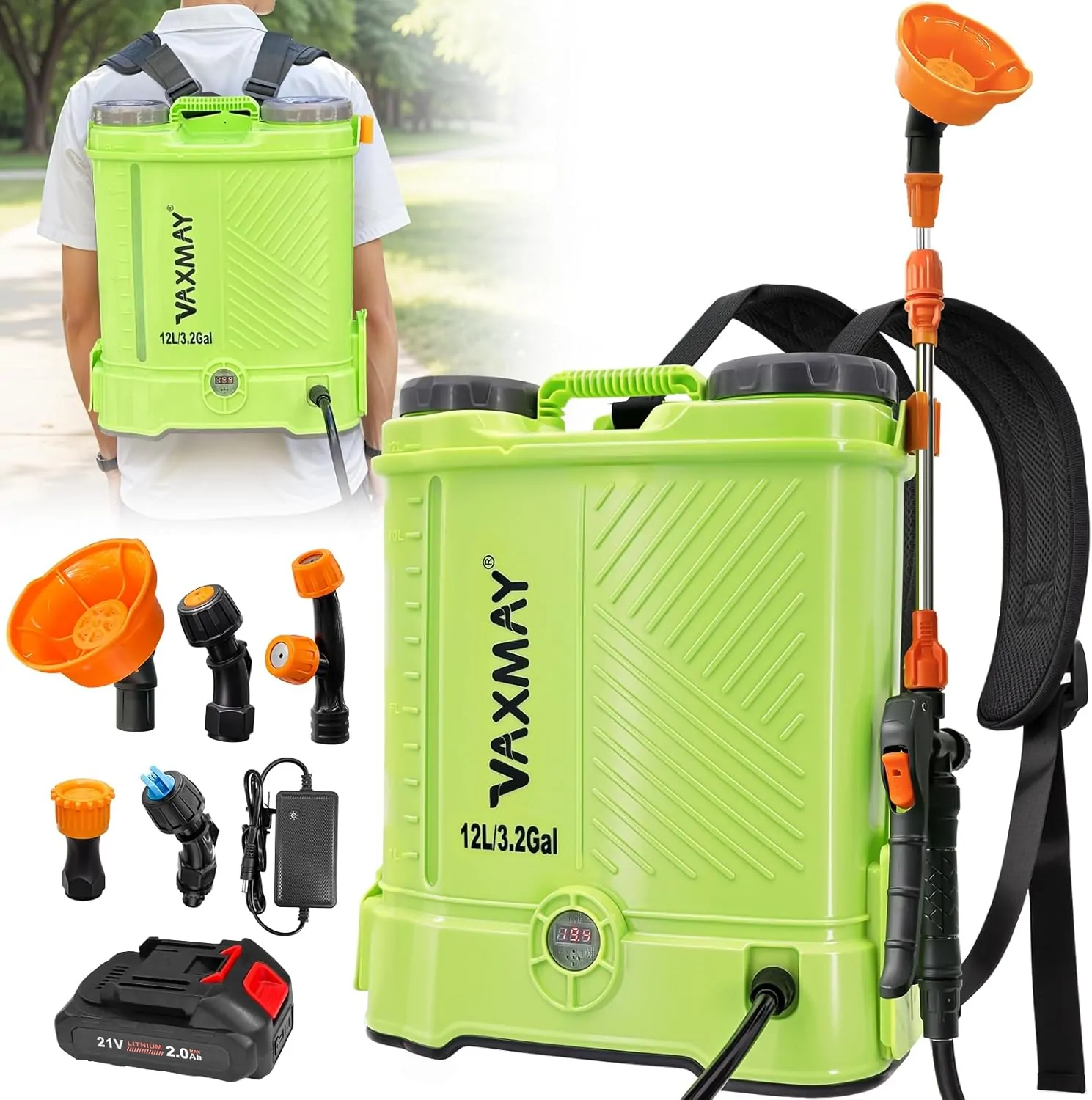
VAXMAY Battery Powered Backpack Sprayer
The VAXMAY Battery Powered Backpack Sprayer features a powerful 80 PSI electric pump, adjustable pressure control, telescopic wand, and five different nozzles for multiple spraying needs. The sprayer supports Makita 18V batteries, includes a 2,0Ah battery, digital voltage display, and discharge protection system for dependable operation and improved battery performance. In my experience, it maintained stable pressure, provided good battery life, offered comfortable backpack support, and made spraying tasks faster and more convenient.
expert start
What Is It and Its Features
The VAXMAY Battery Powered Backpack Sprayer 3.2 Gallon is an electric backpack sprayer designed for garden spraying, weed control, fertilizer application, and general outdoor cleaning tasks. It features a 3.2-gallon tank made from durable polyethylene and polypropylene materials, providing a balance between strength and lightweight design. The sprayer operates using a rechargeable 2.0Ah battery and is also compatible with Makita 18V batteries, which is useful for users who already own Makita equipment. The digital voltage display is a helpful feature because it allows you to monitor the remaining battery level. It also includes battery discharge protection, which automatically stops operation when voltage drops below 14V to help protect the battery.
Another important feature is its powerful 80 PSI high-pressure pump, powered by a 3200 RPM motor. This strong pressure helps the sprayer reach distant plants while maintaining even spray coverage. The pressure can be adjusted using the control knob according to different spraying requirements. The sprayer comes with five nozzle options that create different spray patterns, including fine mist and direct stream. It also includes a telescopic spray wand that extends up to approximately 39 inches, making it easier to spray tall plants, bushes, and difficult-to-access areas.
Why It Matters
The VAXMAY Battery Powered Backpack Sprayer 3.2 Gallon is useful because it removes one of the biggest disadvantages of traditional manual sprayers: repeated pumping. With manual sprayers, users often need to stop and rebuild pressure during spraying. This becomes tiring when working in larger gardens or treating many plants. The electric pump maintains pressure automatically, making the spraying process easier, smoother, and less physically demanding.
Efficiency is another major advantage of this sprayer. According to the manufacturer, it can complete up to 15 tank sprays on one charge, allowing multiple spraying tasks without frequent battery charging. The backpack design, padded straps, and lumbar support also improve carrying comfort by distributing the weight more evenly. When carrying several gallons of liquid, proper balance and comfort are important for longer spraying sessions.
My Set-Up And My Experience
Setting up the VAXMAY Battery Powered Backpack Sprayer 3.2 Gallon was simple and straightforward. The package arrived safely, and the main setup involved connecting the hose, spray wand, and nozzle. The detachable battery was easy to remove and charge. Before applying any chemicals, I filled the tank with clean water to test the sprayer, which is a good practice when using a new machine.
I mainly used this sprayer for watering container plants and applying fungicide to vegetables in my garden. For watering, I often used it without a nozzle because it provided a steady water flow. When applying fungicide, I changed to a mist nozzle to achieve better coverage. The adjustable pressure control was useful because I could lower the pressure for delicate plants and increase it when reaching plants farther away. The backpack straps were comfortable, although the unit became slightly heavy when the tank was completely full.
Performance
The VAXMAY Battery Powered Backpack Sprayer 3.2 Gallon delivered strong and consistent performance during use. The electric pump maintained stable spray pressure without the pressure drops commonly experienced with manual sprayers. The adjustable pressure knob also provided better control over spray intensity for different applications.
The telescopic wand performed very well and allowed me to reach taller plants and spray behind bushes without excessive bending. The five included nozzles increased the sprayer’s versatility. For example, the fine mist nozzle worked well for sensitive plants, while the stronger stream nozzle was useful for weeds and areas near driveway edges. The battery performance was also satisfactory, and I was able to complete spraying across my garden area on a single charge without needing to recharge.
Practical Tips
- Always test the VAXMAY Battery Powered Backpack Sprayer 3.2 Gallon with clean water before applying chemicals.
- Adjust the pressure setting according to the task to protect delicate plants from damage.
- Use the telescopic wand to reach higher branches and deeper garden areas more easily.
- Clean the tank and nozzles after every use to prevent blockages and maintain spraying performance.
- Avoid completely draining the battery regularly to help increase battery lifespan.
expert end
pro start
| Pros | Cons |
|---|---|
| ✔️ Powerful 80 PSI pump provides strong and consistent spraying performance | ❌ Feels heavy when the tank is completely filled |
| ✔️ Compatible with Makita 18V batteries for added convenience | ❌ Plastic construction feels less durable compared with premium models |
| ✔️ Includes five different spray nozzles for multiple applications | ❌ Wand holder design could be improved for better storage |
| ✔️ Comfortable padded backpack design improves carrying support | ❌ Connections may leak if they are not properly tightened |
| ✔️ Large 3.2-gallon tank reduces the need for frequent refilling | ❌ Battery charging may take a longer time |
pro end
3. Wheeled/Cart-Style Sprayers
These are high-capacity sprayers (usually 5+ gallons) that are placed on wheels or designed to be pulled behind a mower or ATV. They can come with electric pumps or engine-powered pumps. Because of their larger tanks and stronger pumps, they can cover wider areas and spray at longer distances. For example, a 25-gallon tow-behind spot sprayer with a 12V pump can reach around 20 ft horizontally and approximately 18 ft vertically when used in spot spray mode.
Compared with backpack sprayers, these models can carry much more liquid, reducing the need for frequent refilling. The extended hose (commonly 10–15 ft long) allows the user to spray while keeping the main unit at a distance. However, these sprayers are heavier and not as easy to move in tight spaces. They are most useful for large lawns, orchards, gardens, and fence line spraying. Their spray range mainly depends on pump pressure (many models operate at 30–40 psi or more) and the type of nozzle being used.
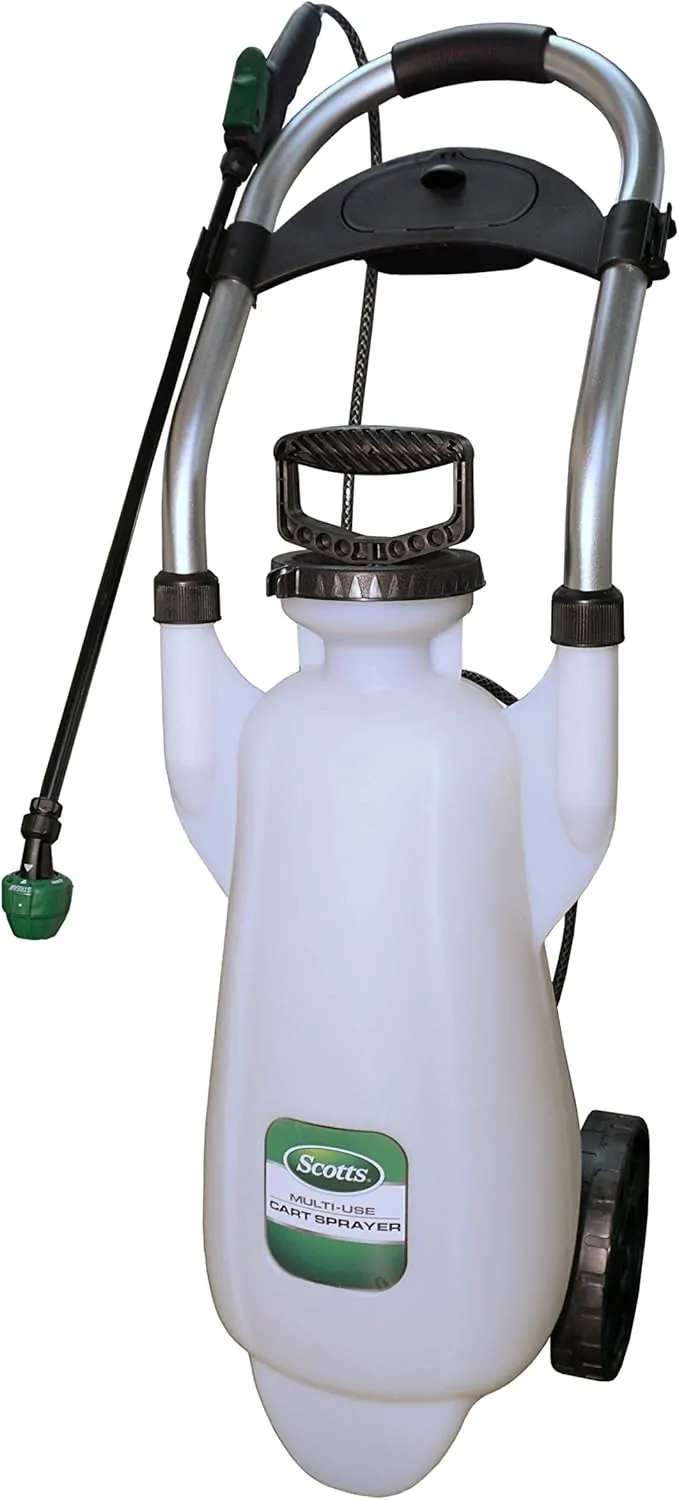
Scotts 190618W Wheeled Sprayer Pump
The Scotts 190618W Wheeled Sprayer Pump comes with a 3-gallon tank, strong wheels, a comfortable handle, and a 3-in-1 adjustable nozzle. It includes a heavy-duty wand, lockable premium shut-off, no-spill funnel, and transparent tank that helps with accurate filling and efficient spraying. In my experience, it is simple to operate, reduces physical effort, provides an even spray pattern, and makes garden care quicker and more convenient.
expert start
What Is It and Its Features
The Scotts 190618W Wheeled Sprayer Pump is a manual cart-style sprayer with a 3-gallon tank, made for home gardens and light commercial applications. It comes with a premium shut-off system featuring a comfortable grip that can be locked for continuous spraying, helping reduce hand tiredness during longer jobs. The sprayer includes a long, heavy-duty non-corrosive wand, a transparent tank with measurement markings, and a no-spill funnel top that makes filling easier and cleaner.
It also features a 3-in-1 adjustable nozzle that provides fan, stream, and cone spray options for different spraying needs. The strong six-inch wheels provide easy movement, while the ergonomic handle includes a built-in wand clip for convenient storage. Constructed from durable polyethylene, the sprayer is lightweight but strong, and the nickel-plated brass poppet provides reliable performance and accurate spraying control.
Why It Matters
The Scotts 190618W Wheeled Sprayer Pump is valuable because it helps solve common gardening problems, especially for users who frequently apply weed killers, fertilizers, or insecticides. Many traditional sprayers are backpack or handheld models that can become uncomfortable to carry and harder to handle when working with chemicals. This wheeled design reduces pressure on your arms and back while providing a steady and controlled spray.
The adjustable nozzle helps users apply spray accurately for different jobs, from covering wider surfaces to treating small flower beds. For older gardeners or anyone looking for a more comfortable spraying method, this sprayer provides a practical and efficient option. Its strong construction and user-friendly design make it a useful tool for keeping gardens healthy and well maintained.
My Set-Up and My Experience
My experience with the Scotts 190618W Wheeled Sprayer Pump has been comfortable and enjoyable. As a female gardener, I especially like the wheel design because it saves me from carrying heavy liquid tanks on my back, which is common with backpack sprayers. The pump works smoothly, and the spray continues for a good amount of time without needing frequent refills. I can easily apply weed killers, insecticides, and fertilizers, while the adjustable nozzle allows me to select the right spray pattern.
I have completed around five refills of 2–3 gallons within a short period, and the sprayer performed well without leaks or causing physical tiredness. Although the tank is advertised as a three-gallon capacity, I noticed it can hold slightly more while still leaving enough air space for proper pumping. The setup process was easy, and the cost feels reasonable considering the features included. Even after years of regular use, this sprayer has continued to work effectively in my garden and yard.
Performance
The performance of the Scotts 190618W Wheeled Sprayer Pump is excellent for home gardening needs. The pumping system operates smoothly and requires little effort, while the lockable shut-off feature helps reduce hand fatigue during longer spraying tasks. The fan spray mode is useful for covering larger areas such as decks and sidewalks, the stream mode works well for targeted weed treatment, and the cone spray provides even coverage for plants.
The durable wand and comfortable handle improve control and spraying accuracy, while the six-inch wheels make transportation easier across different surfaces. I have used this sprayer for several years to apply weed killers and insecticides, and it has remained dependable with regular maintenance. Compared with handheld and backpack sprayers, it requires much less physical effort and makes garden maintenance more efficient.
Practical Tips
- Keep pumping until the pressure builds and the pump becomes firm for steady spraying.
- Select the correct setting on the 3-in-1 nozzle: fan, stream, or cone according to your task.
- Fill the tank carefully through the no-spill funnel to prevent chemical spills.
- Place the wand in the built-in handle clip after finishing work for easy storage.
- Wash the sprayer and clean the filter after each use to maintain performance and extend its life.
expert end
pro start
| Pros | Cons |
|---|---|
| ✔️ Easy transportation with strong 6-inch wheels. | ❌ Manual pumping may require effort during extended spraying jobs. |
| ✔️ 3-in-1 adjustable nozzle provides multiple spray patterns. | ❌ The 3-gallon tank may not be enough for very large spraying areas. |
| ✔️ Comfortable ergonomic handle helps reduce hand and arm strain. | ❌ Wheels may perform poorly on extremely rough or uneven ground. |
| ✔️ Transparent tank with measurement marks helps with accurate filling. | ❌ Not designed for industrial-level spraying or extremely demanding applications. |
| ✔️ Strong wand provides accurate spraying for different garden tasks. | ❌ Some assembly is needed before using the sprayer for the first time. |
pro end
Nozzle Settings and Their Impact on Distance
Nozzle settings are one of the most important factors that influence how far and how effectively a liquid spray can travel. The adjustment of a nozzle controls the spray pattern, droplet size, and pressure, and these factors directly determine the spraying distance. Whether you are watering indoor plants, applying fertilizer, or using a sprayer for pest management, selecting the correct nozzle setting helps achieve better coverage while reducing unnecessary liquid loss and overspray.
The nozzle controls the shape and direction of the spray. Adjustable nozzles give users the flexibility to change between different spray patterns. A narrow jet (stream) setting is designed for maximum distance, while a wider cone or fan setting is better for covering larger areas. For example, many garden sprayers include a twist-adjustable cone nozzle that can be changed from a focused stream to a broader spray pattern.
A narrow stream setting provides the greatest spraying reach because the liquid droplets remain concentrated and travel farther. On the other hand, changing the nozzle to a wider “shower” pattern distributes the liquid over a larger area with softer coverage. Fixed nozzles have only one preset spray pattern, such as a fan or jet spray. Although they are simple and easy to use, they do not provide the same flexibility when switching between short-range misting and long-distance spraying.
Fine Mist vs. Concentrated Stream: A fine mist contains very small droplets that spread over plants evenly but lose momentum quickly and have a shorter spraying range. A concentrated stream produces larger droplets that maintain their force and can travel much farther. As one guide explains, “Mist spray… covers a wider area but doesn’t have the same reach” as a jet spray. Therefore, when maximum distance is required, a medium or narrow spray pattern is usually more effective than a very fine mist setting.
Nozzle Wear: Spray nozzles may become damaged or worn over time, especially when they are used with liquids containing abrasive particles or impurities. As the nozzle opening becomes larger due to wear, more liquid passes through while pressure decreases. This change can reduce both spray distance and the consistency of the spray pattern. Experts explain that “as nozzles wear, the openings become larger and the rate and uniformity become more variable”.
Simply put, an old or damaged nozzle cannot provide the same spraying distance and accuracy as a new one. Regular inspection and timely nozzle replacement help maintain proper performance. Choosing the correct nozzle and keeping it clean and well-maintained are essential steps for achieving the longest and most consistent spray coverage.
Vertical vs. Horizontal Spray Distance
Pump sprayers usually achieve greater distance when spraying horizontally compared to spraying vertically. When the spray is directed upward, gravity works against the liquid droplets, causing them to slow down and fall sooner. For example, a 1-gallon sprayer that can reach around 15 ft horizontally may only achieve approximately 10 ft when spraying upward. Similarly, a larger 4-gallon backpack sprayer with a horizontal range of about 25 ft may reach only around 20 ft vertically. Even a large 25-gallon cart sprayer may achieve about 18 ft upward compared with nearly 20 ft across.
In practical gardening situations, a pump sprayer can usually reach the upper parts of shrubs and lower tree branches when they are within this height range. However, very tall tree canopies or high building surfaces are generally beyond the effective range of a manual sprayer unless additional equipment such as ladders or powered sprayers is used. Some professional backpack sprayers and cold fogger attachments can provide greater reach; for example, battery and gas-powered foggers may achieve horizontal distances of 30–40+ ft under suitable conditions.
Generally, the vertical spraying distance of most pump sprayers is around two-thirds to three-quarters of their stated horizontal range. To improve coverage, use the sprayer at a suitable height and angle, often around 45°. Directing the spray almost straight upward is usually less efficient and provides limited benefits for most gardening applications.
How to Maximize Spray Distance with a Pump Sprayer
Achieving the maximum possible spray distance from a pump sprayer is important for improving efficiency and getting accurate coverage. Whether you are applying fertilizer, pesticides, herbicides, or cleaning solutions, a longer spray reach allows you to cover larger areas more easily while reducing unnecessary effort and liquid consumption.
Many users think that spray distance depends only on the size of the sprayer, but several factors influence performance, including pressure level, nozzle design, liquid thickness, and proper equipment setup. By understanding how these elements work together, you can improve spray distance, minimize waste, and get better results from your pump sprayer for both indoor and outdoor uses.
Pump Fully: Create the highest safe pressure level inside the sprayer tank. Pump the handle or lever until the pressure gauge (if available) reaches the upper part of its recommended range, or until you feel strong resistance while pumping. Higher pressure helps the liquid travel farther. However, every sprayer has a maximum pressure limit, and pumping beyond that point will not increase distance and may put unnecessary stress on the equipment.
Use the Right Nozzle: When maximum distance is needed, choose a nozzle with a smaller opening or a narrower stream setting. Adjustable nozzles allow you to control and focus the spray into a stronger jet. Always ensure that the nozzle is properly fitted and free from blockages. A damaged, loose, or clogged nozzle can reduce pressure and negatively affect spraying distance.
Spray Angle and Technique: The angle at which you hold the spray wand also affects the distance. Pointing the wand too high reduces horizontal reach because gravity pulls the droplets downward faster, while aiming too low may cause the spray to hit the ground before reaching the target area. A spraying angle of approximately 30–45° upward often provides the best effective reach, similar to the principles of projectile motion. Keep the wand stable and press the trigger completely when you need a strong burst of spray, as partially pressing the trigger can reduce pressure and weaken the spray.
By combining proper pumping, using a jet-style nozzle, and maintaining your equipment correctly, you can achieve the maximum possible coverage from each spray session. For example, after applying thick materials such as horticultural oil, cleaning the nozzle and hose properly helps prevent buildup and blockages that may reduce spray distance during future applications. In addition to regular cleaning, following a proper inspection and maintenance routine can significantly improve sprayer performance. Important maintenance steps include:
- Disassembling and Cleaning: Regularly take apart important sprayer parts, including the nozzle, hose, and pump mechanism, and clean them separately. This helps remove hidden residues, prevents blockages, and allows you to identify small issues before they affect the sprayer’s performance.
- Seal and Gasket Check: The seals and gaskets inside a sprayer can gradually wear out or become damaged with regular use. Weak seals may cause leaks and pressure loss. Inspect these parts regularly and replace them when needed to maintain proper sealing and pressure efficiency.
- Pressure Calibration: If your sprayer includes a pressure gauge, check that it is accurate and working properly. An incorrect pressure reading can result in improper adjustments and affect the overall performance of the pump garden sprayer. Regular calibration ensures accurate pressure monitoring and better control during spraying operations.
- Nozzle Replacement: The nozzle plays a major role in controlling spray pattern and distance. Replace the nozzle immediately if you notice damage, uneven spraying, or reduced performance. Keeping extra nozzles with different spray patterns can help you handle various spraying requirements more effectively.
- Pump Lubrication: The pump mechanism is a key part of the sprayer system, and regular lubrication helps maintain smooth movement and reliable operation. Follow the manufacturer’s instructions regarding lubrication frequency and use a suitable lubricant to keep the pump working efficiently.
- Storage Practices: Proper storage helps increase the working life of a pump garden sprayer. Keep the sprayer in a cool and dry location away from direct sunlight and extreme temperatures. Before storage, empty the tank, clean all components properly, and remove any remaining liquid to prevent mold growth, corrosion, or damage.
- Training and Education: Learning how to properly operate your pump garden sprayer helps improve efficiency and extend its lifespan. Read the user manual carefully, participate in training sessions when available, or learn from experienced gardeners. Proper knowledge ensures safer operation and better spraying results.
Limitations of Pump Sprayers
Manual pump sprayers have certain limitations when it comes to spraying distance and power. Once pumping stops, the internal pressure gradually decreases, which means the sprayer can only maintain its maximum range for a limited time. During continuous use, user fatigue may also reduce performance because less frequent pumping causes the spray distance to decrease. As one source explains, a hand pump sprayer’s range “can only be extended to a certain point due to the manual pumping mechanism”. This means that without regular pumping, both height and reach reduce quickly.
Compared with powered sprayers, such as battery-operated or gas-powered models, manual pump sprayers provide a much shorter spraying range. Powered sprayers use motors to maintain consistent pressure, allowing them to achieve “greater distance and less effort”. For example, some battery backpack sprayers can continuously spray 20–30 ft or more, while gas-powered fogging sprayers may project droplets 40–50+ feet depending on the model and conditions. These distances are much greater than what a manual pump sprayer can normally achieve.
Therefore, pump sprayers are not the best choice for extremely tall plants, large agricultural areas, or very high targets. They are most suitable for small to medium-sized gardens, home applications, and tasks where moderate spraying distance is sufficient.
Safety Considerations When Spraying Long Distances
When spraying over longer distances, the chances of spray drift and overspray become higher. Chemical drift may affect nearby plants, animals, or people who are located in the direction of the wind. To reduce this risk, spray only during calm weather or when the wind is very gentle. Avoid spraying when wind speeds are higher than 5–10 mph. If wind is present, choose a coarser spray pattern with larger droplets, or stop spraying when strong gusts appear. A fine mist travels easily in the air and increases drift, so a more concentrated stream is a safer option for outdoor spraying.
Using proper personal protective equipment (PPE) is very important. Even when spraying from a distance, droplets can move back toward the operator or nearby people. Always use chemical-resistant gloves, long-sleeved clothing, protective glasses or goggles, and a mask or respirator to prevent breathing in spray particles. Waterproof footwear and head protection are also useful. After finishing spraying, wash your hands and any exposed skin properly.
Always consider the area where you are applying the spray. Prevent spray from reaching people, pets, or plants that should not be treated. Keep others away from the spraying area until the application is complete. Avoid spraying close to water sources, vegetable gardens, or other sensitive locations. When spraying near windows or buildings, cover them or direct the spray away from the structure. Spray droplets can travel many feet through the air, so always choose your spraying direction carefully.
Conclusion
In practical situations, a pump garden sprayer should not be expected to perform like a fire hose. Under ideal conditions, a quality manual sprayer usually provides around 10–20 feet of spraying distance. This range is generally enough for reaching garden beds, lawns, bushes, and lower tree branches without moving too close. Small handheld sprayers usually provide a shorter range of about 10–15 ft, while stronger backpack or cart sprayers may extend closer to 20–25 ft. These distances are suitable for most household gardening tasks.
Frequently Asked Questions (FAQs)
Can a pump sprayer reach high trees or shrubs?
The answer depends on the height of the plants. A quality 4–5 gallon pump sprayer can usually reach the upper parts of many shrubs and small trees. For instance, a strong backpack sprayer may spray up to around 20–25 ft high. However, very tall trees above 30 ft are generally outside the practical range of manual pump sprayers. Pump sprayers are most effective for low and medium-height plants. For taller trees, using ladders or powered spraying equipment is a safer and more efficient option.
Does pumping more always increase spray distance?
Only to a certain level. Increasing the number of pump strokes increases internal pressure, which helps push the spray farther. Additional pumping can maintain pressure and improve reach during spraying. However, every sprayer has a maximum pressure limit, and once that limit is reached, extra pumping will not increase distance. Excessive pumping may also create problems if the equipment has leaks or pressure issues. Uneven pumping can also result in inconsistent spraying because of operator fatigue. Therefore, pump enough to achieve proper pressure, but remember that every sprayer has its own pressure limit.
How far will a pump sprayer spray upward?
In most cases, vertical spraying distance is slightly lower than horizontal spraying distance. A standard 1-gallon sprayer may send a stream around 10 ft upward, while a powerful backpack sprayer may reach approximately 15–20 ft high. The actual height depends on factors such as nozzle type, spray setting, and internal pressure. Because gravity slows droplets during upward movement, a sprayer that reaches 25 ft horizontally may only achieve around 20 ft vertically.
references:
1. BABA, Z. (2025). DEVELOPMENT AND PERFORMANCE EVALUATION OF A PROTOTYPE POWER TILLER INCORPORATED WITH SPRAY GUN IRRIGATION SYSTEM (Doctoral dissertation).
2. Plant, C., & Long, D. (2025). Variable rate spraying technology user guide. University of Southern Queensland.
3. Ngoma, D. H., & Masenga, B. L. (2026). Design and Development of a Remote Controlled Solar-Powered Pesticides/Herbicides Sprayer for Modern Agriculture. ABUAD Journal of Engineering Research and Development (AJERD), 9(1), 340-351.
4. Ozkan, E. (2022). Best practices for effective spraying in orchards and vineyards. Ohio State University Extension, FABE-539, 4-6.
5. Yu, Z., Geng, M., Zhao, K., Meng, X., Zhang, H., & He, X. (2025). Design and experimental operation of a swing-arm orchard sprayer. Agronomy, 15(7), 1706.
6. Malik, R. K., Pundir, A. K., Dar, S. R., Singh, S. K., Gopal, R., Shankar, P. R., & Singh, N. (2019). Sprayers and spraying techniques–a manual. Gates Open Res, 3(308), 308.
7. Felsot, A. S., Unsworth, J. B., Linders, J. B., Roberts, G., Rautman, D., Harris, C., & Carazo, E. (2010). Agrochemical spray drift; assessment and mitigation—A review. Journal of Environmental Science and Health Part B, 46(1), 1-23.
8. Kerr, J. (1980). Knowledge of spray equipment contributes to applicator efficiency. Weeds Trees & Turf, 19, 28-44.

