
5 Best Garden Tank Sprayers in 2026: Top Picks & Expert Buying Tips
- Garden tank sprayers provide an affordable, simple, and effective solution for applying fertilizers, pesticides, and other treatments with better control and accuracy.
- While manual tank sprayers are lightweight, eco-friendly, and easy to maintain, they are best suited for small gardens and limited spraying tasks rather than large-scale agricultural operations.
- Choosing the right garden tank sprayer and using proper spraying techniques can improve application efficiency, protect plants, and extend the life of your equipment.


When I started comparing garden tank sprayers, I realised that choosing the right equipment involved much more than selecting a large tank or a powerful pump. A sprayer needed to match my garden, the plants I maintained, the liquids I intended to apply and the amount of work I expected to complete. Otherwise, even a well-built machine could become uncomfortable, wasteful or unnecessarily expensive.
My main concern was getting controlled spray coverage without repeated pumping, unnecessary refilling or excessive weight. I needed equipment suitable for vegetables such as chilies and tomatoes, flowers including marigolds and petunias, lawn maintenance and reachable branches of young fruit trees. These activities required different spray patterns, and I wanted a tank sprayer that could handle them without becoming difficult to clean or maintain.
Rather than assuming that the most expensive or largest sprayer was the best, I compared tank capacities, pressure systems, construction materials, nozzles, chemical compatibility and spare-part availability. This helped me understand why the best garden tank sprayers are those that match actual gardening requirements, not simply those with the longest feature lists.
| Product | Title | Features | Explore |
|---|---|---|---|
 | NorthStar Spot Sprayer – 10 Gallon Capacity |
| Check Price |
 | Chapin International 97154 – 15-Gallon Translucent Tank |
| Check Price |
 | Master Manufacturing SSO-01-025D-MM – 25-Gallon Sprayer |
| Check Price |
 | NorthStar Tow-Behind Boom Broadcast Sprayer |
| Check Price |
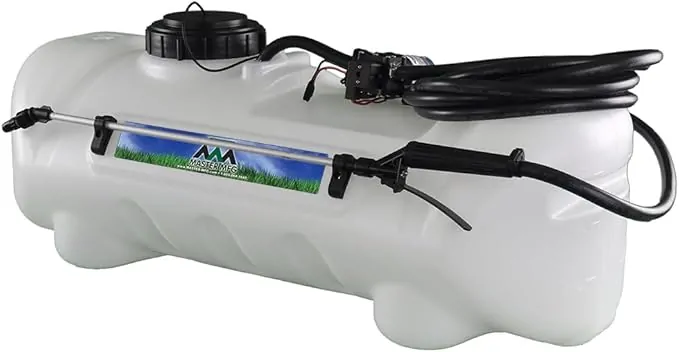 | Master Manufacturing SSN-01-015A-MM – 15-Gallon Sprayer |
| Check Price |
What Makes Garden Tank Sprayers Useful?
A garden tank sprayer is equipment that stores a liquid in a reservoir and delivers it through a pump, hose, spray wand or nozzle. Depending on its design and the liquid’s approved use, it can apply water, foliar nutrients, pesticides, fungicides and other garden treatments. Unlike an ordinary watering can, a sprayer can distribute liquid as a directed stream, fine mist or wider spray pattern.
Tank sprayers normally use either compressed air above the liquid or a pump that directly moves liquid under pressure. In a common manual compression sprayer, pumping compresses the air inside the tank, and the stored pressure pushes liquid through the nozzle. Many battery-powered backpack models instead use an electric diaphragm pump to move liquid from a largely unpressurised reservoir.
For example, a 5-litre tank contains approximately 5 kilograms of water when filled to its rated liquid capacity. A 15-litre tank holds approximately 15 kilograms of water, before accounting for the weight of the tank, pump, hose and accessories.
This difference matters considerably when carrying equipment around vegetable beds. I compared the following practical requirements before deciding which type deserved closer attention:
- Application accuracy: Directing liquid towards intended plant surfaces without unnecessary drift.
- Working capacity: Carrying enough liquid for the task without excessive weight.
- Pressure control: Maintaining an appropriate spray pattern and application rate.
- Cleaning access: Removing residues before storing equipment or changing approved treatments.
- Repairability: Replacing worn seals, filters, hoses and nozzles rather than discarding the entire sprayer.
These considerations helped me separate genuine gardening benefits from features that looked attractive but would rarely be useful. For a few pots, a small compression sprayer could be sufficient. For several vegetable beds, a larger tank could reduce refill interruptions, provided its filled weight remained manageable.
The 5 Best Garden Tank Sprayers of 2026: Easy-to-Use Options
Selecting the right garden tank sprayer can make tasks like watering, fertilizing, and pest management much simpler and more efficient. Garden tank sprayers are available in various sizes and designs, but the top models usually offer strong spraying performance, comfortable handling, and reliable durability.
1. NorthStar Spot Sprayer – 10 Gallon Capacity
The NorthStar ATV Spot Sprayer – 10-Gallon Capacity is a practical option for gardeners, property owners, and small farm operators. It works with a 12-volt power system, usually connected to an ATV or utility vehicle battery, and provides a powerful 1,1 GPM flow rate with pressure reaching up to 100 PSI.
expert start
This makes it useful for controlling weeds, managing pests, spraying fence lines, treating driveways, and other spot spraying tasks where a large boom sprayer is not required.
What Is It and Its Product Features
This product is a 10-gallon ATV-mounted spot sprayer designed with the NorthStar NSQ Series on-demand pump. The pump can deliver up to 100 PSI pressure, allowing spray coverage of around 25 feet horizontally and 14 feet vertically. It features chemical-resistant Viton valves and a Santoprene diaphragm, which are valuable components when working regularly with herbicides, pesticides, and fertilizers. These durable materials help protect the pump from chemical damage and support long-term performance while keeping pressure stable during operation.
Why It Matters
This high-pressure performance helps you spray weeds, bushes, and fence areas while maintaining a safe distance and avoiding unnecessary chemical waste. The heavy-duty polymer tank is another important advantage because it provides better resistance against cracks, leaks, and chemical corrosion compared with lower-quality plastic tanks. The included regulator and pressure gauge allow you to adjust spray strength according to different applications. The deluxe trigger spray gun with a brass adjustable nozzle gives you the flexibility to switch between cone and stream spray patterns, making it suitable for both large-area coverage and precise spraying.
My Set-Up and My Experience
The sprayer has a lightweight design at only 9.6 pounds, and the built-in handles make it simple to lift and install on my ATV. I mostly use it for smaller garden tasks where preparing 2-3 gallons of spray solution is enough. It performed reliably even during larger spraying jobs. I used it to apply 24 gallons of grass killer and later around 96 gallons without experiencing pump failure or major performance problems. The adjustable nozzle and deluxe spray gun gave excellent control when spraying weeds in small garden beds as well as larger open spaces. One minor adjustment I made was slightly tilting the tank when the remaining liquid level dropped to the final 1–1.5 gallons.
Performance
The 1.1 GPM pump provides strong and consistent flow, helping complete spraying jobs faster and more efficiently. The pressure regulator and gauge make it easier to control spray patterns, which is especially useful when treating sensitive plants or targeting specific weed areas. The chemical-resistant components help prevent corrosion and leakage when using different spraying solutions. The deluxe trigger gun improves comfort during extended use. Its compact build and 15-foot hose allow easy access around flower beds, garden corners, and narrow spaces without frequently moving the ATV.
Practical Tips
- Replace the original hose clamp with a stronger clamp for better durability
- Tilt the tank slightly when spraying the final low amount of liquid
- Clean the suction strainer regularly to maintain smooth operation
- Adjust pressure settings according to the required chemical spray rate
- Wash the system with clean water after applying chemicals
expert end
pro start
| Pros | Cons |
|---|---|
| ✔️ Large 15-gallon tank reduces the need for frequent refilling | ❌ Pump flow may not be enough for very heavy spraying tasks |
| ✔️ No manual pumping effort required | ❌ Small amount of liquid may splash around the lid during movement |
| ✔️ Provides long spray reach for garden borders and edges | ❌ Not the best choice for large-area broadcast spraying |
| ✔️ Simple mounting on mower or ATV | ❌ Some users may find the hose length limited |
| ✔️ Comfortable option for users with back problems | ❌ Basic filtration system requires regular maintenance |
pro end
2. Chapin International 97154 – 15-Gallon Translucent Tank
The Chapin 97154 15-Gallon ATV/UTV Tank Sprayer is made for users who need wider spraying coverage without the repeated effort of manual pumping. After testing different gardening and spraying equipment, this model stands out as a convenient option that saves time and reduces physical effort during bigger spraying jobs.
expert start
What Is It and Its Features
The Chapin 97154 is a battery-operated spot sprayer designed to attach to most ATVs, UTVs, and lawn tractors. It comes with a 15-gallon translucent poly tank, allowing users to easily check the remaining liquid level while working. A key feature is its 12V, 1.0 GPM diaphragm pump. Unlike traditional hand-pump sprayers, this pump maintains steady pressure up to 60 PSI, helping create a consistent spray pattern from beginning to end. This is especially useful when applying herbicides and fertilizers because uneven application can negatively affect plants. With its durable 15-gallon poly tank, 12V diaphragm pump, and ATV/UTV mounting design, this sprayer is built for demanding outdoor applications such as weed management, fertilizing, and pest control.
Why It Matters
The sprayer features a triple-stage filtration system that includes a filter basket, in-tank filter, and shut-off filter. These filters help prevent blockages, especially when spraying concentrated solutions or mixtures containing small particles. The 15-foot reinforced PVC hose provides extended reach, while the 18-inch curved poly wand makes it easier to spray around trees, fences, shrubs, and other difficult areas. Another useful feature is the 6-inch wide tank opening, which simplifies filling, mixing, and cleaning. It reduces spills and removes the need for extra tools like funnels.
My Set-Up and My Experience
During my first application, I used this sprayer for weed control along my gravel driveway and around garden beds. The 15-foot hose allowed me to cover narrow spaces without repeatedly moving the ATV. I also tested it for lawn fertilizing, and the diaphragm pump maintained steady pressure, creating an even spray across larger areas. The triple filtration system impressed me because it helped prevent nozzle blockage even when using liquid fertilizers containing fine particles. Despite its larger tank size, the sprayer remained easy to handle and comfortable during longer spraying sessions.
Performance
The Chapin 97154 delivered reliable performance during different spraying tasks. Its 1.0 GPM diaphragm pump produced a strong and stable spray stream with pressure up to 60 PSI, making it suitable for fertilizers, pest control solutions, and herbicides. The triple filtration system worked effectively to reduce clogging, even when using slightly thicker liquids. The curved 18-inch wand provided better control when spraying under bushes or along fence areas, while the 15-foot hose offered enough flexibility to move around easily without constantly repositioning the ATV.
Practical Tips (Small Bullet Points)
- Make sure the drain cap is properly tightened before adding liquid
- Avoid allowing chemicals to come into contact with ATV tires
- Keep the filtration system clean to reduce nozzle blockage
- Flush the tank and hose with clean water after chemical applications
- Use concentrated products when suitable to reduce refilling frequency and cost
expert end
pro start
| Pros | Cons |
|---|---|
| ✔️ Strong 12V diaphragm pump provides consistent spraying | ❌ Drain cap may leak if it is not properly tightened |
| ✔️ Large 15-gallon chemical-resistant tank | ❌ Boom attachment is not included as standard |
| ✔️ Long 15-foot hose provides excellent working range | ❌ Plastic fittings have a simple design |
| ✔️ Triple filtration system helps prevent clogging | ❌ Requires a battery power connection |
| ✔️ Complete wiring kit included for installation | ❌ Hand tightening may not provide enough sealing |
pro end
3. Master Manufacturing SSO-01-025D-MM – 25-Gallon Sprayer
Managing weeds, trees, and difficult areas in a garden can take a lot of time and effort. The Master Mfg 25-Gallon Deluxe UTV & ATV Spot Sprayer is built to make these spraying tasks easier and more efficient. It comes with a large 25-gallon tank, a powerful 2,2GPM Everflo 12V diaphragm pump, and an adjustable spray gun that gives gardeners better control during different applications.
expert start
The sprayer features a white, UV-resistant polyethylene tank and a brass nozzle, which improve durability and make it suitable for different jobs, including weed control and chemical spraying.
What Is It and Its Product Features
This sprayer uses a 2.2GPM Everflo 12V diaphragm pump that can deliver up to 70 PSI for reliable and consistent spraying performance. The adjustable spray gun allows users to switch between a fine mist and a strong focused stream depending on the task. It also comes with a built-in inline strainer that helps stop debris from reaching and blocking the pump. The hook-and-loop hose strap keeps the hose neat and secure, while the quick-grip handles make carrying the tank easier. This sprayer can spray up to 25 feet vertically and 30 feet horizontally, making it useful for spraying around trees, tall plants, fences, and other difficult areas. If wider coverage is needed, it can also be converted into a broadcast sprayer by adding compatible boom kits.
Why It Matters
The included 15-foot hose provides extra flexibility, while the quick-attach inline strainer protects the pump by preventing unwanted particles from entering. The hook-and-loop hose strap helps organize the hose and reduces the chances of damage during storage or transport. Quick-grip handles and the molded drain port make filling, draining, and moving the tank much easier. Because it can be mounted on ATVs, UTVs, and other vehicles, it is a practical option for large gardens, farms, and properties with multiple spraying areas. This sprayer is valuable because it saves time, lowers physical effort, and provides accurate chemical application.
My Set-Up and My Experience
For my setup, I mounted this sprayer on my UTV to handle different garden sections and small areas affected by weeds. Before using chemicals, I tested it with plain water and found that the system worked without any leaks. The 15-foot hose offered good movement, but I eventually replaced it with a longer hose to reach farther areas without moving the UTV again and again. The brass adjustable nozzle performed very well because I could quickly change the spray pattern when moving between herbicide application, watering, and other garden activities.
Performance
The sprayer maintained steady pressure throughout operation, even when working with thicker garden mixtures. The adjustable spray gun made it easy to switch between a gentle mist for young plants and a powerful stream for weeds and fence areas. Spraying around 12 gallons of herbicide in an hour was simple, and the 2.2GPM pump handled larger spraying tasks efficiently. For gardeners managing different locations or uneven ground, the combination of power and flexibility is a major benefit. The unit also continued working well during longer use periods, although checking the wiring and using proper gauge connections is important to avoid electrical overload.
Practical Tips
- Replace the 15-foot hose with a longer hose if you need to cover far-away areas.
- Use a pressure regulator when spraying sensitive plants to avoid harming seedlings or loose soil.
- Clean the inline strainer regularly after every use to prevent blockages.
- Securely mount the sprayer on your ATV/UTV for safe movement and better stability.
- Inspect pump wiring and connections during long spraying sessions to prevent electrical problems.
expert end
pro start
| Pros | Cons |
|---|---|
| ✔️ Simple installation and assembly process. | ❌ The 15-foot hose may not provide enough reach for some users. |
| ✔️ Adjustable brass nozzle supports both mist and stream spraying. | ❌ Pump wiring may require improvement for frequent heavy-duty use. |
| ✔️ Strong UV-resistant tank construction. | ❌ High spray pressure can disturb loose soil or young plants. |
| ✔️ Compatible with ATV, UTV, and other vehicles. | ❌ Requires some practice to achieve the best spraying technique. |
| ✔️ Inline strainer with quick attachment helps prevent pump clogging. | ❌ Additional broadcast sprayer upgrade kits are purchased separately. |
pro end
4. NorthStar Tow-Behind Boom Broadcast Sprayer
The NorthStar ATV Spot Sprayer is a small and easy-to-carry sprayer designed for small to medium gardening tasks. Its main advantage is the powerful NorthStar NSQ Series quick-connect on-demand pump, which produces 100 PSI for quick and effective spraying. The pump valves are made with chemical-resistant Viton, helping the pump prime faster and improving durability, while the Santoprene diaphragm provides better reliability and resistance against chemicals.
expert start
What Is It and Its Features
The sprayer includes a deluxe trigger spray gun with an adjustable stream-to-cone brass nozzle, allowing users to control the spray pattern according to their needs. It can spray up to 25 feet in distance and 14 feet in height. The included 15-foot hose provides extra reach, allowing gardeners to treat narrow spaces and difficult areas without moving the ATV repeatedly.
Why It Matters
These features are important because they provide better control during spraying, reduce chemical waste, and help the sprayer handle common garden chemicals such as herbicides and fertilizers. The extra-thick polymer tank is designed to resist cracks, leaks, and chemical damage, making the sprayer a reliable choice for long-term gardening applications.
My Setup and Experience
The sprayer weighs only 9.6 pounds, and its handles make it simple to lift and attach to my ATV. I mainly use it for smaller garden projects where preparing 2-3 gallons of spray is enough. Even with larger spraying jobs, the unit performed effectively. The deluxe spray gun and adjustable nozzle provided accurate coverage and better control. One helpful adjustment I made was slightly tilting the tank when the liquid level dropped to the final 1–1.5 gallons. This helped the pickup tube collect more of the remaining spray solution.
Performance
The NorthStar ATV Spot Sprayer performs especially well because of its strong 1.1 GPM pump, which allows fast and efficient spraying. The pressure regulator and gauge provide better control over spray output, which is useful when working around sensitive plants or applying targeted weed treatments. The chemical-resistant parts help prevent corrosion and leakage when using different spraying solutions. The deluxe trigger gun makes the sprayer comfortable to operate, even during longer work sessions. Its compact size and 15-foot hose make it easy to spray flower beds, corners, and tight garden spaces without frequently repositioning the ATV.
Practical Tips for Gardeners
- Inspect hose clamps and connections before every use to avoid leaks.
- Tilt the tank slightly when using small amounts of liquid to improve spray pickup.
- Clean the suction strainer after each spraying session to avoid clogging.
- Select the correct spray pattern for each task—use cone spray for wider coverage and stream spray for spot treatment.
- Keep the sprayer stored in a shaded location to increase the life of the tank and pump.
expert end
pro start
| Pros | Cons |
|---|---|
| ✔️ Powerful high-pressure 1.1 GPM pump. | ❌ Drain cap may develop leaks over time. |
| ✔️ Strong chemical-resistant tank construction. | ❌ Pickup tube length could be improved. |
| ✔️ Adjustable spray gun provides accurate application. | ❌ Hose clamp may leak when operating at higher pressure. |
| ✔️ Lightweight design makes transportation easier. | ❌ Does not include a detailed instruction manual. |
| ✔️ 15-foot hose provides additional spraying range. | ❌ Limited tank design when spraying very low liquid volumes. |
pro end
5. Master Manufacturing SSN-01-015A-MM – 15-Gallon Sprayer
The Master Manufacturing 15-Gallon UTV & ATV Spot Sprayer is built for gardeners, property owners, and small-scale farmers who need an easier way to apply sprays. It features a 15-gallon translucent tank and an Everflo 1,0 GPM 12-volt diaphragm pump. The sprayer can be attached to ATVs, UTVs, riding lawn mowers, or utility carts, making it a practical choice for users who want to reduce physical effort during gardening tasks.
expert start
What Is It and Its Product Features
This is a battery-operated spot sprayer designed mainly for weed management and garden spraying applications. Its 15-gallon tank size works well for medium to large garden spaces because it allows you to spray more area without stopping frequently for refills. The tank is manufactured from UV-resistant polyethylene, which protects it from sunlight damage and improves its outdoor durability.
Why It Matters
The main component of this sprayer is the Everflo 1.0 GPM 12V diaphragm pump, which automatically controls operation according to pressure levels. Because of this feature, users do not need to pump manually. When the spray gun trigger is pressed, the pump starts and provides a continuous flow. When the trigger is released, the pump stops automatically. The adjustable spray gun gives flexibility by allowing users to change between a fine mist and a stronger spray stream. This is useful because gentle misting is suitable for sensitive plants, while a stronger stream helps target weeds near fences, pathways, and difficult areas.
My Set-Up and My Experience
I installed the tank firmly on my riding mower with a simple wooden platform and ratchet straps. The mounting remained secure and the sprayer stayed stable while moving. Connecting the 12V wire harness to the mower battery was straightforward because the included alligator clips made the process simple. During operation, I was able to spray large garden beds, fence borders, and weed-affected areas without frequent breaks for refilling. Cleaning the unit was also convenient because the molded drain port allows the remaining liquid to be removed completely after use.
Performance
The performance of this sprayer is dependable for regular gardening applications. The 1.0 GPM pump produces enough pressure for controlling weeds and spraying garden boundaries. It provides a smooth spray pattern with consistent pressure and does not create unnecessary pulsing. The automatic pressure control reduces effort and makes longer spraying jobs easier. The adjustable nozzle helped control spray direction and reduce unwanted overspray around plants, which is especially important when applying herbicides near garden beds. For most home gardeners, this performance level is suitable for everyday needs.
Practical Gardening Tips
- Use a fine mist setting around flowers and vegetables to reduce chemical drift
- Fasten the tank properly to prevent liquid movement while transporting
- Wash the hose and spray gun after each gardening application
- Install a filter or strainer to protect the pump from debris damage
- Avoid filling the tank completely; keep some empty space to minimize liquid movement
expert end
pro start
| Pros | Cons |
|---|---|
| ✔️ 15-gallon tank capacity means fewer refills | ❌ Pump output may not be enough for intensive spraying tasks |
| ✔️ Automatic operation eliminates manual pumping | ❌ Some liquid movement may occur around the lid during transportation |
| ✔️ Provides good spray reach for garden borders | ❌ Not designed for large-area broadcast spraying |
| ✔️ Simple installation on ATV, UTV, or mower | ❌ Hose length may be limited for certain setups |
| ✔️ Reduces physical stress for users with mobility or back issues | ❌ Basic filtration requires regular maintenance |
pro end
Which Garden Tank Sprayer Type Fits?
The first important buying decision was choosing the operating style. Tank sprayers differ in capacity, pressure generation, portability and workload. A handheld model and a wheeled battery-powered unit may both deliver liquid through a nozzle, but they solve very different problems.
Comparing Manual and Powered Tank Sprayers
Small handheld compression sprayers commonly serve short spraying sessions involving pots, nursery plants and limited flower beds. Their compact tanks are convenient, but their smaller liquid capacity means more frequent refilling. They are useful where careful positioning matters more than covering a large area.
Larger manual pump tank sprayers can be suitable for regular vegetable and flower maintenance. They avoid battery charging and usually have relatively simple mechanisms. However, the operator must restore pressure periodically, which can interrupt spraying and change the output unless the system includes effective pressure regulation.
Battery-powered tank sprayers reduce repeated manual pumping. Many use electric pumps that maintain flow while the trigger is operated. Their disadvantages include additional weight, charging requirements, battery replacement costs and more electrical components that may need protection from moisture.
Backpack tank sprayers distribute the carried load through shoulder straps and, on some models, a waist belt. They can be useful for larger vegetable plots and extended work, although the combined weight of liquid and equipment can become tiring. Backpack models may use either manual or powered pumping systems.
Wheeled tank sprayers transfer much of the liquid weight to wheels. They can be practical for lawns, level pathways and larger gardens, but narrow beds, stairs, soft ground and uneven surfaces can limit their usefulness.
| Sprayer Type | Typical Capacity Range | Suitable Work | Main Trade-Off |
|---|---|---|---|
| Handheld compression | 1–3 L | Pots and small flower beds | Frequent refilling |
| Manual shoulder tank | 3–8 L | Vegetables and mixed beds | Manual pressurisation |
| Battery-powered tank | Varies by design | Repeated garden spraying | Battery and pump maintenance |
| Backpack tank | 12–20 L | Larger plots and longer sessions | Carried weight |
| Wheeled tank | 15–60 L or more | Lawns and accessible large areas | Restricted movement |
These are broad shopping ranges rather than standard capacities or specifications for every product. Actual tank size, maximum fill volume and approved applications vary by manufacturer.
For someone maintaining a small courtyard, I recommend starting with a compact manual sprayer rather than purchasing a heavy backpack model. For several vegetable beds requiring frequent treatments, a larger manual or battery-powered unit deserves attention. Where carrying weight is the main difficulty and pathways are suitable, a wheeled tank may be the better choice.
How Garden Tank Sprayers Actually Work
Understanding the working mechanism helped me judge whether a sprayer could provide consistent output. Every tank sprayer needs a way to store liquid, generate pressure, control flow and direct the spray. However, the pressure system determines how these functions interact.
In a manual compression sprayer, I considered how pumping increases the pressure of the trapped air above the liquid. Opening the trigger allows this pressure to push liquid through the pickup tube, hose and nozzle. As the liquid leaves, pressure generally falls, and pumping becomes necessary again.
In a powered sprayer, an electric motor drives a pump. Depending on the design, pressure switches, bypass systems or regulators control the pump’s operation. A stated maximum pressure is not necessarily the pressure maintained at the nozzle during spraying.
For instance, a product may advertise 60 PSI maximum pressure, approximately 4.1 bar, but its actual working pressure depends on the pump, regulator, hose losses, nozzle and flow demand. I therefore treated maximum pressure as one specification rather than proof of better spraying performance. The following components deserve attention when comparing working systems:
- Pump: Produces the pressure or liquid flow required for spraying.
- Pressure regulator: Helps control working pressure where fitted.
- Hose and wand: Carry and direct liquid towards the target.
- Trigger valve: Starts and stops spraying and should close reliably.
- Nozzle: Determines the spray pattern, droplet characteristics and flow rate at a given pressure.
- Filter: Reduces the chance of particles reaching sensitive pump components or blocking nozzles.
A useful way to compare nozzles is through their flow rate. If a nozzle delivers 0.5 litres per minute at a specified pressure, a 10-litre tank could theoretically provide 20 minutes of continuous spraying. Actual operating time may differ because of pressure changes, trigger interruptions, residual liquid and usable tank volume.
For vegetable beds, I placed greater importance on controlled output than extreme pressure. Excessive pressure can produce smaller droplets with greater drift potential, depending on nozzle design. A suitable low-drift nozzle operated within its recommended pressure range may give better control than a high-pressure setting.
Choosing Tank Capacity Without Excess Weight
Tank capacity looked straightforward until I considered how much liquid I actually needed. A larger reservoir reduces refill frequency, but it also increases weight, takes more storage space and may encourage mixing more treatment solution than necessary.
I began with the intended spraying area rather than choosing a tank by appearance. A practical selection method is to estimate how much liquid the garden requires through a clean-water calibration, then select a capacity that balances refill frequency and handling.
Consider a calibration scenario where a vegetable area requires 8 litres of spray mixture at the selected application rate. A 4-litre tank would require two full loads, whereas a 12-litre tank could complete the work in one load. However, filling the larger tank with only the required 8 litres may be more comfortable than carrying its full capacity.
Water weighs approximately 1 kilogram per litre under ordinary gardening conditions. Therefore, a 16-litre fill adds approximately 16 kilograms before including equipment weight. If the empty sprayer weighs 4 kilograms, the combined load approaches 20 kilograms. My capacity-selection priorities were:
- 1–3 litres: Small, short-duration spraying jobs.
- 4–8 litres: Mixed vegetable and flower beds with moderate liquid demand.
- 12–16 litres: Larger areas where carrying comfort and workload justify the capacity.
- 20 litres or more: Higher-volume applications where transport, stability and equipment design are suitable.
These ranges are decision guides, not fixed rules. The actual volume needed depends on nozzle output, travel speed, plant canopy, target coverage and the product label.
For young tomatoes and chilies, I favoured selecting a manageable fill volume and refilling when necessary rather than carrying unnecessary liquid. For larger lawn areas, higher capacity became more attractive, especially where a wheeled sprayer could reduce physical strain.
Inspecting Tank Materials and Component Durability
Once I understood the appropriate capacity, I turned towards construction quality. A sprayer may perform well when new but become frustrating if its seals leak, hose stiffens, trigger sticks or replacement parts are unavailable.
High-density polyethylene tanks are common because they are relatively light and resist many chemicals. However, compatibility depends on the exact formulation, temperature, concentration and exposure time. Plastic quality, wall thickness, moulding consistency and protection against sunlight also influence service life.
Stainless-steel tanks can provide good mechanical strength and corrosion resistance, but they are not automatically suitable for every chemical. Stainless-steel grade, weld quality and exposure to chloride-containing substances matter. Metal tanks also add weight and may require more careful inspection of fittings and joints.
Checking Pumps, Seals and Spray Components
The pump deserves particular attention because it is central to sprayer performance. In a manual unit, I looked for a smooth pumping mechanism, accessible service parts and a reliable pressure-release system. For battery-powered equipment, I compared the stated duty cycle, operating pressure, electrical protection and availability of replacement pumps.
Seals are equally important. Manufacturers may use materials such as EPDM, nitrile rubber or FKM, sometimes sold under the Viton trademark. Each material has different resistance characteristics. No single seal material is universally compatible with all garden chemicals, so I would check the manufacturer’s compatibility information for the intended formulation.
I also considered the hose, wand, trigger and filters together. A durable tank provides little benefit if a weak hose connection leaks or a poorly designed filter is difficult to remove. Important inspection points included:
- Tank body: No visible cracks, poor seams or damaged threaded openings.
- Cap and gasket: Secure fitting without damaged or displaced seals.
- Pump assembly: Accessible components and smooth operation.
- Hose: Suitable chemical resistance, flexibility and secure connections.
- Wand: Adequate stiffness, reach and compatible fittings.
- Trigger: Reliable shutoff without dripping.
- Filters: Removable elements that can be inspected and cleaned.
Before buying, I could inspect construction and ask about replacement components, but these checks could not establish long-term durability. That required extended ownership, correct maintenance and repeated use over different conditions.
For a sprayer intended for frequent vegetable treatments, I recommend prioritising replaceable seals, hoses and nozzles over decorative features. A moderately priced, serviceable sprayer can provide better ownership value than an expensive model with proprietary parts that are difficult to obtain.
Finding Suitable Nozzles and Spray Patterns
Nozzle selection was one of the most important parts of my buying comparison because the same tank and pump can behave very differently with different nozzles.
A flat-fan nozzle produces a sheet-shaped spray commonly suited to uniform coverage along a defined swath. A cone nozzle can be useful for some plant canopy applications, depending on the treatment label and desired coverage. An adjustable nozzle may change from a narrow stream to a broader spray, but that does not guarantee consistent droplet size or application rate at every setting.
For example, I considered foliar treatment on tomato plants, where reaching appropriate leaf surfaces matters. A suitable nozzle, directed carefully around the canopy, could improve placement. However, simply increasing pressure would not guarantee better underside coverage and could increase drift or runoff.
For a lawn application, uniformity across the intended area mattered more than producing a very fine mist. I therefore looked for a nozzle with published flow information and a spray pattern appropriate for the treatment. When comparing nozzles, I focused on:
- Flow rate: Litres per minute at a stated pressure.
- Spray angle: Width and distribution of the spray pattern.
- Droplet characteristics: Drift potential and target coverage.
- Material: Wear resistance and chemical compatibility.
- Replacement availability: Ability to maintain consistent performance.
Brass nozzles can be durable in appropriate applications, while suitable polymer nozzles may resist certain chemicals and reduce weight. Stainless-steel and ceramic components are also used where wear resistance is important. Material alone does not establish nozzle quality.
For general garden work, I recommend a sprayer that accepts suitable replacement nozzles rather than relying entirely on one permanently fitted adjustable tip.
Matching Sprayers With Garden Chemicals
Chemical compatibility required more care than comparing pressure or tank capacity. Garden sprayers may handle different approved liquid formulations, but the fact that a substance can physically pass through the nozzle does not mean it is safe for the equipment or appropriate for the crop.
For foliar feeding on chilies and tomatoes, I considered whether the sprayer could handle the selected water-soluble fertiliser according to its instructions. For pest management, I looked at the pesticide label, approved application equipment, required droplet characteristics and cleaning requirements.
Some formulations contain solvents, oils or other ingredients that can affect seals, hoses or plastic components. Others may contain suspended particles that increase filtration requirements or nozzle wear.
Neem-based products, soluble fertilisers, insecticides and fungicides should not automatically be treated as interchangeable liquids. Their formulations and equipment requirements can differ substantially. My compatibility checks covered:
- Product label: Approved crop, treatment, application method and rate.
- Tank material: Manufacturer-confirmed compatibility with the complete formulation.
- Seals and hoses: Resistance to the intended mixture.
- Filters and nozzles: Suitability for the formulation and application.
- Cleaning: Label-approved procedures that prevent contamination between uses.
I would not use the same sprayer for herbicides and sensitive vegetable or flower treatments without a verified decontamination procedure. Where contamination risks are significant, dedicated equipment is the safer practical choice.
Likewise, I would not assume that a sprayer approved for ordinary garden pesticides is suitable for strong acids, concentrated solvents, flammable liquids or corrosive cleaning chemicals. Those applications require equipment specifically rated for them.
Testing Spray Performance After Purchase
Once a suitable model had been selected and purchased, the next stage was checking its condition and calibrating it with clean water. This provided a safer way to identify mechanical problems and understand output before introducing any approved treatment mixture.
I started by checking the tank, hose connections, cap, pump and trigger against the supplied instructions. After filling with clean water within the manufacturer’s limits, I checked for leaks and observed whether the nozzle produced a stable pattern at the intended operating pressure.
A useful practice scenario involved collecting nozzle output for one minute. If the collected volume was 600 millilitres, the calculated flow rate was 0.6 litres per minute. Repeating the collection at the same pressure could reveal whether the output was reasonably consistent.
However, flow rate alone does not establish the correct application rate. I also needed to consider travel speed, spray width and the area being treated.
Calibrating Output for Vegetable Beds
For a measured garden bed, I could spray clean water using the intended walking speed and nozzle position, then measure how much liquid was consumed. If a 20-square-metre practice area used 0.8 litres, the calculated application volume would be:
0.8 ÷ 20 × 100 = 4 litres per 100 square metres, equivalent to 400 litres per hectare.
This figure describes the water volume in that particular scenario, not a recommended pesticide application rate. The correct volume must be consistent with the relevant treatment label and crop requirements.
For young vegetable plants, the objective was controlled coverage without excessive dripping. For denser foliage, nozzle position and canopy penetration needed additional attention. A pressure increase alone could not compensate for unsuitable technique. My initial clean-water checks included:
- Measuring nozzle output over a fixed time.
- Checking the spray pattern at the intended pressure.
- Observing leakage at the trigger and connections.
- Recording liquid consumption over a measured area.
- Checking handling comfort with the intended fill volume.
For example, a 15-minute clean-water session could reveal awkward wand handling, pressure fluctuations or inconvenient controls. It could not establish long-term pump reliability or seal durability.
After calibration, any crop-specific treatment would still require confirmation of the product label, suitable weather conditions, protective equipment and the correct application rate.
Handling Sprayers Safely Around Plants
Safe spraying involves much more than wearing gloves. I considered the treatment, weather, surrounding plants, nearby people, water sources and equipment condition before beginning work.
When working near marigolds, tomatoes or young fruit trees, I needed to avoid unnecessary contact with neighbouring plants. This was particularly important where the applied product could damage non-target vegetation.
Wind speed, nozzle selection, operating pressure and spray height all influence drift. A commonly used precaution is to avoid spraying in unsuitable windy or gusty conditions, but there is no universal wind-speed threshold suitable for every product. The label and local requirements take priority.
For pesticide applications, personal protective equipment must follow the product label. Depending on the formulation, this may include chemical-resistant gloves, eye protection, protective clothing, footwear or respiratory protection. Before spraying, I would confirm:
- Weather: Wind, rainfall forecast, temperature and conditions affecting drift.
- People and animals: Required exclusion and re-entry precautions.
- Nearby crops: Risk of off-target application or chemical injury.
- Water sources: Protection of drains, ponds and irrigation supplies.
- Equipment: Leak-free connections, functioning shutoff and correct pressure.
- Product label: Approved application, PPE, restrictions and disposal instructions.
When a tank was pressurised, I would release pressure according to the manufacturer’s instructions before opening it. Removing a cap from a pressurised compression sprayer can release liquid unexpectedly.
I also avoided directing spray towards electrical equipment, people or animals. Where spraying near flowers visited by pollinators, I considered the product’s pollinator precautions and avoided applications that conflicted with label restrictions.
For lawns, I paid particular attention to drift towards flower borders. For vegetable crops, I considered harvest intervals, crop approval and treatment restrictions. A good sprayer helps control placement, but it cannot make an unsuitable chemical application safe.
Maintaining Tanks, Pumps and Seals Properly
Maintenance was another factor that influenced my buying decision. A sprayer with accessible filters, replaceable seals and straightforward cleaning procedures was easier to justify than one requiring complicated disassembly for ordinary servicing.
After use, I followed the applicable product label and sprayer instructions for handling remaining mixture and cleaning equipment. I did not assume that repeated water rinsing alone was adequate for every chemical. Some formulations require a specific cleaning procedure, while others have restrictions on cleaning agents.
Filters and nozzles need careful attention because small particles can change spray output. A partially blocked nozzle may produce an uneven pattern, while a worn nozzle can deliver more liquid than intended.
For instance, if a nozzle originally delivered 0.5 litres per minute but later delivered 0.6 litres per minute under the same test conditions, its output would have increased by 20%. That difference could affect calibration and treatment quantity. I considered the following maintenance tasks essential:
- Tank: Clean according to instructions and inspect for damage.
- Filters: Remove trapped material and check for tears.
- Nozzles: Inspect spray patterns and replace worn components.
- Hoses: Check for cracking, swelling and damaged connections.
- Seals: Inspect for leakage, hardening or deformation.
- Battery: Charge and store according to the manufacturer’s guidance.
For storage, I preferred a dry, protected location away from direct sunlight, extreme temperatures, children and animals. A powered sprayer also needed appropriate battery care. Lithium-ion batteries should not be charged with incompatible chargers or stored under conditions prohibited by the manufacturer.
A short cleaning session could reveal visible damage or blockage, but it could not establish corrosion resistance over several seasons. Long-term durability depends on chemical exposure, maintenance, storage conditions, operating pressure and component quality.
Where Should You Buy Tank Sprayers?
After comparing technical features, I considered where to purchase the equipment. The best buying channel depended on whether I needed physical inspection, technical support, convenient returns or access to genuine replacement parts.
Local garden suppliers can be useful for examining tank size, carrying arrangements, pump operation and wand handling. I could check whether the cap fitted securely, whether the trigger felt comfortable and whether the seller stocked replacement seals or nozzles.
Equipment shops may offer a wider range of manual and powered sprayers, particularly for larger gardens. However, I would confirm that the exact model was intended for garden applications rather than assuming that all pressure-spraying equipment was interchangeable.
Manufacturer websites and authorised sellers can help establish exact model specifications, warranty terms and genuine package contents. Reputable online retailers can also be convenient, provided the seller’s identity, return conditions and delivery charges are clear.
| Buying Check | In-Store Purchase | Online Purchase |
|---|---|---|
| Exact model | Inspect model label | Match model number and listing |
| Tank and fittings | Examine physically | Review official specifications |
| Pump demonstration | Request a permitted demonstration | Check operating documentation |
| Accessories | Confirm package contents | Check included-item list |
| Warranty | Request written terms | Confirm regional coverage |
| Returns | Confirm shop policy | Review return eligibility and costs |
| Spare parts | Ask about local stock | Confirm compatible part numbers |
Before paying, I would calculate the total delivered cost rather than comparing the advertised equipment price alone. Delivery charges, batteries, chargers, replacement nozzles and future maintenance can change the value of a purchase.
For example, a lower-priced sprayer that requires an expensive proprietary battery may cost more over several years than a slightly higher-priced model with readily available service parts. Without verified prices and expected service life, I would treat that as a buying consideration rather than a guaranteed saving.
After delivery, I would compare the received model and accessories with the order, inspect for shipping damage, retain proof of purchase and complete the manufacturer’s recommended initial checks before use.
Understanding the Real Cost of Ownership
Purchase price was only one part of the decision. I also considered how much time the sprayer might save, whether it required charging, how frequently consumable parts could need replacement and whether repairs were economical.
A manual tank sprayer generally avoids battery replacement costs but requires physical pumping. A powered sprayer may reduce pumping effort while adding electrical components and charging requirements. Neither design is automatically cheaper or more reliable throughout its service life.
For a simple ownership calculation, suppose one sprayer costs 50 currency units and requires 10 units in replacement parts over three years. Its direct equipment expenditure would be 60 units, excluding labour and operating supplies. A second sprayer costing 70 units with no replacements during the same period would have a higher direct expenditure, even if it required less maintenance time. That calculation does not establish which model performs better. I would also consider:
- Operating effort: Pumping, carrying and refilling time.
- Replacement parts: Availability and expected cost.
- Battery ownership: Charger compatibility and eventual replacement.
- Maintenance time: Cleaning, inspection and servicing.
- Service support: Warranty coverage and repair options.
For occasional spraying, a simple manual model often deserves serious consideration because the workload may not justify powered equipment. For frequent garden maintenance, reducing repeated pumping can become more valuable, provided the powered system is suitable for the intended liquids and is properly supported.
Choosing the Best Garden Tank Sprayer
My final buying decision came back to the original problem: I wanted reliable spraying without unnecessary physical effort, inconsistent coverage or complicated maintenance. Comparing different designs showed me that tank size and maximum pressure were not enough to identify the best equipment.
For larger plots and reachable young fruit trees, I recommend considering a backpack or wheeled sprayer according to terrain, liquid demand and carrying comfort. However, spray reach should never be confused with safe or effective coverage. A powerful stream may reach a branch without delivering the required distribution across its leaves.
For anyone preparing to buy, my strongest recommendation is to start with the plants, spraying workload and approved treatments, then select the tank sprayer that meets those requirements. Once the equipment arrives, calibrate it with clean water, learn its operating limits and maintain it according to the manufacturer’s instructions. That approach gives a stronger foundation for choosing a useful sprayer than relying on price, appearance or advertising claims alone.
Frequently Asked Questions (FAQs)
1. Are these garden sprayers suitable for organic gardening practices?
Yes, these garden sprayers are suitable for organic gardening practices. Their design and materials allow them to be used with organic solutions. However, always clean the sprayer properly between different applications to prevent cross-contamination between different substances.
2. Can these sprayers handle different types of liquids?
Yes, these sprayers can be used with different types of liquids, including concentrated solutions. Always follow the manufacturer’s instructions and clean the equipment properly after each use to maintain its performance. It is also recommended to flush the sprayer system with clean water after applying concentrated solutions to remove leftover residues and prevent buildup.

