
7 Best 2-Gallon Garden Sprayers in 2026 (Expert Picks & Buying Guide)
- A 2-gallon garden sprayer offers the perfect balance of capacity, control, and convenience for everyday gardening tasks.
- With better design, accurate spraying, and durable materials, modern sprayers make plant care easier and more efficient.
- Choosing the right sprayer helps gardeners save time, reduce waste, and achieve healthier plant growth.


When I started comparing garden sprayers for my vegetables, flowers and young fruit trees, I realised that choosing the right tank capacity was just as important as choosing a reliable pump or nozzle. My smaller sprayer was convenient for a few plants, but frequent refilling interrupted larger jobs. On the other hand, carrying a large sprayer for a short treatment around my tomato beds or marigolds seemed unnecessary. This was why I became interested in finding the best 2-gallon garden sprayer for everyday gardening.
A 2-gallon garden sprayer holds approximately 7.57 litres of liquid when its stated capacity refers to US gallons. This gives a useful middle ground between small handheld bottles and larger garden sprayers. However, I soon understood that capacity alone could not tell me whether a sprayer would be comfortable, durable or suitable for the products I planned to apply.
I looked closely at the tank construction, pump mechanism, nozzle adjustment, seals, pressure control and ease of cleaning. I also considered how the sprayer would perform when working between closely planted vegetables, flower borders, lawn edges and reachable branches of young fruit trees. These details helped me separate attractive product descriptions from features that genuinely mattered in my garden.
| Product | Title | Features | Explore |
|---|---|---|---|
 | VIVOSUN Pump Pressure 2-Gallon Garden Sprayer |
| Check Price |
 | Chapin 20002 2-Gallon Lawn and Garden Pump Pressured Sprayer |
| Check Price |
 | Flo-Master 24102 by Hudson 2 Gallon Lawn & Garden Sprayer |
| Check Price |
 | Scotts 190567 Lithium-Ion Battery Powered 2-Gallon Sprayer |
| Check Price |
 | VAXMAY Battery Powered Sprayer 2 Gallon |
| Check Price |
 | PetraTools HD2000 2-Gallon Battery Powered Sprayer |
| Check Price |
 | Deck the Home Deck & Home 190399 Universal 2-Gallon Sprayer |
| Check Price |
Why Choose a 2-Gallon Garden Sprayer?
My first consideration was the amount of spraying I normally completed in one session. A small 1-gallon sprayer could handle a few pots or a limited flower bed, but its capacity became restrictive when several vegetable rows needed attention. Meanwhile, a 4-gallon sprayer carried more liquid than I needed for many small treatments and became heavier when filled.
A 2-gallon sprayer appeared to offer a practical compromise. The liquid alone weighs approximately 7.57 kg when filled with water, excluding the tank, pump, hose and accessories. This meant I had to consider the complete working weight rather than assuming a compact-looking sprayer would always be lightweight.
For example, a sprayer weighing 1.5 kg when empty would weigh approximately 9.1 kg after adding 7.57 litres of water. That calculation helped me understand why shoulder straps, handles and carrying positions deserved attention even on smaller garden sprayers.
I also realised that a 2-gallon tank does not mean every spraying job requires a full tank. For a small section of chilies or a few rose bushes, I could prepare only the amount needed, provided the pump operated correctly at that fill level and the chemical label permitted the application.
- Small vegetable gardens: Useful for treating selected rows without carrying excessive liquid.
- Flower beds: Suitable for controlled applications around marigolds, petunias and other ornamentals.
- Young fruit trees: Practical for reachable foliage when the nozzle and wand provide adequate coverage.
- Small lawn areas: Useful for spot treatments rather than extensive broadcast spraying.
- Frequent garden maintenance: Offers a manageable capacity for repeated small tasks.
However, I would not select a 2-gallon sprayer simply because it appeared easier to carry. If the job required several full tanks, a larger sprayer might reduce refill interruptions. Equally, someone spraying only a handful of indoor plants might find a smaller model more convenient.
7 Best 2-Gallon Garden Sprayers in 2026: Powerful & Affordable Picks
In 2026, gardeners have access to a wide range of 2-gallon garden sprayers with different designs and features. Each model is developed to improve spraying efficiency, reduce effort, and make regular garden maintenance more convenient.
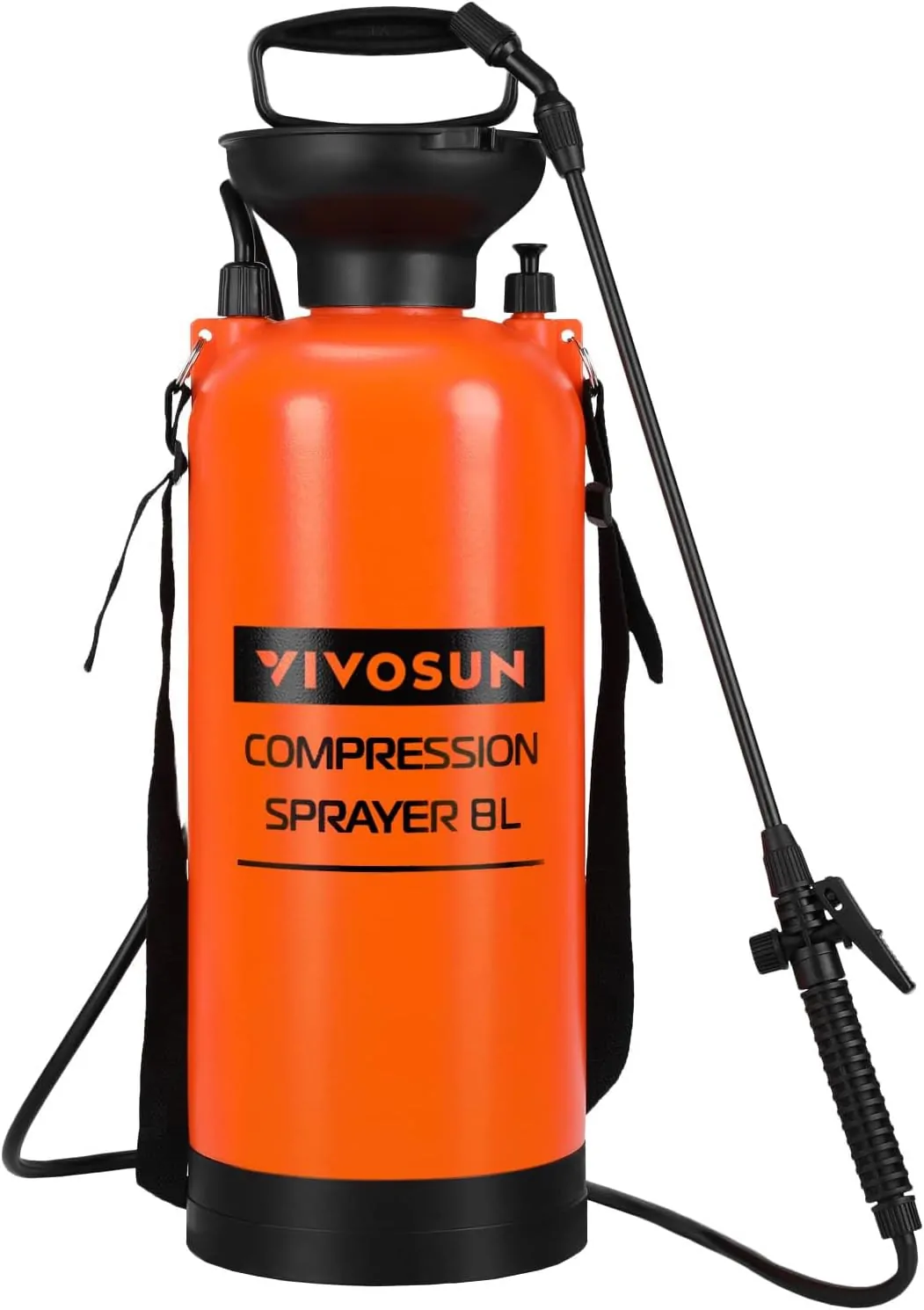
1. VIVOSUN Pump Pressure 2-Gallon Garden Sprayer
The VIVOSUN Pump Sprayer 2 Gallon is a pressurized lawn and garden sprayer made for regular plant care, garden watering, and basic household cleaning tasks. Its bright orange polyethylene tank, adjustable nozzle, extended spray wand, and safety pressure valve make it a practical choice for gardeners who need reliable spraying performance while caring for multiple plants. This manual compression pump sprayer comes with a 2-gallon tank capacity, making it suitable for medium to large gardens, outdoor plants, and people who manage a large collection of houseplants.
expert start
What Is It and Its Product Features
The adjustable nozzle is one of the main features of this sprayer because it allows users to change the spray pattern according to their needs. You can switch between a concentrated water stream and a wider shower-style spray. The built-in pressure relief valve helps remove extra pressure before opening the tank, which improves safety and prevents sudden spray release. The locking trigger handle is another useful feature because it keeps the spray running without continuous hand pressure, helping reduce tiredness during longer spraying sessions.
Why It Matters
This feature is important because every plant requires different spraying conditions. Soft leaves and delicate plants may need a gentle mist, while soil watering and cleaning jobs often require stronger water flow. The 22.28-inch long wand combined with the 50-inch hose provides better reach, allowing you to spray hanging plants, difficult corners, and taller plants without excessive bending or stretching. Safety features also make daily use more convenient.
My Set-Up and My Experience
I mostly use this sprayer for caring for more than 100 houseplants, outdoor container plants, and occasional patio cleaning. After pumping the handle, the tank builds pressure quickly, and I can spray continuously for several minutes before pumping again. During my use, the sprayer maintained pressure effectively and delivered balanced spray coverage. Sometimes air may leak if the top is not tightened properly, but after securing it correctly, the sprayer works smoothly and consistently.
Performance
In terms of performance, this sprayer works very well for gardening tasks and light cleaning purposes. The spray output remains stable, and the adjustable nozzle changes easily between mist and stream settings. The locking trigger becomes especially helpful during long watering periods because it allows continuous spraying without constant squeezing. The reinforced bottom design improves stability, but users should avoid applying excessive pressure to protect the tank structure. For everyday gardening, plant maintenance, pet washing, and simple cleaning jobs, this sprayer provides efficient and dependable performance.
Practical Tips
- Make sure the top lid is tightly closed before building pressure
- Avoid adding unnecessary pressure inside the tank
- Use the safety valve to release pressure after finishing work
- Wash the nozzle and hose after using chemicals
- Keep the sprayer empty and without pressure during storage
expert end
pro start
| Pros | Cons |
|---|---|
| ✔️ Provides strong and consistent spray pressure | ❌ Bottom seam may develop leakage after extended use |
| ✔️ Adjustable nozzle supports multiple spray patterns | ❌ Does not include a pressure gauge for pressure checking |
| ✔️ Long wand and hose improve spraying distance | ❌ Requires careful tightening of the top lid |
| ✔️ Includes a comfortable shoulder strap for easy carrying | ❌ Not designed for extremely high-pressure spraying tasks |
| ✔️ Transparent tank with measurement marks for easy filling | ❌ Replacement components may be difficult to find |
pro end
2. Chapin 20002 2-Gallon Lawn and Garden Pump Pressured Sprayer
The Chapin 20005 is a manual pump-pressure sprayer that comes with a 2-gallon polypropylene tank. The translucent tank makes it easier to monitor the remaining liquid level while working, so you know when to refill and avoid adding too much solution. Its wide funnel-top opening allows smooth filling with less mess, which is helpful when using fertilizers, vinegar mixtures, or pest control solutions.
expert start
What is it and its features
The Chapin 20005 Pump Sprayer is a 2-gallon manual garden sprayer built for regular lawn and garden activities such as fertilizing, weed management, pest control, and general plant care. A key feature of this sprayer is the SureSpray in-tank anti-clog filter. During normal gardening work, small particles like soil, plant debris, or fertilizer granules can mix into the liquid. The filter helps block these particles from reaching the nozzle, preventing clogging and maintaining a smooth spray pattern.
Why it matters
The adjustable cone nozzle allows users to easily change the spray pattern according to the task. You can select a fine mist for delicate plants or a stronger spray for areas that need more coverage. The 34-inch hose provides enough reach for most ground plants and small bushes. With a maximum pressure of 60 PSI, this sprayer offers sufficient power for common household gardening jobs.
My Set-Up and My Experience
Setting up the sprayer was simple, and the pump handle worked smoothly without requiring much effort. The ergonomic pump handle helped reduce hand stress, especially during longer spraying sessions. I used this sprayer for weed control with diluted vinegar, applying fertilizer, and watering different garden plants. The tank provided a secure seal, and after building pressure, it maintained pressure effectively even when left unused for a day or two.
Performance
During practical use, the Chapin 20005 provided steady and consistent spray performance. The SureSpray anti-clog filter was especially useful when working with solutions that contained small particles. The adjustable nozzle changed easily between mist and stream settings without needing extra tools or removing parts. The hose length works well for normal garden tasks, although a longer spray wand would improve access to plants located deeper in garden beds.
Practical Tips
- Clean the tank after using fertilizers or vinegar-based solutions
- Build full pressure before spraying to get an even spray output
- Use the mist setting when applying solutions to young plants and seedlings
- Clean the SureSpray filter regularly to maintain proper liquid flow
- Keep the sprayer empty during storage to protect the seals
expert end
pro start
| Pros | Cons |
|---|---|
| ✔️ Lightweight design makes it easy to carry | ❌ Spray wand length could be improved |
| ✔️ Translucent tank allows quick checking of liquid level | ❌ Shoulder strap is not included |
| ✔️ SureSpray anti-clog filter helps prevent nozzle blockage | ❌ Manual pumping can become tiring during extended use |
| ✔️ Adjustable nozzle supports different spray patterns | ❌ Not designed for very large lawn areas |
| ✔️ Maintains pressure well with minimal leakage | ❌ Comes with limited additional accessories |
pro end
3. Flo-Master 24102 by Hudson 2 Gallon Lawn & Garden Sprayer
The Flo-Master by Hudson 2 Gallon Lawn & Garden Sprayer is a lightweight manual pump sprayer designed for regular lawn and garden maintenance. It features a 2-gallon translucent tank, adjustable spray nozzle, and thumb-operated control valve, making it a suitable choice for home gardeners who need a simple and affordable spraying solution. After testing different garden sprayers, I found this model useful for light to medium spraying tasks without requiring a large investment.
expert start
What Is It and Its Features
This is a handheld manual pump sprayer mainly constructed from plastic and polypropylene (PP). The 2-gallon tank capacity provides a good balance because it stores enough liquid for flower beds, small gardens, shrubs, and fruit trees while remaining easy to carry. The translucent tank is a practical feature because it allows you to check the liquid level during filling and spraying, helping prevent overfilling or unexpected emptying.
Why It Matters
The funnel-shaped top opening makes filling the tank easier and helps reduce spills. The 34-inch anti-kink hose provides better movement while spraying and reduces problems caused by twisting or bending. The 12-inch poly spray wand allows more accurate application around plants. The adjustable poly cone nozzle lets you switch between a stronger stream and a fine mist, which is useful when moving between tasks like watering seedlings, applying fertilizers, or spraying insecticides. For gardeners who regularly use a sprayer, this flexibility improves the overall experience.
My Set-Up and My Experience
The complete setup process was simple, and all parts, including the tank, hose, spray wand, nozzle, and shutoff valve, connected easily without needing tools. The components fit properly, and the overall quality felt suitable for its price range. I used this sprayer for watering newly planted seeds, applying insecticide to fruit trees, and spraying homemade garlic water for pest protection. The pump handle felt strong, and only a few pumps were needed to build pressure. The built-in clip for attaching the spray wand to the pump handle was also convenient for carrying and storage.
Performance
In everyday garden use, the sprayer performs well for small and medium spraying tasks. The pump creates pressure smoothly with only a few strokes, and the tank maintains pressure effectively during short working sessions. The thumb lock feature makes continuous spraying easier by reducing the need to constantly press the trigger. The adjustable nozzle performs reliably, with the mist setting working well for seedlings and delicate plants, while the stream setting helps clear minor nozzle blockages.
Practical Tips
- Wash the tank, hose, and nozzle with clean water after every use
- Fill the tank slowly through the funnel top to avoid chemical splashes
- Use the stream setting for a short time if the nozzle becomes partially blocked
- Apply a small amount of petroleum jelly to hose connections if air leakage appears
- Avoid filling the tank completely to keep handling comfortable
expert end
pro start
| Pros | Cons |
|---|---|
| ✔️ Lightweight design makes carrying easier | ❌ Hose length may feel short for some users |
| ✔️ Translucent tank makes liquid level easy to monitor | ❌ Does not include a built-in pressure relief valve |
| ✔️ Adjustable nozzle supports both mist and stream spraying | ❌ Plastic construction is not designed for heavy-duty use |
| ✔️ Thumb lock trigger improves comfort during spraying | ❌ Small air leaks can develop around hose connections |
| ✔️ Affordable and offers good value for home gardeners | ❌ Not suitable for large-scale garden spraying |
pro end
4. Scotts 190567 Lithium-Ion Battery Powered 2-Gallon Sprayer
The Scotts 2 Gallon Lithium-Ion Battery Powered Sprayer with Pump Zero Technology is a great choice for gardeners who want to avoid repeated manual pumping. It is designed to provide steady spraying pressure, simple operation, and reliable battery performance. This makes everyday gardening jobs such as weed control, pest management, fertilizing, and plant care much easier and more comfortable. This 2-gallon battery-powered tank sprayer uses a built-in rechargeable lithium-ion battery that operates an electric air compressor inside the unit.
expert start
What Is It and Its Features
Instead of forcing liquid through the system with manual pumping, this sprayer creates air pressure inside the tank to push the liquid through the hose and nozzle. The “Pump Zero” technology keeps the chemicals separated from the motor, which helps improve durability and long-term performance. It comes with a 21-inch heavy-duty poly wand fitted with Viton seals that provide excellent protection against strong chemicals. The premium shut-off handle has a comfortable design, a trigger lock to reduce hand strain, and an in-line filter that helps stop debris from blocking the nozzle.
Why It Matters
The sprayer features a durable plastic tank with a teardrop shape that improves balance and stability during use and storage. A pressure relief valve allows users to safely remove built-up pressure before opening the tank, which is an important safety feature when handling chemicals. Another valuable feature is the 3-in-1 rotating nozzle. By simply rotating the nozzle, you can select between fan spray, stream spray, and cone spray options. This allows one sprayer to perform multiple tasks without needing different equipment.
My Set-Up and My Experience
The trigger lock was very helpful during longer spraying jobs because it reduced hand tiredness. The built-in filter worked well in keeping small particles away from the nozzle, and the extended wand made spraying easier while standing in a comfortable position. In my garden, where I use it for lawns, flower beds, and vegetable plants, this sprayer made it easy to change between different spray patterns. I used the fan spray for wider areas, the stream spray for weeds, and the cone spray for gentle plant applications. Compared with my older manual sprayers, it saved time and provided more accurate spraying than some other electric models I have used.
Performance
The overall performance of this sprayer was impressive. The lithium-ion battery can power up to 12 full tanks on a single charge, which is sufficient for most home garden applications. The Pump Zero technology allows the pump to operate only when required, helping reduce noise and improve efficiency. The Viton seals, strong wand, and pressure release valve worked reliably throughout use. The spray pattern remained consistent even during extended spraying sessions. After using it with deer repellant, which can create problems in many sprayers, this model continued working smoothly and was easy to clean. The lock-on trigger, long wand, and solid construction made it comfortable for larger garden tasks.
Practical Tips
- Release pressure with the relief valve before opening the tank
- Clean the tank, hose, and nozzle after every chemical application
- Regularly clean the in-line filter to avoid nozzle blockages
- Select the correct spray pattern to prevent unnecessary application
- Store the sprayer empty and without pressure
expert end
pro start
| Pros | Cons |
|---|---|
| ✔️ Eliminates the need for manual pumping | ❌ Charger does not use USB-C connection |
| ✔️ Maintains consistent pressure while spraying | ❌ Nozzle is plastic instead of brass |
| ✔️ Rechargeable lithium-ion battery provides long runtime | ❌ Shoulder strap lacks extra padding |
| ✔️ Offers three spray patterns with one nozzle | ❌ Slightly weaker compared with some premium models |
| ✔️ Keeps chemicals separated from the motor system | ❌ Costs more than traditional manual sprayers |
pro end
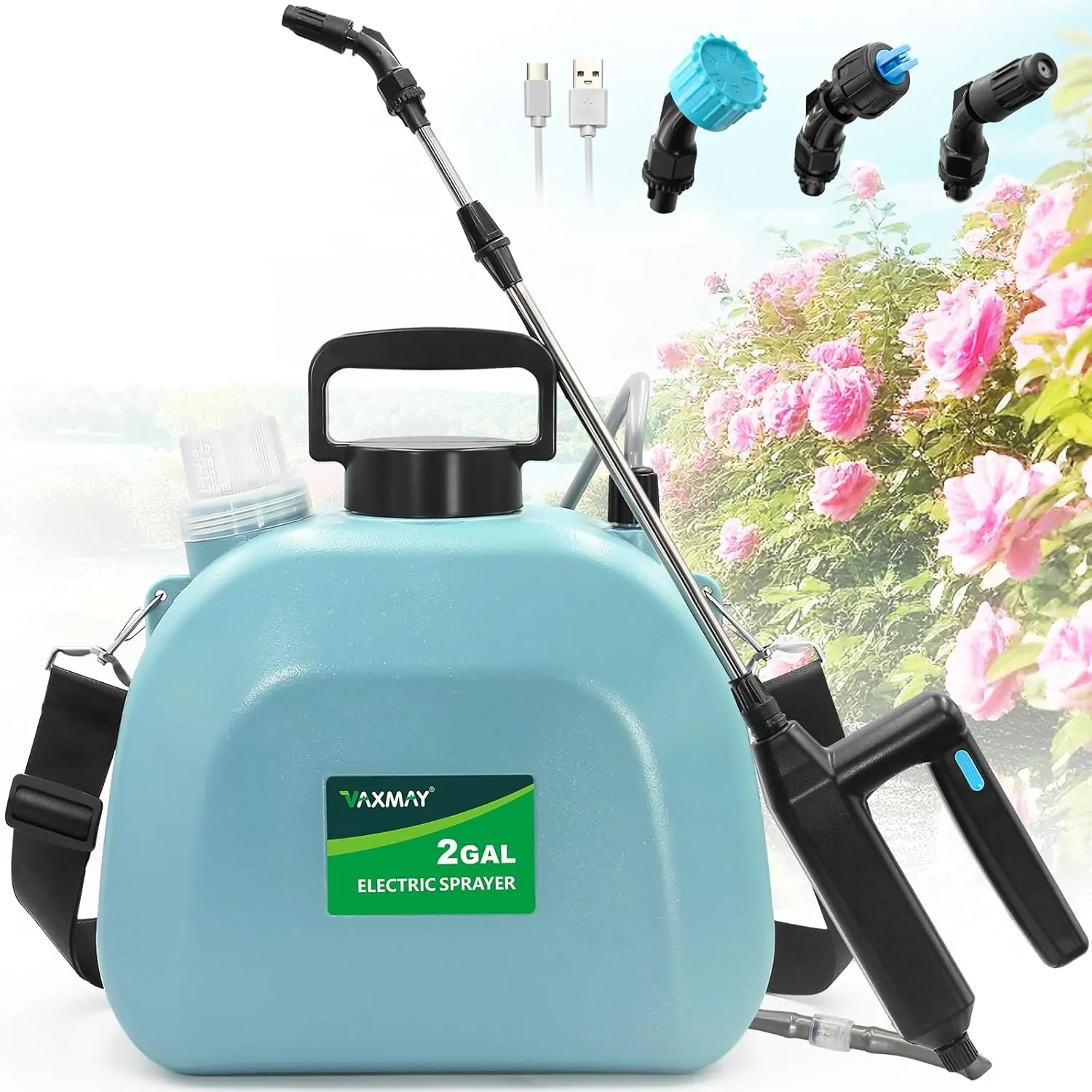
5. VAXMAY Battery Powered Sprayer 2 Gallon
The VAXMAY 2 Gallon Battery Powered Sprayer is an electric garden sprayer that works with a built-in rechargeable battery instead of requiring manual pumping. It uses a 7,4V motor with a self-priming pump that provides continuous spraying for up to 3 hours after a full charge. This feature is especially useful because traditional pump sprayers require repeated pumping, which can become tiring during long gardening tasks.
expert start
What Is It and Its Features
The sprayer includes three adjustable spray nozzles: a fine mist nozzle, a fan spray nozzle, and a direct stream nozzle. These options allow you to select the right spray pattern for different jobs, from gentle plant watering to applying fertilizer, vinegar solutions, or pest-control liquids. The 2-gallon translucent tank has clear measurement markings, allowing you to easily check the remaining liquid level. The tank also has two large openings, making filling, mixing, and cleaning more convenient while reducing spills.
Why It Matters
The sprayer is made from HDPE and ABS plastic materials, which provide a strong and durable construction. The ergonomic handle houses the battery and power button, while the retractable telescopic wand helps you reach different areas comfortably. These design features improve overall convenience, reduce pressure on the hands and arms, and make the sprayer a practical choice for users who need an easier-to-use gardening tool, including people with limited strength or those who prefer low-effort equipment.
My Set-Up and My Experience
Setting up the VAXMAY sprayer was simple and required only a few steps. I connected the hose, attached the wand, selected the required nozzle, and fully charged the handle before using it for the first time. I mainly used this sprayer for outdoor insect control, watering plants, and applying vinegar solutions around my home. The balanced design made carrying it much more comfortable compared with heavier manual pump sprayers that often create stress on the wrists and shoulders. The wide tank openings and built-in filter helped keep dirt and particles away from the spraying system. After each use, I cleaned the tank, hose, and nozzles and allowed them to dry properly before storage.
Performance
The motor delivers stable and consistent pressure without sudden changes, resulting in smooth and uniform spraying. The fine mist nozzle works well for delicate plants and light applications, while the fan spray and direct stream settings are more suitable for weeds, insects, and cleaning tasks. The battery performance is excellent for regular garden work. The handle trigger is comfortable to operate and does not create hand fatigue even during extended use.
Practical Tips
- Fully charge the sprayer before using it for the first time
- Clean the tank, hose, and nozzle after every application
- Allow all components to dry completely before storing
- Avoid keeping liquid stored inside the tank for extended periods
- Select the correct nozzle according to the task
- Do not fill above the maximum marked level
- Store the sprayer in a cool and dry location
- Inspect O-rings regularly to reduce the chance of leaks
expert end
pro start
| Pros | Cons |
|---|---|
| ✔️ Provides strong and consistent spray pressure | ❌ Bottom seam may develop leakage after extended use |
| ✔️ Adjustable nozzles offer different spray patterns | ❌ Does not include a pressure gauge |
| ✔️ Long wand and hose provide better reach | ❌ Top lid requires careful tightening |
| ✔️ Comfortable shoulder strap makes carrying easier | ❌ Not suitable for applications requiring extremely high pressure |
| ✔️ Transparent tank with measurement scale is easy to monitor | ❌ Replacement parts can be difficult to find |
pro end
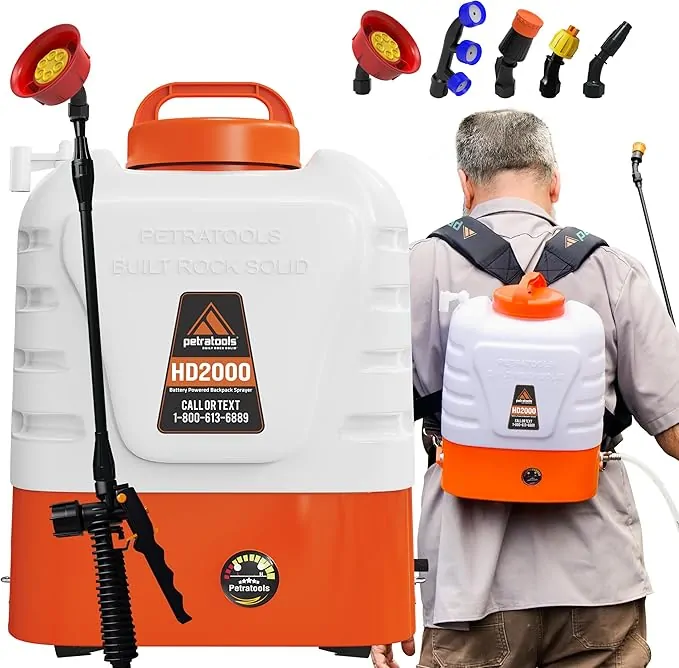
6. PetraTools HD2000 2-Gallon Battery Powered Sprayer
The PetraTools HD2000 is a 2-gallon battery-powered backpack sprayer built with strong HDPE plastic for long-lasting use. It features a built-in electric pump, so there is no need for manual pumping. This is a major advantage during extended spraying jobs because hand pumping can quickly make your arms tired and may lead to uneven pressure. The fully battery-operated system provides up to 80 PSI pressure and allows several hours of continuous spraying.
expert start
What Is It and Its Features
The main highlight of this sprayer is its powerful 80 PSI pump, which delivers consistent pressure for weed control, pest management, and fertilizer applications. It uses a lead-acid battery that PetraTools states can provide up to 2–3 hours of operation per charge or cover more than 50 gallons of spraying. In practical situations, this means you can complete most garden and yard spraying tasks without frequent charging breaks.
Why It Matters
The large tank opening makes filling the sprayer easier and reduces the chances of spills. The transparent tank markings help you measure liquids accurately when mixing solutions. It also comes with five different spray nozzles, allowing you to choose between fine misting, wider coverage, or focused weed spraying. The padded backpack straps improve comfort by reducing pressure on the shoulders, making it easier to carry, even for users who prefer a more comfortable design.
My Set-Up and My Experience
Setting up the HD2000 was quick and uncomplicated. The package includes a battery charger, replacement seal, shoulder straps, strainer, and other required parts. After charging the battery overnight, I filled the tank with a regular weed control mixture and selected the nozzle that produced a fine spray pattern. I mainly tested it for weed spraying around fences, garden beds, pathways, and for light watering tasks. The trigger handle worked smoothly, and controlling the spray was simple. Walking around, aiming the wand, and pressing the trigger made spraying much easier compared with using a manual sprayer.
Performance
The HD2000 performed better than expected during testing. The 80 PSI pump maintained steady pressure and produced an even spray pattern throughout use. The five included nozzles provided excellent flexibility, from gentle misting for sensitive plants to stronger spraying for weeds and shrubs. The battery performance was dependable and allowed me to cover my garden area without repeated charging interruptions. Its lightweight construction and padded straps also reduced back and shoulder stress compared with traditional manual backpack sprayers.
Practical Tips
- Charge the battery completely before starting long spraying tasks
- Clean and rinse the tank after applying chemicals
- Keep the sprayer stored in a dry location during winter
- Select the correct nozzle according to the spraying job
- Avoid filling the tank above the recommended level
expert end
pro start
| Pros | Cons |
|---|---|
| ✔️ Eliminates the need for manual pumping | ❌ Battery performance can decrease after extended storage |
| ✔️ Provides strong and consistent 80 PSI pressure | ❌ Becomes heavier when the tank is completely filled |
| ✔️ Offers reliable long-duration battery operation | ❌ Lead-acid battery requires more charging time |
| ✔️ Comfortable padded backpack straps for easier carrying | ❌ More expensive compared with basic manual sprayers |
| ✔️ Helpful and responsive customer support | ❌ Not the best choice for very large spraying areas |
pro end
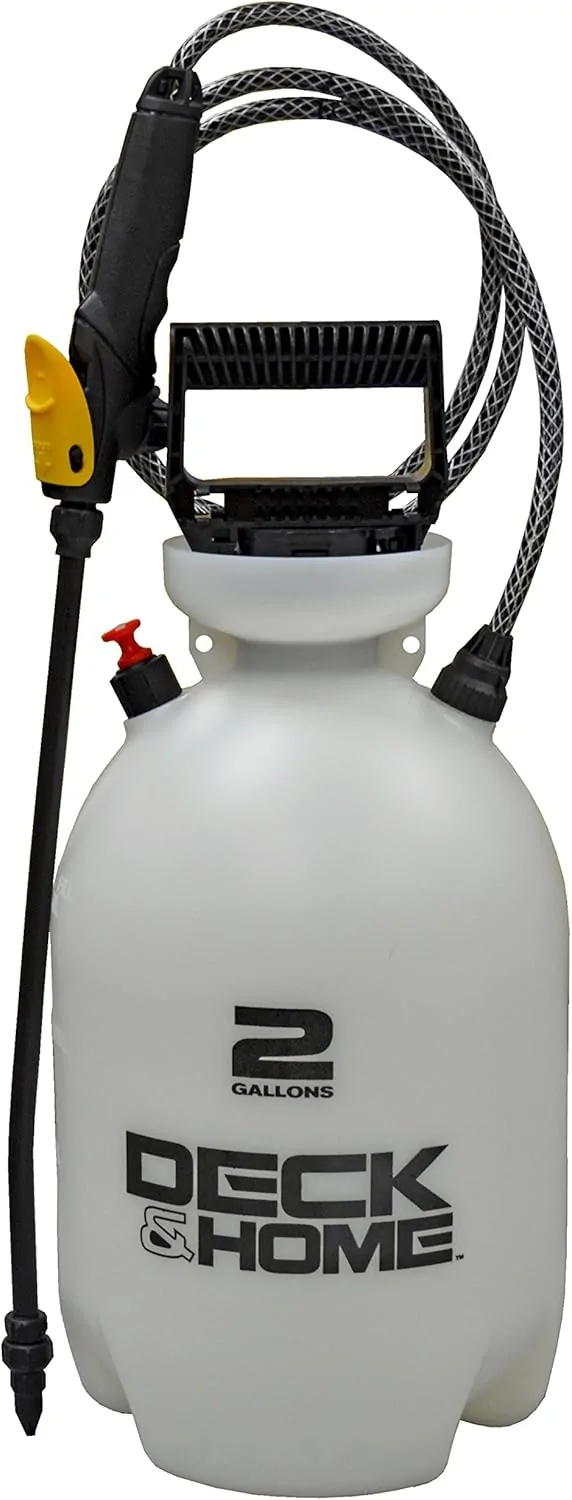
7. Deck the Home Deck & Home 190399 Universal 2-Gallon Sprayer
The Deck & Home 190399 Universal Sprayer is a 2-gallon pump sprayer designed for various household and gardening tasks, including plant watering, insect control, deck cleaning, car washing, and outdoor maintenance. Its key advantages include strong chemical resistance, an efficient pumping system, and multiple spray nozzles that provide flexibility for different applications.
expert start
What Is It and Its Product Features
The Deck & Home 190399 is a 2-gallon (2000 ml) pump sprayer designed for home and garden use. It has a lightweight design, weighing approximately 3 pounds when empty, which makes it convenient to move around the yard or home. This sprayer can be used for watering plants, applying insecticides, controlling weeds, cleaning siding, washing windows, fertilizing gardens, and even cleaning vehicles.
Why It Matters
One of the most useful features is the premium shut-off system with a comfortable grip and lock-on function. This allows continuous spraying without needing to hold the trigger constantly, reducing hand fatigue during longer jobs. The sprayer also uses Viton seals and gaskets, which provide better resistance when working with chemicals such as insecticides, cleaning solutions, and diluted bleach. Many low-quality sprayers experience seal damage over time, so durable seals are an important advantage. The built-in pressure release valve also improves safety by allowing pressure to be released before opening the tank, which is especially important when handling chemical solutions.
My Set-Up and My Experience
The sprayer arrived with four attachments, although the third fan nozzle mentioned in the manual was not included. After adding half a gallon of liquid, around 80 pumps were needed to build enough pressure for effective spraying. Once pressurized, it produced enough power to quickly remove bird droppings from my car. The foaming nozzle worked well when the correct soap-to-water ratio and pressure level were used, creating a thick foam layer. I also tested it for insect control around my garden area. Compared with my previous sprayer, this model provided better spray distance, and the curved handle design made it easier to reach under decks and into narrow spaces.
Performance
The Deck & Home 190399 performs effectively across different tasks. After proper pumping, it maintains pressure well, and the lock-on feature allows comfortable continuous spraying. The included nozzles increase its versatility by allowing different spray patterns for specific applications. For better durability, I recommend storing it indoors after use. With its Viton seals, it handles different liquids safely and provides reliable performance for spraying, cleaning, and chemical applications.
Practical Tips
- Keep the sprayer indoors during cold weather conditions
- Use the pressure release valve before opening the tank
- Clean the tank thoroughly after using strong chemicals such as bleach
- Pump completely to achieve the best spraying and foaming results
- Use separate sprayers for different chemicals to prevent contamination
expert end
pro start
| Pros | Cons |
|---|---|
| ✔️ Produces strong and consistent spray pressure | ❌ Bottom seam may develop leakage after extended use |
| ✔️ Adjustable nozzle supports multiple spray patterns | ❌ Does not include a pressure gauge for monitoring pressure |
| ✔️ Long wand and hose provide better reach | ❌ Lid requires careful tightening to prevent issues |
| ✔️ Comfortable shoulder strap improves portability | ❌ Not suitable for extremely high-pressure spraying needs |
| ✔️ Transparent tank with measurement markings | ❌ Replacement components can be difficult to find |
pro end
Understanding 2-Gallon Garden Sprayer Types
Once I settled on the capacity, I investigated the different operating systems available in 2-gallon garden sprayers. I found that two sprayers with the same tank size could behave quite differently because of their pump designs, pressure delivery and carrying arrangements.
Manual Pump Sprayers for Everyday Gardening
A manual pump sprayer normally uses a hand-operated pump to compress air inside a pressure-rated tank. This stored air pressure pushes liquid through the hose, trigger valve, wand and nozzle when the trigger opens.
I liked the simplicity of this arrangement because it did not depend on a battery or charger. However, the operator must restore pressure periodically as the compressed air expands and the tank empties. This can change the spray pattern and flow rate if pressure is not maintained within the appropriate operating range.
For my smaller gardening jobs, I considered a manual model with a comfortable pump handle, pressure relief valve and replaceable seals. A smooth pump stroke was more important to me than an unusually high advertised pressure rating.
Before buying, I planned to inspect whether the pump could be removed for maintenance and whether the handle provided enough grip when my hands were damp. A clean-water demonstration, where permitted, would help identify obvious pumping difficulties without pretending to establish long-term reliability.
Battery-Powered Sprayers for Consistent Spraying
Battery-powered 2-gallon garden sprayers use an electric pump to move liquid from the tank toward the nozzle. Depending on the design, the pump may maintain pressure automatically or operate while the trigger is activated.
The main attraction was reduced manual pumping. When spraying several vegetable beds, consistent pressure could make the work less tiring and help maintain a more predictable spray pattern. However, I understood that pressure stability depends on the pump, controls, nozzle and battery condition.
I examined battery capacity, charging arrangements, pump specifications and whether replacement batteries were available. A battery marked 2 Ah did not automatically tell me its runtime because voltage, motor power, pressure and operating conditions also affected energy consumption.
Battery-powered sprayers also introduced additional components that could fail, including switches, wiring, connectors and charging equipment. Therefore, I considered them worthwhile mainly when the reduction in manual pumping justified the extra cost and maintenance.
| Feature | Manual 2-Gallon Sprayer | Battery 2-Gallon Sprayer |
|---|---|---|
| Pressure generation | Hand-operated pump | Electric pump |
| Operating effort | Periodic manual pumping | Reduced pumping effort |
| Power requirement | No electricity required | Battery charging required |
| Maintenance | Pump, seals and valves | Pump, electrical parts and battery |
| Best suited for | Occasional small garden jobs | More frequent spraying sessions |
| Main limitation | Pressure gradually decreases | Higher complexity and battery dependence |
My selection depended on how often I expected to spray. For occasional treatment of a few plants, a well-built manual sprayer seemed sufficient. For regular work involving several beds, I gave battery-powered models more consideration, provided their replacement parts and service arrangements were satisfactory.
How 2-Gallon Garden Sprayers Work
Understanding the working mechanism helped me evaluate sprayers beyond their appearance. Every functional part influences how liquid travels from the tank to the plant, and a weakness in one component can affect the entire spraying process.
In a manual pressure sprayer, the pump increases the pressure of the air above the liquid. Opening the trigger allows that pressure to force liquid through the pickup tube, hose and wand before it passes through the nozzle opening. The nozzle converts the moving liquid into a particular spray pattern.
In a battery-powered sprayer, an electric pump creates the required pressure or flow. Some designs use pressure switches or regulators, while others have simpler controls. I considered the actual operating mechanism more useful than assuming every battery sprayer delivered identical pressure.
The relationship between pressure, flow rate and nozzle size became particularly important. Increasing pressure generally increases flow through a given nozzle, although the exact change depends on the nozzle and system. Higher pressure can also produce finer droplets, which may increase drift risk.
For example, a nozzle delivering 0.5 litres per minute would theoretically empty 7.57 litres in about 15 minutes of continuous spraying. At 1 litre per minute, the same volume would last approximately 7.6 minutes. These are calculations, not measured runtimes, and they exclude interruptions, residual liquid and changes in pressure.
- Tank: Stores the prepared liquid and must tolerate the intended formulation.
- Pump: Creates the pressure needed to move liquid.
- Hose: Carries liquid while allowing the wand to move freely.
- Trigger: Starts and stops the spray.
- Wand: Helps position the nozzle accurately.
- Nozzle: Controls spray pattern and contributes to flow rate and droplet size.
This understanding changed my buying priorities. Instead of choosing the sprayer with the most accessories, I preferred a model whose pressure system, nozzle and controls matched the tasks I intended to perform.
Essential Features Worth Checking Before Buying
After comparing operating types, I concentrated on the features that would make a 2-gallon sprayer comfortable and dependable. Some features looked impressive in product descriptions but offered little benefit for my actual gardening activities.
Tank Capacity, Weight and Carrying Comfort
I first checked whether the stated 2-gallon capacity represented the actual liquid capacity or the total internal tank volume. Pressurised sprayers need sufficient air space for safe operation, so the manufacturer’s maximum fill line is more important than the physical volume of the container.
I also inspected the handle and carrying arrangement. A narrow plastic handle could become uncomfortable during repeated movement between beds, particularly when the tank was full. For shoulder-carried models, strap width, adjustment and attachment strength mattered more than decorative padding.
As a practical comparison, I considered how a full sprayer weighing approximately 9 kg might feel when moved repeatedly between vegetable rows. This helped me prioritise balance and grip rather than simply choosing the lightest empty tank.
Nozzles, Pressure and Spray Control
The nozzle was another major consideration because my gardening tasks required different application patterns. A concentrated stream could help reach a specific location, while a suitable fan pattern could provide more uniform coverage across a narrow bed.
However, I avoided assuming that every adjustable nozzle was suitable for every chemical. Some formulations require particular droplet sizes, application methods or nozzle types. The product label and sprayer manufacturer’s guidance must determine whether an application is appropriate.
I preferred clearly adjustable controls that could be operated without forcing the nozzle assembly. I also looked for replaceable nozzle components because a worn or blocked nozzle can affect application accuracy.
Hose Length, Wand and Filtration
A longer hose could make it easier to reach around plants without moving the tank constantly, but excessive hose length could become inconvenient in narrow beds. I considered a hose of around 1 to 1.5 metres as a comparison target rather than a universal requirement.
Similarly, a wand of approximately 40 to 60 cm might provide useful reach for some vegetable and flower applications. The ideal length depended on plant height, operator comfort and whether the wand could be controlled without bending or twisting.
Filtration was equally important. A properly fitted filter could prevent particles from reaching the nozzle, reducing blockages. Nevertheless, filtration could not make an unsuitable chemical formulation safe for the equipment.
- Pressure relief valve: Important for safely releasing pressure before opening a pressurised tank.
- Wide filling opening: Helps reduce spills and makes cleaning easier.
- Visible fill markings: Support accurate preparation of permitted mixtures.
- Replaceable nozzle: Makes maintenance and application adjustment easier.
- Accessible filter: Simplifies inspection and cleaning.
- Trigger lock: Can reduce hand fatigue where appropriate, but requires careful handling.
By the end of this comparison, I had a clearer preference for practical features that improved control, maintenance and safety rather than a long accessory list.
Checking Materials, Durability and Chemical Compatibility
Durability was one of the most difficult qualities to judge before purchase. A sprayer could feel solid in the shop but still develop problems after repeated exposure to sunlight, pressure, moisture or chemicals.
I started with the tank material. Many garden sprayers use polyethylene or other plastics, but their suitability depends on the exact material grade, formulation and operating conditions. A thicker-looking tank is not automatically stronger or more chemically resistant.
I checked for consistent moulding, secure seams, a stable base and clearly marked maximum filling instructions. I also examined the tank opening because damaged threads or a poorly fitted pump assembly could make sealing difficult.
Pumps, Seals and Corrosion Resistance
The pump assembly deserved particular attention because it experiences repeated movement and pressure changes. I looked for a smooth operating mechanism, accessible seals and evidence that replacement parts could be obtained.
Seal material was especially important. EPDM, nitrile rubber and FKM materials have different chemical resistance characteristics, and none should be assumed compatible with every pesticide, fertiliser or cleaning agent.
For example, a manufacturer might specify FKM seals for particular chemical applications, but this does not establish compatibility with every solvent-based formulation. I would still verify the exact formulation and the manufacturer’s compatibility guidance.
I also considered the metal components. Stainless steel and brass can provide useful corrosion resistance in suitable environments, but their performance depends on the alloy and chemical exposure. Brass should not be treated as universally resistant to corrosive liquids.
During a proposed post-purchase clean-water trial, I planned to inspect the hose joints, pump connection, trigger and nozzle for visible leakage after several pressure cycles. This would help identify immediate assembly problems, although it could not predict how the materials would perform after years of use.
Evaluating Long-Term Wear and Repairability
For long-term ownership, I placed considerable value on repairability. A sprayer with replaceable seals, valves, hoses and nozzles could remain useful after a minor component failed. A sealed or proprietary assembly might require replacement of a much larger section.
I also considered how easily the tank could be rinsed and dried. Residual moisture and chemicals can affect some components, while sunlight and heat may gradually weaken certain plastics and rubber materials.
- Tank construction: Check material specifications, moulding quality and pressure rating.
- Seals and gaskets: Confirm compatibility and replacement availability.
- Hose: Inspect flexibility, connection security and resistance to kinking.
- Metal components: Verify corrosion resistance for intended liquids.
- Pump assembly: Prefer accessible components where practical.
- Spare parts: Confirm availability before purchase.
I concluded that a durable 2-gallon garden sprayer should not be judged by tank thickness alone. Its reliability depends on how the entire system handles pressure, chemicals, cleaning and repeated use.
Matching Sprayer Performance to Garden Tasks
Once I understood the construction, I considered how the sprayer would fit into my seasonal gardening work. This was important because a sprayer that performed well on open lawn edges might not be the best choice for closely planted vegetables or delicate flowers.
Vegetable Beds and Flower Gardens
During spring gardening, I normally paid close attention to young tomato plants, chilies and seasonal flowers. These plants required controlled applications rather than excessive spraying that could wet nearby foliage unnecessarily.
For a practice clean-water trial, I considered filling the sprayer with 2 litres of water and checking coverage across a measured section of vegetable bed. By recording the area, spraying time and remaining water, I could estimate how much liquid the nozzle delivered under my normal walking speed.
For example, using 1.2 litres over 20 square metres would correspond to 0.06 litres per square metre, or 600 litres per hectare. That calculation would not automatically make the rate suitable for a pesticide; the approved label rate, target crop and application method would still determine the correct setup.
I also considered the importance of directing spray beneath leaves when treatment instructions required coverage there. A suitable wand angle and controlled nozzle could help, but excessive pressure might increase drift and unnecessary wetting.
Young Fruit Trees and Lawn Treatments
For young lemon, guava and mango trees, the main challenge was reaching foliage safely while maintaining control. A 2-gallon sprayer could be useful for reachable branches, but I would not treat it as a substitute for equipment designed for tall trees.
I preferred to work from the ground rather than use ladders while spraying. If the target canopy could not be reached properly, the safer decision was to choose suitable equipment or another approved treatment method.
For small lawn areas, I considered a fan nozzle useful for controlled applications. However, large lawns could require several tank refills, and maintaining uniform coverage across a broad area would be more demanding with a small handheld system.
- Chilies and tomatoes: Prioritise controlled spray direction and suitable droplet size.
- Marigolds and petunias: Avoid unnecessary high-pressure spray on delicate flowers.
- Young fruit trees: Check reachable height and wand control.
- Lawn edges: Consider a suitable fan nozzle and measured walking speed.
- Spot treatments: Prepare only the quantity required for the approved application.
These comparisons convinced me that the best 2-gallon garden sprayer is not necessarily the one producing the highest pressure. It is the one providing the control, reach and capacity needed for the intended treatment.
How to Calibrate a 2-Gallon Sprayer
Calibration became one of my most important considerations because even a well-built sprayer can waste liquid or apply an incorrect amount when used without measurement.
I planned to perform the first calibration with clean water after purchase. This allowed me to understand the nozzle output and operating behaviour without introducing a pesticide into an unfamiliar system.
The first step was to fill the tank to a known level and establish the intended operating pressure. For a manual sprayer, I needed to maintain pressure as consistently as possible during the test. For a battery-powered model, I needed to follow the manufacturer’s operating instructions.
I would then collect the nozzle output for one minute in a measuring container. If the collected volume was 600 millilitres, the measured flow rate would be 0.6 litres per minute under those specific conditions.
Next, I would measure the intended treatment area and practise a consistent spraying speed. Comparing the amount of water used with the measured area would establish the application volume. For band or broadcast spraying, nozzle width and walking speed would also be relevant.
Calibration should be repeated when the nozzle, pressure setting or application method changes. A worn nozzle can deliver more liquid than expected, while partial blockage may reduce output or distort the pattern.
- Use clean water and a suitable measuring container.
- Record nozzle output over a measured period.
- Measure the actual treatment area.
- Practise a consistent movement and spray distance.
- Compare the calculated application volume with label requirements.
- Adjust the setup and repeat the measurement when necessary.
I considered calibration a practical way to reduce guesswork. Rather than relying on how wet the leaves looked, I could make decisions using measured flow and area coverage.
Buying the Right 2-Gallon Garden Sprayer
After identifying the features I needed, I turned my attention to where and how to buy. I wanted a sprayer that could be maintained and supported rather than a product that appeared attractive only in photographs.
At a local garden equipment shop, I could inspect the handle, pump, hose connections and tank markings directly. I could also ask whether the seller stocked replacement seals and nozzles. If demonstrations were permitted, I could check the pumping action or observe a clean-water test.
Online buying required a different approach. I needed to verify the exact model number, capacity, included accessories and seller identity. Product pages sometimes combine several capacities under one listing, so selecting the correct variation was essential.
I also checked whether the stated capacity referred to US gallons or another measurement. Two US gallons equal approximately 7.57 litres, whereas two imperial gallons equal approximately 9.09 litres. This difference matters when comparing tank specifications.
| Buying Check | What to Verify | Why It Matters |
|---|---|---|
| Tank capacity | Actual 2-gallon model and fill line | Prevents incorrect capacity selection |
| Pump type | Manual or battery-powered | Determines effort and maintenance |
| Nozzle system | Patterns, replacements and compatibility | Supports accurate applications |
| Seals | Material and chemical compatibility | Reduces risk of premature failure |
| Accessories | Included wand, hose, straps and charger | Avoids unexpected extra purchases |
| Warranty | Coverage, exclusions and service region | Clarifies repair support |
| Delivered cost | Product, shipping and additional charges | Shows total purchase expense |
| Return policy | Return period and conditions | Protects against incorrect or defective items |
I also considered ownership cost rather than purchase price alone. A cheaper sprayer requiring frequent replacement parts could become more expensive over time, while a higher-priced model might not justify its cost if I used it only occasionally.
Before paying, I preferred to confirm the availability of basic consumable parts and retain the invoice or order confirmation. For battery-powered equipment, I also checked whether battery replacement was practical and whether the charger matched the supplied battery system.
Inspecting and Testing After Purchase
Once a sprayer arrived, my first priority was to confirm that it matched the ordered model. I would inspect the tank, pump, hose, trigger, wand, nozzle and accessories before adding any liquid.
I planned to compare the delivered components with the manufacturer’s package description and inspect the tank for cracks, deformation or shipping damage. Loose fittings or damaged threads needed attention before pressurising the equipment.
After assembly, I would perform a clean-water test according to the instructions. For a manual sprayer, this meant pumping within the recommended operating limits and observing the connections for leakage. For a battery model, I would check charging, switching and pump operation as directed by the manufacturer.
A useful initial test could involve operating the sprayer for 10 to 15 minutes with clean water while checking nozzle consistency, trigger response and hose connections. However, this short test would establish only immediate operation, not long-term durability.
Over subsequent gardening sessions, I would record any pressure changes, blockages, leaks or unusual pumping effort. Comparing these observations over several weeks would provide more useful information than relying on a single successful demonstration.
- Before assembly: Check the tank and all supplied components.
- Before pressurising: Confirm secure fittings and correct assembly.
- During testing: Watch for leaks and irregular spray patterns.
- After testing: Release pressure and inspect seals where instructed.
- During later use: Record maintenance needs and recurring problems.
If the sprayer leaked from a pressure-bearing component or showed visible structural damage, I would stop using it rather than attempt an improvised repair.
Using 2-Gallon Garden Sprayers Safely
Safe spraying required more attention than simply filling the tank and pressing the trigger. I considered the treatment product, weather, nearby plants, people, animals and equipment condition before beginning any application.
For pesticides and other regulated treatments, the product label determines the approved crops, application rate, protective equipment, re-entry requirements and other restrictions. I would never assume that a sprayer’s chemical resistance meant a particular pesticide was approved for a crop.
I also avoided spraying during windy conditions because drifting droplets could reach unintended plants, neighbouring areas or people. Fine spray patterns require particular care because smaller droplets may travel farther from the target.
When preparing a permitted treatment, I would measure the required quantity using dedicated equipment and follow the label’s mixing sequence. I would not prepare additional mixture merely to fill the entire 2-gallon tank.
Protective gloves, eye protection, suitable clothing and any additional label-required equipment were part of my preparation. I also kept children, pets and other people away from the treatment area according to the product instructions.
- Read the treatment label before preparing the mixture.
- Confirm crop, equipment and chemical compatibility.
- Wear the protective equipment required for the product.
- Inspect the sprayer before pressurising it.
- Avoid windy conditions and uncontrolled drift.
- Never open a pressurised tank before safely releasing pressure.
- Follow label instructions for leftover mixture and rinse water.
Another important consideration was keeping equipment dedicated to appropriate uses. I would not use a sprayer previously containing herbicide for sensitive vegetables or flowers unless the manufacturer and chemical labels provided a validated cleaning procedure that made such reuse appropriate. Where contamination risk remained, separate labelled equipment was the safer choice.
Cleaning, Maintenance and Storage for Durability
Maintenance was the final factor I considered before deciding whether a 2-gallon sprayer offered good long-term value. Even a well-constructed sprayer could develop problems when chemicals remained inside the tank or when moving components were neglected.
After each permitted application, I would follow the product label and sprayer manufacturer’s cleaning instructions. Some formulations require specific cleaning procedures, and simply rinsing with water may not remove every residue safely.
I also checked the filter and nozzle for blockages. A blocked nozzle should be cleaned using the approved method, not by blowing through it with my mouth or forcing unsuitable sharp objects into the opening.
For the pump and seals, I preferred to follow the manufacturer’s lubrication recommendations. Applying an unsuitable oil or grease could damage certain rubber components or interfere with chemical compatibility.
Storage conditions also mattered. I planned to keep the sprayer clean, depressurised and protected from prolonged direct sunlight, excessive heat and freezing temperatures. Battery-powered models required additional attention to battery storage and charging instructions.
During a practice four-week maintenance assessment, I could inspect the tank, hose, seals and nozzle at weekly intervals while recording any changes in operation. This would help identify early wear or maintenance needs, but four weeks would not prove multi-year durability.
- After spraying: Follow the required cleaning and disposal procedure.
- Before storage: Release pressure and drain as instructed.
- Filters and nozzles: Inspect and clean without damaging openings.
- Seals: Check for cracking, swelling or loss of flexibility.
- Hoses: Inspect for kinks, leaks and loose connections.
- Batteries: Follow the manufacturer’s charging and storage guidance.
Regular maintenance could reduce avoidable failures, but it could not compensate for poor material compatibility or a defective pressure system. This reinforced my preference for a sprayer with clear instructions, accessible components and dependable replacement parts.
Choosing the Best 2-Gallon Garden Sprayer
After working through capacity, operating type, materials, nozzle performance, safety and maintenance, I understood that choosing the best 2-gallon garden sprayer required balancing several practical priorities.
However, I would not recommend the same configuration to every gardener. Someone spraying occasionally might benefit most from a simple manual model with reliable seals and a comfortable handle. A gardener completing frequent sessions might value a battery-powered pump, provided the additional cost, battery maintenance and repair requirements were acceptable.
I also learned that the best sprayer is not necessarily the one with the highest pressure, most accessories or lowest price. A suitable model should deliver controlled spraying, comfortable handling, compatible materials and practical maintenance for the intended workload.
Before making the final purchase, I would confirm the actual 2-gallon capacity, maximum fill line, pump mechanism, chemical compatibility, replacement parts, warranty and total delivered cost. After purchase, clean-water calibration and careful observation would help determine whether the sprayer met my expectations.
Frequently Asked Questions (FAQs)
1. How much area does a 2-gallon garden sprayer cover? The coverage capacity of a 2-gallon garden sprayer depends on several factors, including nozzle settings, spray pressure, application method, and the type of liquid being used. Generally, a 2-gallon sprayer can cover around 2,000 to 4,000 square feet. However, users should always check the manufacturer’s instructions because coverage may vary between different sprayer models.
2. Do 2-gallon sprayers come with adjustable nozzles for different spray patterns? Yes, adjustable nozzles are one of the important features that make 2-gallon garden sprayers highly useful and flexible. These nozzles allow gardeners to select different spray patterns according to their needs. Whether applying pesticides, herbicides, fertilizers, or simply watering plants, adjustable nozzles provide better control, accurate application, and improved efficiency.
references:
1. Bartok Jr, J. W. (2021). Sprayers and spray application techniques. Center for Agriculture, Food, and the Environment.
2. Bode, L. E., & Butler, B. J. (1981). Equipment and calibration: low-pressure sprayers. Circular (University of Illinois at Urbana-Champaign. Cooperative Extension Service) 1192.
3. Giles, D. K., Klassen, P., Niederholzer, F. J., & Downey, D. (2011). “Smart” sprayer technology provides environmental and economic benefits in California orchards. California Agriculture, 65(2).
4. Malonde, S., Kathwate, S., Kolhe, P., Jacob, R., Ingole, N., & Khorgade, R. D. (2016). Design and development of multipurpose pesticides spraying machine. Journal of Advanced Engineering and Global Technology ISSN, (2309-4893).
5. Raut, L. P., Jaiswal, S. B., & Mohite, N. Y. (2013). Design, development and fabrication of agricultural pesticides sprayer with weeder. International Journal of Applied Research and Studies, 2(11), 1-8.
6. Makhnenko, I., Alonzi, E. R., Fredericks, S. A., Colby, C. M., & Dutcher, C. S. (2021). A review of liquid sheet breakup: Perspectives from agricultural sprays. Journal of Aerosol Science, 157, 105805.
7. Ozkan, E. (2018). How Much Chemical Product Do I Need to Add to My Sprayer Tank?. FABE-530). Ohioline, The Ohio State University. ohioline. osu. edu/factsheet/fabe-530.
8. Honrao, D. V., & Awadhani, L. V. (2023). Design and development of agricultural spraying system. Materials Today: Proceedings, 77, 734-738.
9. Yallappa, D., Veerangouda, M., Maski, D., Palled, V., & Bheemanna, M. (2017, October). Development and evaluation of drone mounted sprayer for pesticide applications to crops. In 2017 IEEE global humanitarian technology conference (GHTC) (pp. 1-7). IEEE.
10. Ghafar, A. S. A., Hajjaj, S. S. H., Gsangaya, K. R., Sultan, M. T. H., Mail, M. F., & Hua, L. S. (2023). Design and development of a robot for spraying fertilizers and pesticides for agriculture. Materials Today: Proceedings, 81, 242-248.

