
6 Best 5 Litre Garden Sprayers in 2026: Reviews And Buying Guide
- A 5 liter garden sprayer is a lightweight and practical tool for watering, fertilizing, and protecting plants efficiently.
- Its compact design, easy handling, and versatile use make it ideal for home gardens and small farming areas.
- Choosing the right 5 litre garden sprayer can save time, reduce effort, and help maintain a healthier garden.


When a friend asked me how to choose the best 5 litre garden sprayer, I explained that tank capacity alone was not enough to make a good decision. A sprayer might hold the right quantity of liquid but still become uncomfortable, lose pressure too quickly, produce an uneven spray or require replacement parts that were difficult to find. I wanted equipment that made regular garden work easier without introducing unnecessary weight, expense or maintenance.
My main concern was finding a practical balance between capacity, pressure, portability and control. Small spray bottles were convenient for a few plants, but frequent refilling became frustrating when working across several vegetable beds. Larger backpack sprayers could carry more liquid, although their additional weight and size were not always justified for smaller gardening tasks. This made a 5 litre garden sprayer an interesting middle option.
However, I soon realised that not every 5 litre model worked in the same way. Manual pressure sprayers, shoulder-carried designs and battery-powered models offered different advantages. I therefore concentrated on understanding their working mechanisms, materials, compatibility and long-term maintenance before deciding which features deserved priority.
| Product | Title & Rating | Features | Explore |
|---|---|---|---|
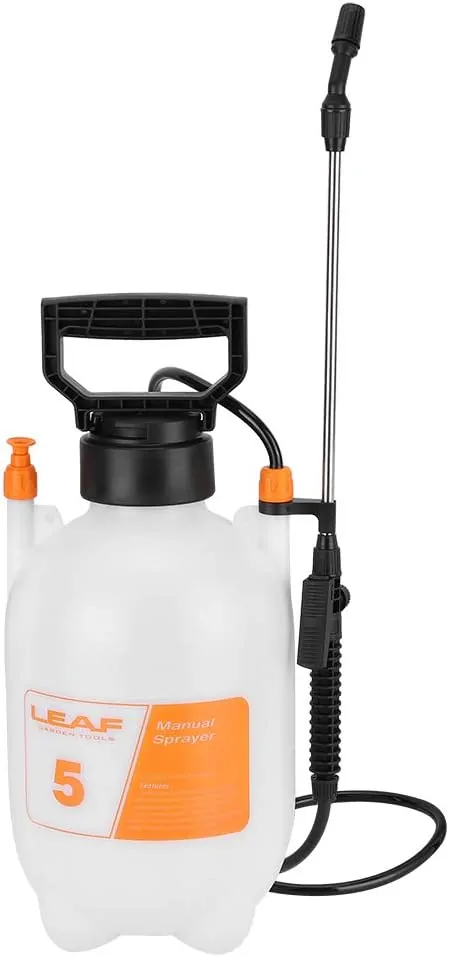 | Plplaaoo 5L Garden Sprayer⭐ 4.9 |
| Check Price |
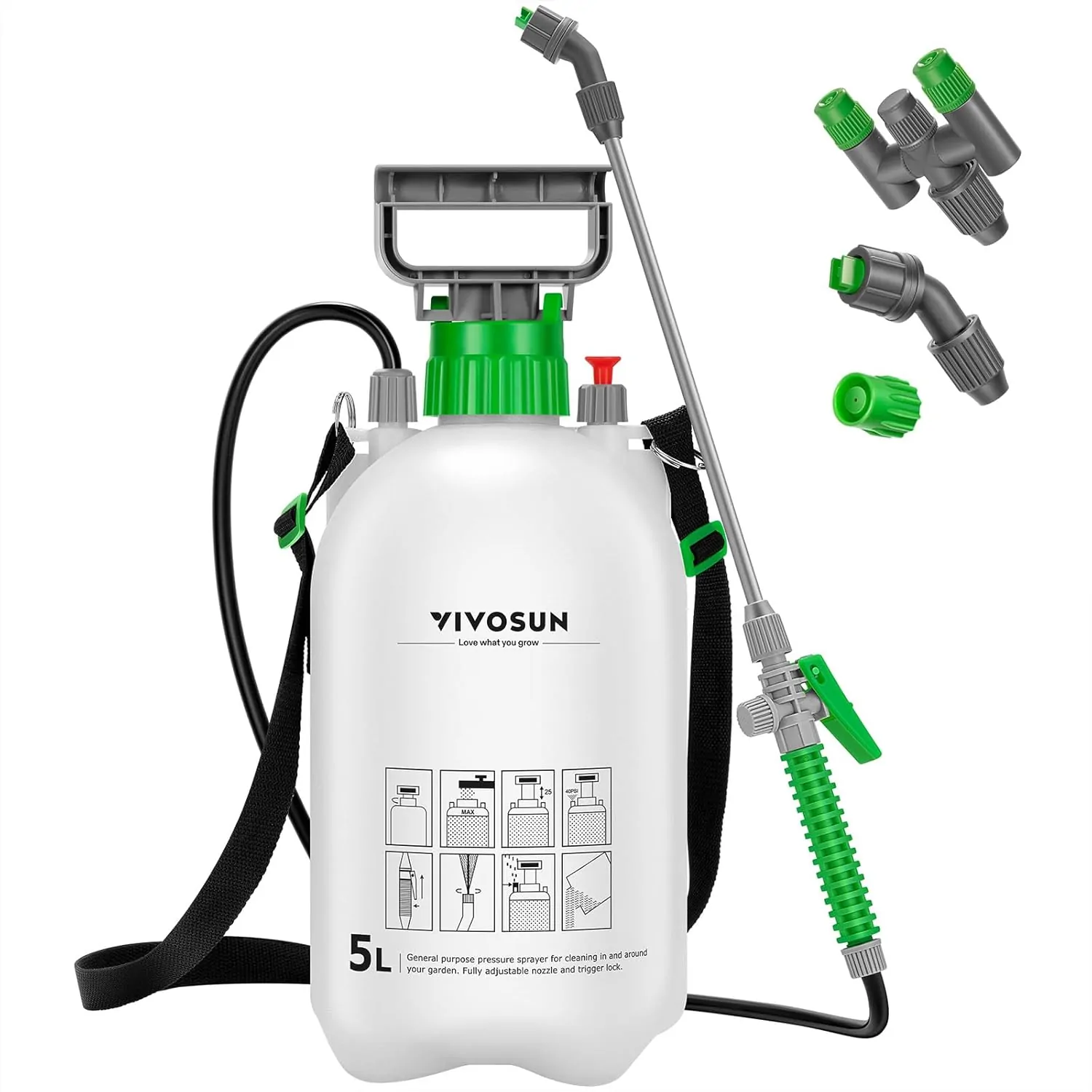 | VIVOSUN 5L Pressure Sprayer⭐ 4.7 |
| Check Price |
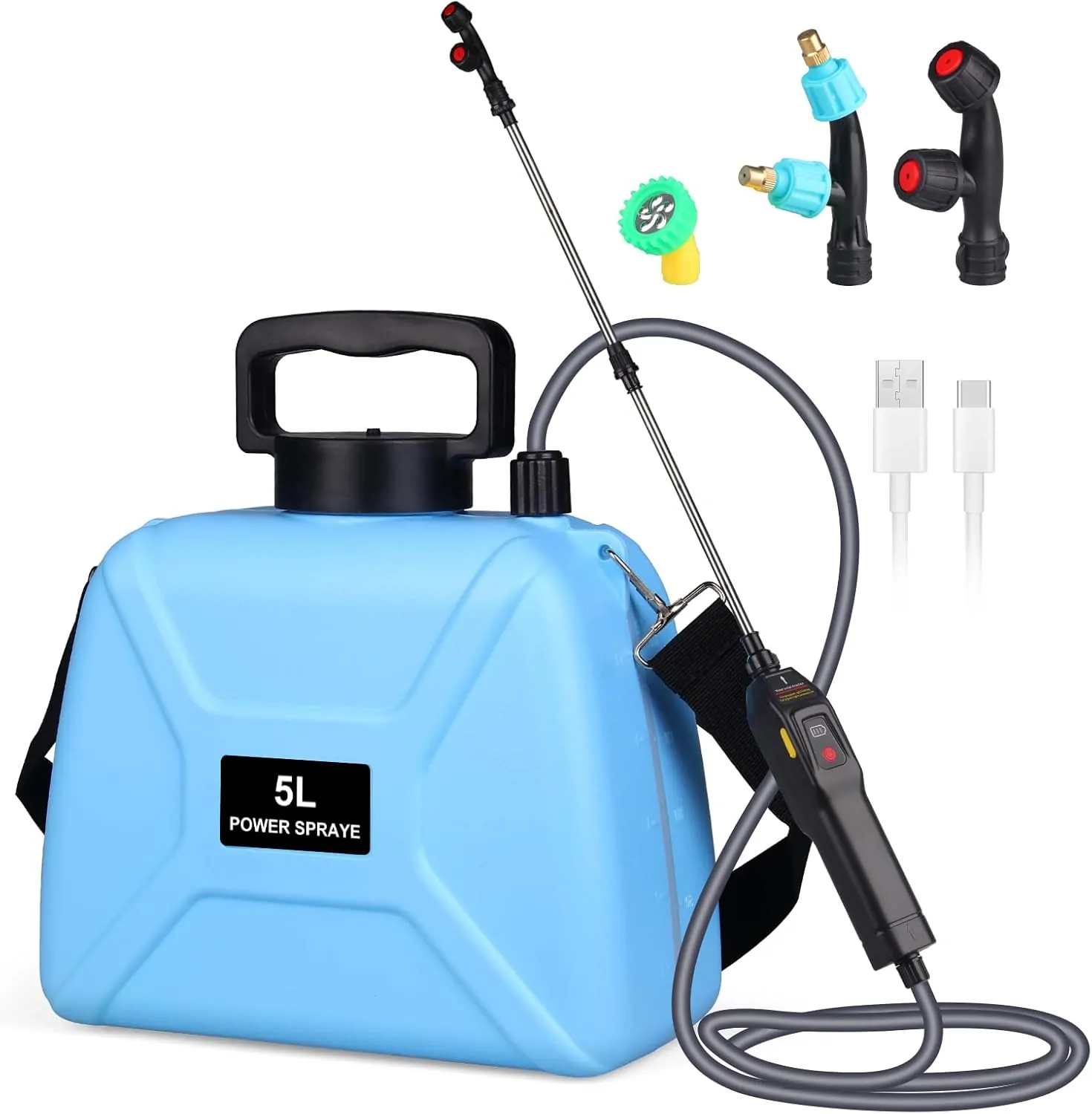 | Qdreclod Battery Powered Sprayer⭐ 4.8 |
| Check Price |
Why Choose a 5 Litre Sprayer?
A 5 litre garden sprayer is a portable spraying tool designed to distribute water or an approved diluted garden treatment through a nozzle. Depending on its design, pressure comes from a manually operated pump or an electrically powered pumping system. The tank holds the liquid, while the hose, trigger, lance and nozzle control its delivery.
The main attraction of a 5 litre sprayer is its manageable capacity. Five litres of water weigh approximately 5 kg, excluding the tank, pump, hose and accessories. If the empty equipment weighs 1.5 kg, its approximate filled weight becomes 6.5 kg. This is an example calculation rather than the weight of a particular product, but it shows why carrying arrangements deserve attention.
For my vegetable beds, including chilies, tomatoes and cucumbers, I wanted enough liquid for several planting rows without repeatedly returning to the water source. I also needed controlled spraying around marigolds, petunias and young fruit trees, where nozzle direction mattered more than simply covering a large area. Before choosing the capacity, I considered three practical questions:
- Garden size: Could a 5 litre tank cover the intended area without excessive refilling?
- Working weight: Could I comfortably carry the filled equipment for the expected spraying duration?
- Application: Did the nozzle and pressure system suit the intended water or labelled treatment?
Compared with a 1–2 litre hand sprayer, a 5 litre model generally reduces refill interruptions for medium-sized jobs. Compared with an 8–16 litre sprayer, it generally carries less liquid weight and is easier to store. Nevertheless, a smaller tank does not automatically make the equipment lighter to operate if its pump, shoulder strap or handle is poorly designed.
My recommendation: Choose a 5 litre sprayer when your regular workload needs more capacity than a spray bottle but does not justify carrying a large backpack tank. For extensive lawns or repeated large-area treatments, calculate the required liquid volume before assuming five litres will be sufficient.
6 Best 5 Litre Garden Sprayers for Plants & Lawn Care
After practical testing and personal use, I have selected six of the best 5-litre garden sprayers that performed well in terms of durability, convenience, and overall efficiency. In this article, I will share my genuine experience with each sprayer, explain their main features and performance, and provide useful tips to help you select the most suitable sprayer according to your gardening requirements.
1. Plplaaoo 5L Garden Sprayer
The plplaaoo 5L Garden Pump Sprayer is a manual pressure sprayer made for small and medium gardening jobs. With a 5-liter tank capacity, it allows you to spray for longer periods without needing frequent refilling. The sprayer body is built from durable plastic, making it strong enough for regular garden use while keeping the overall weight low. It weighs around 1,22 kg when empty, so carrying it is comfortable even after filling it with water or spraying solution.
expert start
What Is It and Its Features
A useful feature of this sprayer is the adjustable shoulder strap. It helps you carry the tank comfortably on your shoulder and keeps your hands free while working in the garden. The large opening at the top makes filling the tank simple and reduces spills when adding fertilizers, pesticides, or other garden solutions.
Why It Matters
The sprayer comes with a comfortable grip handle and a shut-off valve that gives better control over the spray flow. These features are important because gardening tasks can take a long time. A sprayer that is difficult to hold, refill, or control can quickly become uncomfortable. This model focuses on easy handling, balanced weight distribution, and comfortable use during longer spraying sessions.
My Set-Up and My Experience
Setting up the plplaaoo sprayer was quick and simple. I first removed the top lid, added clean water to check for any leakage, and later used it with liquid fertilizer solutions. The wide opening helped me mix the solution easily without making a mess. After tightening the lid properly, I pumped the handle to create pressure inside the tank. Around 15–20 pumps were enough to achieve good spraying pressure. During operation, the handle felt comfortable in my hand, and the shut-off valve worked smoothly. Even after extended use, I did not feel much hand tiredness.
Performance
The spray performance is consistent and easy to control. It works well for gentle watering, especially for flower beds, small plants, and shrubs. When used with fertilizer or pest control solutions, it provides an even spray pattern without unwanted leaks or sudden bursts. The plastic tank handled normal pressure effectively and showed good durability during use. The trigger mechanism responded quickly, and the shut-off valve allowed instant control whenever needed.
Practical Tips
- Build enough pressure before starting spraying
- Avoid filling above the 5L tank capacity
- Wash the tank and nozzle after applying chemicals
- Adjust the shoulder strap to distribute weight properly
- Keep the sprayer stored in a cool and dry location
- Release internal pressure before opening the lid
- Clean the nozzle frequently to prevent blockage
expert end
pro start
| Pros | Cons |
|---|---|
| ✔️ Lightweight design makes it easy to carry | ❌ Plastic construction may not be suitable for heavy commercial work |
| ✔️ Large opening allows quick and easy filling | ❌ Requires manual pumping to create pressure |
| ✔️ Adjustable shoulder strap improves comfort | ❌ Not the best choice for very large garden areas |
| ✔️ Maintains pressure well during spraying | ❌ Does not include a metal spray lance |
| ✔️ Useful for different gardening applications | ❌ Shoulder strap padding could be improved |
pro end
2. VIVOSUN 5L Pressure Sprayer
The VIVOSUN 1,35 Gal Pump Sprayer is a manual pressure sprayer designed for different outdoor and indoor gardening tasks. It can be used for watering plants, weed control, lawn maintenance, and cleaning jobs such as car washing or spraying around outdoor areas. The tank is made from high-density polyethylene (HDPE), while other components use brass, stainless steel, and polypropylene materials, giving it a balance of strength, durability, and lightweight handling.
expert start
What Is It and Its Features
VIVOSUN offers a reliable 5-litre pressure sprayer that works well for medium to large gardening areas. Its ergonomic design improves comfort during extended spraying sessions, while the built-in pressure release valve adds an extra layer of safety. One of its most useful features is the translucent tank. Unlike completely solid-colored tanks, this design allows you to easily check the liquid level and read the measurement markings.
Why It Matters
This feature is important because the VIVOSUN 1.35 Gallon Pump Sprayer helps you apply water, nutrients, and solutions more accurately and efficiently. The translucent tank makes it easier to measure the correct amount of liquid, reducing the chances of overwatering or applying excessive fertilizer concentration. The pressure control system and release valve also help protect plants by preventing strong spray pressure that can disturb soil, damage roots, or affect the growing medium.
My Set-Up and My Experience
Before using this model, I had already used a smaller handheld VIVOSUN sprayer for more than one year for both indoor and outdoor gardening. It performed well, but after creating a new indoor grow setup, I noticed a major limitation. Reaching plants placed at the back of my grow tent became challenging. The branches were thicker, plants were closer together, and moving around them without causing damage was difficult. The longer wand and flexible hose solved this problem. They allowed me to reach deeper areas without leaning into the tent or disturbing nearby leaves and stems. I was able to water plants more comfortably and achieve better coverage, even when the grow space was crowded.
Performance
The performance of this sprayer is one of its strongest points. After building pressure, it produces a smooth and consistent spray instead of uneven bursts. The pressure relief valve is especially helpful because it allows quick pressure adjustment. If too much pressure builds up and causes strong spraying, soil splashing, or possible erosion, the valve allows you to release pressure immediately and continue working. The package includes all three nozzles, although some users may misunderstand the wide nozzle because it works as an insert rather than a complete separate nozzle. Even so, it performs effectively for different applications.
Practical Tips
- Always remove pressure before opening the tank
- Never carry a completely filled tank using only the pump handle
- Adjust fertilizer concentration carefully because of the 1.3-gallon capacity
- Use the pressure release valve to prevent soil disturbance
- The standard adjustable nozzle works well for most gardening tasks
- Use the shoulder strap for more comfortable long spraying periods
expert end
pro start
| Pros | Cons |
|---|---|
| ✔️ Long wand helps reach difficult areas inside grow tents | ❌ Pump handle clips may become weak if used for lifting a full tank |
| ✔️ Translucent tank makes measuring nutrients easier | ❌ Double nozzle spray performance may vary when applying pesticides |
| ✔️ Pressure release valve provides better spraying control | ❌ Wand length may not be enough for some taller users |
| ✔️ Lightweight design even after filling the tank | ❌ Plastic pump components require careful handling |
| ✔️ Includes all three nozzles for different applications | ❌ Requires dosage adjustment when replacing a smaller sprayer |
pro end
3. Qdreclod Battery Powered Sprayer
The Qdreclod Battery Powered Garden Sprayer is a rechargeable electric sprayer that comes with a 1,3-gallon (5-liter) tank. It has a lightweight blue design and is built with strong plastic material for regular outdoor use. This sprayer can handle many tasks, including garden spraying, lawn care, plant watering, vehicle cleaning, and washing outdoor surfaces.
expert start
What is it and its Features
Unlike traditional hand-pump sprayers, this model uses a built-in electric motor to maintain steady pressure without requiring manual pumping. Its rechargeable battery provides around 2–3 hours of continuous operation, which makes it suitable for medium to large gardens and longer spraying jobs. It offers three spray settings, including adjustable mist modes for wide and gentle coverage and a strong stream mode for focused spraying. The atomizing nozzle converts liquid into a fine mist, helping reduce liquid waste and improving spray distribution.
Why It Matters
This sprayer is useful because it reduces physical effort and saves valuable time. Manual sprayers require repeated pumping, which can become tiring and may create uneven pressure during use. The Qdreclod sprayer provides continuous and stable spraying, allowing users to complete garden work with less fatigue. It is especially helpful for gardeners with larger outdoor spaces or those who want a faster plant-care routine.
My Set-Up and My Experience
The package contained the sprayer unit, telescopic wand, adjustable shoulder strap, USB rechargeable handle, and three different nozzles. Setting it up was quick, and every component connected properly without difficulty. I started by using it for watering garden beds and found it comfortable to handle. The lightweight plastic body made carrying easier, while the shoulder strap helped reduce pressure during longer spraying sessions. I also tried it on my grape arbor and taller fruit trees, where traditional pump sprayers usually require extra effort or a ladder.
Performance
The Qdreclod sprayer delivers reliable performance for everyday garden tasks. The electric pump maintains consistent pressure, and changing between mist and stream modes is straightforward. The atomizing nozzle provides balanced coverage, which is beneficial for plants that require gentle spraying. It worked efficiently on lawns, trees, and garden beds. The strong stream setting reached nearly 9 feet from the wand tip, helping spray taller plants without unnecessary stretching. The removable nozzle and hose design also make cleaning easier and help prevent blockages.
Practical Tips
- Charge the battery completely before the first use to get the best battery performance.
- Adjust the telescopic wand when spraying high or distant areas to avoid unnecessary stretching or ladder use.
- Clean the nozzle and hose after every use to reduce the chance of clogging.
- Choose mist mode for sensitive plants and stream mode for trees or areas requiring stronger spray.
- Monitor the liquid level regularly to prevent the sprayer from running without fluid.
expert end
pro start
| Pros | Cons |
|---|---|
| ✔️ Lightweight design even after filling the tank | ❌ Pump handle clips may feel weak when carrying a full tank |
| ✔️ Transparent tank helps measure nutrients and liquids easily | ❌ Double nozzle spray may not provide consistent pesticide coverage |
| ✔️ Pressure relief valve provides better spraying control | ❌ Wand length may feel short for taller users |
| ✔️ Long wand helps reach plants placed deeper in growing areas | ❌ Plastic pump components require careful handling |
pro end
4. MagicFox Deluxe 5L Garden Sprayer
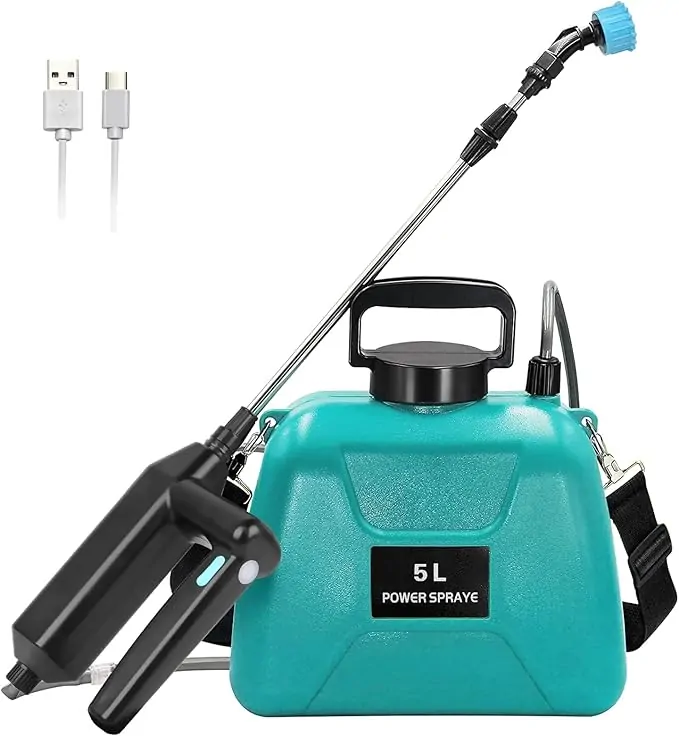
The MagicFox Electric Plant Sprayer is a battery-operated garden sprayer with a 5-liter (1,35-gallon) tank capacity. It is designed to simplify tasks like watering plants, controlling weeds, applying fertilizers, and light outdoor cleaning without requiring manual pumping. The sprayer uses a 7,4V rechargeable battery with a 2000mAh capacity and starts spraying automatically with the push of a single button.
expert start
What Is It and Its Features
The MagicFox Deluxe 5L Garden Sprayer is designed with convenience, durability, and easy operation in mind. It includes a pressure relief valve and a translucent tank, allowing users to check the liquid level quickly. The wide tank opening makes filling easier, while the built-in filter helps reduce clogging problems during spraying. A major feature of this model is the electric handle, which allows simple spray control with an on/off function. The telescopic stainless-steel wand extends up to 23.6 inches, helping users reach plants more comfortably without excessive bending or stretching.
Why It Matters
The wide opening and transparent tank improve the overall user experience. The large opening makes refilling faster and reduces spills, while the translucent design helps you monitor remaining liquid without opening the tank. Overall, this sprayer is built to provide better comfort, faster operation, and easier handling for regular gardening activities.
My Set-Up and My Experience
Setting up the MagicFox sprayer was quick and straightforward. The assembly process took only a short time, and all parts connected properly without requiring any special tools. I charged the battery using the USB cable, filled the tank through the wide opening, and installed the nozzle according to the task. The sprayer was lightweight when empty and remained easy to carry after adding liquid. During my first test, it operated smoothly and provided a noticeable improvement compared with traditional manual pump sprayers, especially when covering larger areas.
Performance
When used correctly, the MagicFox sprayer provides strong and reliable performance. The electric pump delivers a stable spray flow, helping users cover larger areas in less time. Compared with hand-operated sprayers, it reduces the effort required and makes long spraying sessions more comfortable. Battery performance is another positive feature, as a full charge can handle several gallons of spraying work without frequent interruptions. The fine mist nozzle worked well for delicate plants, while the stronger spray setting was useful for weed control and general outdoor applications.
Practical Tips
- Run a water test before the first application to make sure the sprayer works properly.
- Avoid tightening the lid too much because it may create sealing problems.
- Check that the lid is properly closed before carrying or moving the sprayer.
- Charge the battery completely before starting longer spraying jobs.
- Clean the nozzles after every use to maintain proper spray performance and prevent blockages.
expert end
pro start
| Pros | Cons |
|---|---|
| ✔️ Electric spraying reduces time and physical effort | ❌ The lid may become loose while carrying a full tank |
| ✔️ Good battery capacity with convenient recharging | ❌ Some users report power problems after limited usage |
| ✔️ Different nozzle options support various spraying needs | ❌ Overall build quality may differ between units |
| ✔️ Adjustable wand helps reach difficult areas easily | ❌ Handle performance depends heavily on lid security |
| ✔️ Large filling opening makes adding liquid simple | ❌ Long-term reliability may vary from one unit to another |
pro end
5. Spear & Jackson 5LPAPS Pump Action Pressure Sprayer
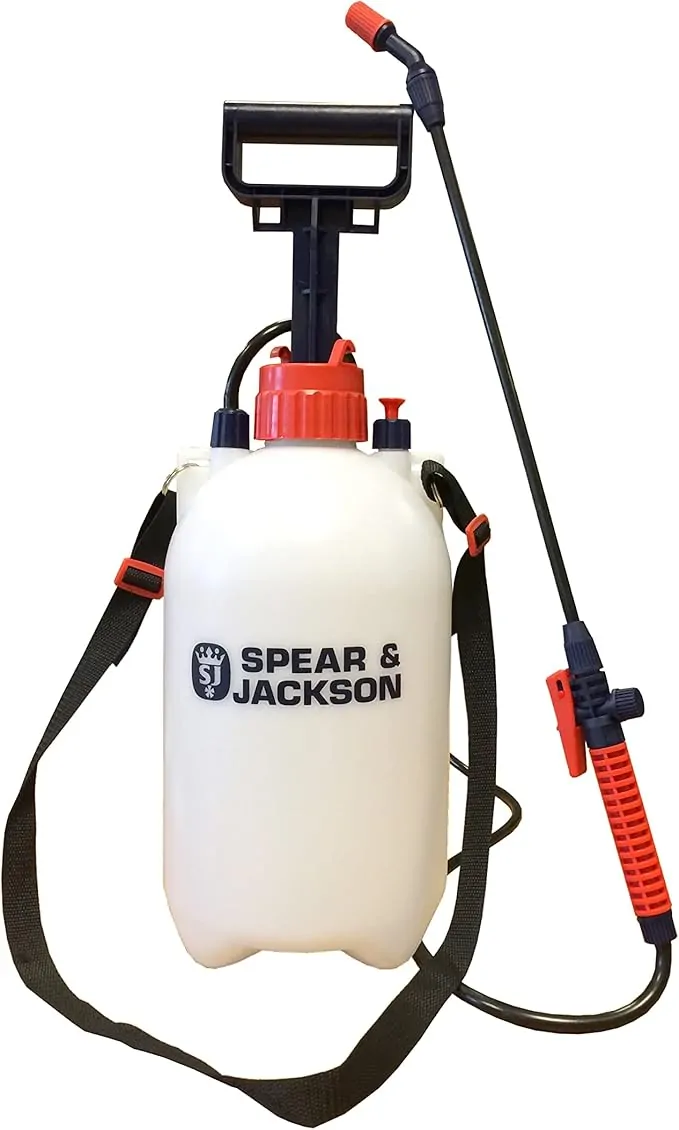
The Spear & Jackson 5LPAPS is a manual pump action pressure sprayer that comes with a 5-litre (1,3 gallon) tank, making it a suitable choice for small to medium-sized gardens. The tank is built from strong plastic and has a translucent design with clear measurement markings in both litres and fluid ounces. This feature is very useful because it helps you measure and mix water-based products accurately inside the tank without needing to estimate amounts.
expert start
What Is It and Its Features
The Spear & Jackson 5L Hand Pump Sprayer is a small and lightweight sprayer designed for gardeners who need a simple handheld solution. Its hand pump system provides good control over spraying, making it useful for precise applications. A helpful feature is the pressure release valve, which improves safety by allowing you to release built-up pressure after finishing the work.
Why It Matters
The sprayer includes a fully adjustable nozzle that lets you change the spray pattern from a fine mist to a stronger stream. This adjustment is important because different plants and gardening tasks require different spray types. The 560 mm long watering wand and 1.3-metre hose provide better reach under leaves, around pots, and in hard-to-access garden areas. The lockable trigger also helps reduce hand strain during extended spraying jobs.
My Set-Up and My Experience
I filled the tank by following the measurement markings, which helped me prepare the correct water mixture without wasting liquid. The wide filling opening made it simple to add water, even when using a watering can. After closing the lid, I pumped the handle around 10–12 times to create pressure. The pumping process was smooth and required little effort. I adjusted the shoulder strap according to my height, which made carrying the full 5-litre tank more comfortable. The weight distribution felt balanced, and the sprayer remained stable while moving around the garden.
Performance
The adjustable nozzle performs efficiently, and changing between mist and spray modes only requires a quick twist. The mist setting works well for sensitive plants, while the stronger spray option is useful for watering soil or applying gardening treatments. The trigger operates smoothly, and the locking feature is convenient when spraying for longer periods. I did not notice any leakage from the hose or nozzle during repeated use. The pressure remains stable for covering a reasonable area before another pump is needed, helping save time and effort.
Practical Tips
- Pump the sprayer completely before use to maintain consistent pressure
- Choose the mist setting for seedlings and fragile plants
- Release pressure after use to extend seal life
- Wash the tank with clean water after applying fertilisers
- Set the shoulder strap properly for comfortable carrying
expert end
pro start
| Pros | Cons |
|---|---|
| ✔️ Simple pumping system creates pressure easily | ❌ Plastic construction may feel less premium for heavy-duty users |
| ✔️ Tank includes clear measurement markings | ❌ Metal lance option is not available |
| ✔️ Adjustable nozzle provides smooth spray control | ❌ Not ideal for thick or high-viscosity liquids |
| ✔️ Extended wand helps reach difficult spots | ❌ Requires manual pumping for larger areas |
| ✔️ Comfortable shoulder strap improves portability | ❌ Strap cushioning could be improved |
pro end
6. SideKing 5L Multi-Purpose Battery Powered Sprayer
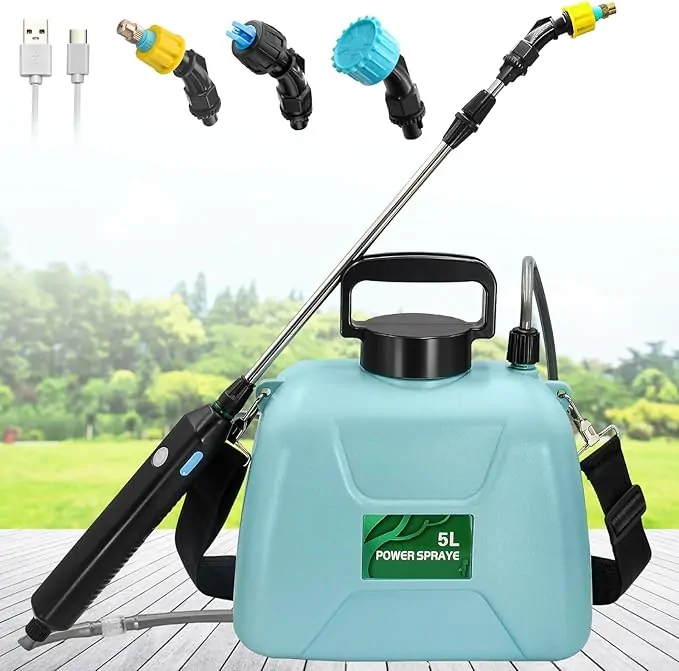
The SideKing Electric Sprayer is a portable battery-powered garden sprayer with a 1,35-gallon (5L) tank capacity. It includes a USB rechargeable handle, three types of mist nozzles (fan-shaped, shower-shaped, and brass), a telescopic wand that extends from 8,66 inches to 23,6 inches, and an adjustable shoulder strap for comfortable carrying. Unlike traditional manual sprayers, it removes the need for repeated pumping and can provide continuous spraying for up to two hours on a full charge.
expert start
What is it and its Features
The SideKing 5L Multi-Purpose Sprayer is designed for different gardening applications and everyday outdoor tasks. Its adjustable nozzle system and durable build make it useful for applying herbicides, pesticides, fertilizers, and other liquid solutions. It also includes a pressure release valve that allows safe pressure removal and easier maintenance.
Why it Matters
This sprayer is a good option for gardeners who want to reduce physical effort while maintaining accurate spraying. It can be used for watering plants, applying fertilizers, insecticides, herbicides, disinfectants, and even household cleaning tasks. The adjustable nozzle gives you the flexibility to move between a soft mist and a stronger spray, making it suitable for multiple purposes.
My Set-Up and My Experience
When I received the SideKing sprayer, all components were included, and assembling the unit was simple. The instructions were limited, but a helpful YouTube guide made the setup process easier. I charged the sprayer with my regular phone charger instead of the provided cable, and it worked without any issue. The lightweight design, comfortable handle, and shoulder strap made it easy to carry during outdoor work.
I originally planned to use this sprayer for pesticide application and weed control around my home. During the first operation, I noticed some initial sputtering as air moved out of the lines, but after that, the spray became smooth and consistent. The fan nozzle provided wide coverage, which worked well for treating larger areas. I also tested it inside a small greenhouse, and the performance was excellent.
Another thing I appreciated was the customer support. When I noticed that a wand component was missing, I contacted the company by email. They quickly provided the missing part and sent a replacement wand. Their fast response increased my confidence in the product.
Performance
The SideKing electric sprayer delivered better performance than I expected. The interchangeable nozzles were useful for different applications—the brass nozzle allowed accurate spraying in specific areas, while the fan nozzle helped cover larger surfaces quickly. The wide-mouth tank opening makes filling convenient, and the handle on the lid improves handling. The translucent tank allows easy monitoring of liquid levels, and cleaning the sprayer is simple.
Practical Tips
- Fully charge the battery before the first use to achieve maximum runtime
- Begin spraying slowly to clear air from the hose lines
- Use the fan nozzle for large areas and the brass nozzle for precise spraying
- Avoid filling beyond the maximum level to reduce leakage risk
- Clean the wand and nozzles after each use to avoid blockages
expert end
pro start
| Pros | Cons |
|---|---|
| ✔️ Long wand helps reach plants in deep or difficult areas | ❌ Pump handle clips may not handle lifting when the tank is full |
| ✔️ Transparent tank makes liquid measurement easier | ❌ Dual nozzle performance may vary with pesticide solutions |
| ✔️ Pressure relief valve provides better spraying control | ❌ Wand length may feel short for taller users |
| ✔️ Lightweight design even with a full tank | ❌ Plastic pump components require careful use |
| ✔️ Includes all three nozzle options | ❌ Spray dosage may need adjustment compared with smaller sprayers |
pro end
Which 5 Litre Sprayer Type Works?
Before comparing individual features, I wanted to understand how the different operating systems affected everyday gardening. A 5 litre capacity describes the liquid volume, not the pumping mechanism or carrying arrangement. Two sprayers with similar tanks can therefore behave very differently during use.
Manual Pressure Sprayers Explained
A manual 5 litre pressure sprayer commonly uses a hand-operated piston pump to compress air above the liquid inside a pressure-rated tank. When the trigger opens, the compressed air pushes liquid through the outlet, hose and nozzle. As spraying continues, tank pressure gradually decreases, so additional pumping becomes necessary.
This simple mechanism appealed to me because it did not require battery charging. However, I also considered the effort involved in restoring pressure, particularly when spraying several vegetable beds. A model with a smooth pump handle, effective seals and a suitable pressure relief valve seemed more useful than one advertised only for high pressure.
For a clean-water evaluation, I would record the initial pumping effort, the time taken for pressure to fall and the spray pattern before repressurising. These observations are more meaningful than assuming every manual sprayer delivers constant pressure.
Shoulder-Carried Sprayers and Comfort
Many 5 litre garden sprayers include a shoulder strap, allowing the operator to carry the tank while holding the spray lance. This arrangement can improve mobility around vegetable beds, flower borders and small fruit trees.
However, the weight rests unevenly on the body. A narrow strap may become uncomfortable during longer sessions, while a poorly positioned hose can interfere with walking or bending. I therefore preferred to examine strap width, adjustment, attachment points and tank balance rather than judging comfort from product photographs.
A practical inspection should include carrying the empty sprayer and, where permitted, testing it with clean water. The tank should remain reasonably stable without pulling the shoulder excessively to one side.
Battery-Powered 5 Litre Sprayers
A 5 litre battery garden sprayer uses an electric pump to move liquid through the system. Depending on the design, it may provide automatic pressure control or continuous pumping while the trigger is operated.
This arrangement can reduce repetitive manual pumping, making it attractive for gardeners who spray frequently or experience difficulty operating a pressure pump. However, the battery, motor, electrical connections and charging system introduce additional maintenance considerations.
I would check the manufacturer’s stated battery voltage, capacity, charging time, replacement availability and permitted operating conditions. Battery capacity alone does not establish spraying duration because runtime also depends on motor power, operating pressure and flow rate.
| 5 Litre Sprayer Type | Main Advantage | Main Limitation | Suitable Situation |
|---|---|---|---|
| Manual pressure sprayer | Simple operation without charging | Requires repeated pumping | Occasional garden spraying |
| Shoulder-carried pressure sprayer | Convenient movement around beds | Uneven carrying weight | Vegetables and flower borders |
| Battery-powered sprayer | Reduced manual pumping effort | Battery and motor maintenance | Frequent spraying sessions |
These categories can overlap because manual and battery-powered models may both use shoulder straps. For occasional spraying, I would generally prioritise a well-built manual model. For frequent work where pumping effort becomes a significant concern, a battery-powered design deserves consideration, provided its replacement components are available.
How Does a 5L Sprayer Work?
Understanding the working principle helped me recognise which specifications were genuinely important. A sprayer does more than release liquid from a tank. Its components must maintain a controlled flow while producing a spray pattern suitable for the target.
In a typical manually pressurised model, the pump introduces air into the tank, creating pressure above the liquid. Opening the trigger allows this pressure to move liquid through the pickup tube, hose and lance. The nozzle then shapes the liquid into droplets.
In a battery-powered model, an electric pump generally supplies the driving pressure instead. Some models use pressure switches to regulate operation, while others use different control arrangements. The exact system should be confirmed from the manufacturer. The most important working components include:
- Tank: Stores the liquid and, in pressurised models, must withstand the specified operating pressure.
- Pump: Generates the pressure needed for liquid movement.
- Seals and valves: Help prevent leakage and control pressure or liquid direction.
- Hose and lance: Carry liquid towards the application point.
- Trigger and nozzle: Control release, flow pattern and droplet distribution.
I also paid attention to the distinction between nominal capacity and maximum working fill. Some pressure sprayers require an air space above the liquid. A tank described as having 5 litres of total volume may therefore permit less than 5 litres of liquid, while another model may be designed to hold 5 litres of liquid with additional space for compressed air.
The manufacturer’s filling mark and instructions must determine the correct amount. Overfilling a pressurised tank can interfere with proper operation and create unnecessary risk.
Which Features Actually Improve Spraying?
When comparing the best 5 litre garden sprayers, I found that practical features mattered more than the number of accessories advertised. A sprayer with several nozzles was not necessarily better than one with a single reliable nozzle suited to my main gardening tasks.
Pressure, Flow and Nozzle Control
Pressure affects liquid delivery, but higher pressure is not automatically better. Excessive pressure may produce finer droplets, increasing drift under unsuitable conditions. Insufficient pressure can create an uneven pattern or poor coverage.
I therefore focused on stable pressure and appropriate flow control. An adjustable nozzle can be useful when changing between targeted spraying and broader coverage, but its adjustment range should remain predictable.
For example, a clean-water calibration might show a nozzle delivering 0.4 litres per minute under a particular operating condition. At that rate, 5 litres would provide approximately 12.5 minutes of actual spraying. This is a calculation, not a universal performance figure, and the result changes with pressure and nozzle setting.
During a practical test, I would collect discharge for one minute in a measuring container, repeat the measurement and compare the results. If output changed considerably as pressure declined, I would account for that variation when deciding whether the sprayer suited precise applications.
Tank Design and Carrying Comfort
A well-designed tank should be stable, easy to fill and convenient to clean. A wide filling opening can reduce spills, particularly when adding clean water or preparing a label-approved mixture.
Translucent tanks with clear volume markings are useful because they allow the operator to monitor remaining liquid. However, markings should be checked against a measured volume rather than assumed accurate.
For my gardening routine, I preferred a tank that could stand securely on level ground while filling. I also looked for a handle that allowed controlled lifting without putting unnecessary stress on the pump assembly.
Wands, Hoses and Filtration
The spray lance influences reach and direction. A longer lance can help direct spray towards lower leaf surfaces or reachable young fruit-tree branches without forcing the operator to bend excessively.
However, a long or heavy lance may become tiring. I would compare its material, connection quality, balance and ability to maintain the intended spray direction.
Filtration also deserves attention. A removable inlet or nozzle filter can help prevent particles from blocking narrow passages. Nevertheless, filters do not make contaminated water suitable for spraying, and fine particles may still pass through unsuitable mesh sizes. My preferred features were:
- Adjustable spray pattern suitable for the intended application.
- Reliable trigger with smooth operation and secure shutoff.
- Accessible filter that can be cleaned without unnecessary dismantling.
- Comfortable lance with secure hose connections.
- Pressure relief valve on applicable pressurised designs.
Rather than choosing the longest feature list, I would select the model whose components worked together reliably for my regular spraying tasks.
Which Materials Last Longer?
Durability became one of my main buying concerns because a 5 litre sprayer experiences repeated pumping, liquid contact, lifting and storage. The quality of individual components determines how well the equipment handles these demands.
Tank and Pump Construction
Many garden sprayers use plastic tanks, commonly made from materials such as polyethylene or polypropylene. These materials can provide useful resistance to various substances, but actual compatibility depends on the specific formulation, concentration, temperature and manufacturer’s approval.
I would inspect the tank for consistent wall construction, secure joints, visible damage and a stable base. A pressure-rated tank should also have clear manufacturer identification and operating instructions.
The pump deserves equal attention. A smooth-moving piston, reliable check valves and replaceable seals are valuable because repeated pumping places mechanical stress on these parts.
For durability evaluation, I would distinguish a short functional test from evidence of long-term reliability. A sprayer maintaining pressure during a 15-minute clean-water session demonstrates short-term function, not several years of dependable operation.
Seals, Hoses and Corrosion Resistance
Seals are particularly important because they contact both liquid and moving components. Materials such as EPDM, nitrile rubber and FKM are used in different equipment, but none should be treated as universally compatible with every garden chemical.
I would check the exact seal material and manufacturer compatibility guidance before using fertilisers, pesticides or cleaning agents. If this information was unavailable, I would avoid assuming that a general-purpose sprayer could safely handle the formulation.
Metal parts also require inspection. Stainless steel and brass can provide useful corrosion resistance in suitable applications, but their performance depends on the alloy, liquid chemistry and exposure conditions. To judge build quality, I concentrated on:
- Connection strength: Secure fittings without damaged threads or loose joints.
- Seal accessibility: Replaceable O-rings and pump seals where supported.
- Hose flexibility: Resistance to kinking during ordinary handling.
- Metal protection: Suitable materials for the intended liquids and cleaning procedures.
A clean-water leak inspection can identify immediate defects, while repeated checks after normal use may reveal developing problems. However, corrosion and material degradation require longer observation under known conditions, so I would not claim permanent durability from a few successful trials.
Can 5L Sprayers Handle Garden Chemicals?
Chemical compatibility is one of the most important considerations when selecting a 5 litre garden sprayer. A model suitable for clean water is not automatically suitable for insecticides, fungicides, herbicides or foliar fertilisers.
In my vegetable garden, different activities required different decisions. Watering newly transplanted seedlings was not the same as applying a crop-approved pesticide, and a sprayer previously used for herbicide treatment could create contamination risks if later used on vegetables.
I therefore treated compatibility as a combination of equipment approval, product label instructions, seal resistance, cleaning requirements and intended crop use.
For foliar feeding on tomatoes or chilies, I would first confirm that the fertiliser formulation was approved for foliar application and suitable for the equipment. I would also check whether it dissolved or dispersed as required, whether filtration was appropriate and whether the nozzle could provide the intended coverage.
For pesticide applications, the product label determines the permitted crop, pest, dilution, application method, protective equipment and restrictions. A sprayer’s advertised chemical resistance does not override these requirements. My compatibility checks included:
- Approved formulation: Confirm the intended liquid is permitted by both the product label and sprayer manufacturer.
- Seal material: Verify compatibility rather than relying on general claims.
- Application pattern: Match the nozzle to the treatment instructions.
- Cross-contamination: Use dedicated equipment where necessary, especially for herbicides.
- Cleaning: Follow the chemical label and equipment manufacturer’s decontamination instructions.
I would not conduct casual chemical compatibility experiments with unknown mixtures. Where approval or compatibility remained uncertain, choosing another suitable sprayer was safer than risking equipment damage or crop injury.
How Much Garden Can 5L Cover?
One question I wanted answered before buying was how much practical work a 5 litre tank could complete. The answer depends on the application rate, nozzle output, walking speed, plant density and target coverage.
For example, if a calibrated application required 0.1 litres per square metre, a 5 litre working fill would theoretically cover 50 square metres. If the required application volume increased to 0.2 litres per square metre, the same quantity would cover only 25 square metres.
These figures demonstrate the calculation rather than recommending an application rate. Actual treatment volume must follow the relevant label and calibration results. For my gardening activities, I considered several situations:
- Vegetable beds: Targeted spraying around chilies, tomatoes and cucumbers.
- Flower borders: Controlled application around marigolds, zinnias and petunias.
- Young fruit trees: Spraying reachable foliage without excessive drift.
- Small lawn areas: Applying suitable treatments after calculating the required volume.
A 5 litre sprayer may be convenient for small lawn sections, but its capacity becomes less attractive when the required treatment volume is high. Similarly, reaching young fruit-tree foliage depends on lance length, plant height, nozzle design and safe operator positioning. High pressure should not be used as a substitute for appropriate reach.
My recommendation: Estimate the treatment area and calibrate the nozzle before deciding whether five litres will reduce refilling enough to justify the purchase.
How Should You Test Your Sprayer?
After selecting a suitable model, I considered delivery inspection and clean-water calibration essential before any garden treatment. These checks help identify manufacturing defects, assembly problems and unsuitable spray patterns without introducing chemicals.
Inspection and Clean-Water Calibration
The first step is to compare the delivered equipment with the manufacturer’s package description. The tank, pump, hose, lance, nozzle, seals, strap and accessories should match the stated configuration.
Next, assemble the equipment according to its instructions and inspect every connection. For a pressure sprayer, check the pressure relief mechanism and never exceed the manufacturer’s specified pressure or filling limit.
For a practical calibration, I would add a measured quantity of clean water, operate the sprayer under normal conditions and collect the discharge for a timed interval.
Suppose the measured output was 300 millilitres in 30 seconds. The calculated flow rate would be 0.6 litres per minute. At that rate, a full 5 litre working fill would theoretically provide about 8.3 minutes of continuous discharge, assuming the flow remained constant.
For manual pressure sprayers, I would repeat the measurement at different stages of pressure reduction. This would help identify whether the nozzle output remained suitable throughout the operating cycle.
Crop-Specific Garden Trials
Once calibration was satisfactory, I would begin with the intended gardening tasks rather than immediately testing every available attachment.
For newly transplanted chilies and tomatoes, clean-water practice could help establish how easily the lance directed liquid towards the target area. A 10-minute session could reveal handling difficulties, hose interference or awkward trigger operation, although it would not establish long-term performance.
For flower borders, I would examine spray pattern consistency and whether nearby plants received unwanted droplets. With young fruit trees, I would assess reachable foliage while keeping both feet safely on the ground. Throughout these sessions, I would record:
- Operating duration: Actual spraying time separately from preparation and refilling.
- Liquid consumption: Measured water used for the calibrated task.
- Pressure behaviour: Pumping frequency or electric pump operation.
- Handling: Comfort, balance, hose movement and trigger effort.
- Leakage: Any visible moisture around joints, seals or the tank.
These measurements would help determine whether the sprayer suited my workload. They would not establish treatment effectiveness or crop improvement without a properly designed assessment.
How Can You Spray More Safely?
Safety is not limited to wearing gloves. It begins with choosing the correct equipment, understanding the intended liquid and preventing unnecessary exposure to people, animals and nearby plants.
For a manually pressurised sprayer, I would always follow the specified filling limit and release pressure using the manufacturer’s procedure before opening the tank. I would never attempt to remove a pump assembly while the tank remained pressurised.
Before spraying, I would inspect the hose, trigger, nozzle and connections for damage. A leaking hose or poorly secured nozzle can cause unexpected exposure, particularly when handling a labelled garden treatment. My essential precautions included:
- Protective equipment: Wear the gloves, eye protection, clothing and respiratory protection required by the product label.
- Weather: Avoid unsuitable windy conditions and temperatures that increase drift or crop injury risks.
- People and animals: Keep others away according to label requirements.
- Pressure: Never exceed equipment limits or bypass safety valves.
- Mixing: Use only approved formulations and follow exact label instructions.
When spraying near vegetables, flowers and fruit trees, I would also consider neighbouring plants and sensitive growth. A treatment approved for one crop may damage another, even when applied through the same equipment.
For herbicide applications, I strongly preferred dedicated equipment to reduce the possibility of residues reaching edible crops or ornamental plants. Cleaning cannot be assumed to eliminate every contamination risk.
Finally, I would keep children and animals away from stored chemicals and spraying equipment, and never use food or drinking containers for mixing or measuring treatments.
How Do You Maintain 5L Sprayers?
A 5 litre garden sprayer may be relatively simple equipment, but maintenance affects its reliability and useful life. Neglected residues, damaged seals and blocked nozzles can create problems even when the original construction is sound.
After each application, I would follow the treatment label and manufacturer’s cleaning procedure. Clean-water spraying may require straightforward draining and rinsing, while chemical applications can require specific decontamination steps and lawful disposal of rinsate. I would never discharge leftover pesticide or contaminated rinse water into drains, ponds or unsuitable soil areas. Routine maintenance should cover:
- Tank: Inspect for cracks, distortion, residue and damaged threads.
- Pump: Check smooth operation and maintain seals as instructed.
- Nozzle: Remove deposits using the approved cleaning method, never by blowing through it with the mouth.
- Hose: Inspect for kinks, brittleness and damaged connections.
- Battery: Follow charging, storage and replacement instructions where applicable.
For longer storage, I would release pressure, complete the required cleaning, drain the equipment as instructed and allow appropriate drying. Storage should protect the tank, seals and electrical components from excessive heat, direct sunlight and freezing conditions.
I would also examine the equipment before the next spraying season. A clean tank does not guarantee that an O-ring, hose or valve has remained in good condition during storage. Long-term durability is best assessed through documented use and periodic inspection rather than a single successful cleaning session.
Where Should You Buy 5L Sprayers?
When shopping for the best 5 litre garden sprayers, I would compare the reliability of the seller alongside the equipment specifications. A reasonably priced sprayer can become expensive if essential parts are missing, the warranty is unclear or replacement seals are unavailable.
Local garden suppliers and equipment shops offer the advantage of physical inspection. I could examine the tank, operate the pump without pressure where permitted, inspect the trigger and assess the strap before making a decision.
Manufacturer websites can help confirm the exact model, technical specifications, package contents and authorised distributors. Reputable online sellers may offer wider choices, but their descriptions should be checked against the manufacturer’s information.
| Buying Check | What to Verify | Why It Matters |
|---|---|---|
| Tank capacity | Nominal and permitted working fill | Prevents incorrect filling assumptions |
| Pressure system | Operating method and safety limits | Matches equipment to workload |
| Nozzle and lance | Included parts and available replacements | Supports intended spray applications |
| Seal compatibility | Materials and approved formulations | Reduces leakage and damage risks |
| Warranty | Coverage, region and claim procedure | Clarifies after-sales support |
| Total cost | Price, delivery, accessories and maintenance | Reveals longer-term ownership expense |
Before paying, I would ask whether the seller supplied replacement nozzles, pump seals, hoses and pressure relief components. For battery-powered models, I would also investigate battery replacement cost and charger availability.
After delivery, I would inspect the packaging, confirm the exact model and retain the invoice or proof of purchase. Any damaged component or missing accessory should be reported within the seller’s return period.
My buying recommendation: Prioritise a verified model with suitable specifications, dependable safety features and accessible replacement parts over an attractive listing that provides little technical information.
Is a 5 Litre Sprayer Worth Buying?
After examining capacity, operating systems, construction, compatibility and maintenance, I found that the value of a 5 litre garden sprayer depended mainly on how well it matched the intended workload. However, the capacity does not eliminate the need for careful selection. A manual model still requires pumping, a shoulder-carried tank can become uncomfortable, and a battery-powered design introduces charging and electrical maintenance.
If I were choosing again, I would begin with the required spraying volume, then examine the pump mechanism, pressure stability, nozzle control, carrying comfort, chemical compatibility and replacement parts. These factors would influence my decision more than decorative features or unsupported performance claims.
For occasional garden spraying, a dependable manual 5 litre pressure sprayer with a comfortable strap, adjustable nozzle and functional pressure relief system would be a sensible starting point. For frequent spraying where manual pumping becomes tiring, I would consider a battery-powered alternative after checking its runtime information and serviceability.
Before purchasing, measure your garden workload, confirm the equipment’s approved applications and inspect its most important components. After purchasing, complete clean-water calibration and record actual performance. This approach provides a stronger basis for choosing a reliable sprayer than relying on capacity or promotional descriptions alone.
Frequently Asked Questions (FAQs)
1. Can I use these 5L garden sprayers for both water and chemical solutions?
Yes, most 5L garden sprayers mentioned here can be used for both water and different chemical solutions. However, always review the manufacturer’s instructions and product specifications before using any chemical to confirm that the sprayer materials are compatible with that substance.
2. Can I use these sprayers for indoor plants or are they specifically for outdoor use?
Although 5L garden sprayers are mainly designed for outdoor gardening, many models can also be used for indoor plants when used correctly. Choose a sprayer with adjustable nozzle settings to control spray intensity and pattern. Ensure proper ventilation during indoor use and always follow the manufacturer’s recommendations to prevent possible problems.
3. Are replacement parts readily available for these garden sprayers?
Most trusted garden sprayer brands offer replacement parts for their products. Gardeners can usually find spare components such as nozzles, seals, and valves through manufacturers or authorized dealers. Keeping replacement parts available helps with quick repairs and extends the overall lifespan of your 5L garden sprayer.
references:
1. Morgan, W., & Matthews, G. (2012). Compression sprayer without the drudgery of manual pumping. International Pest Control, 54(4), 200.
2. Hazrati, H., Saharkhiz, M. J., Niakousari, M., & Moein, M. (2017). Natural herbicide activity of Satureja hortensis L. essential oil nanoemulsion on the seed germination and morphophysiological features of two important weed species. Ecotoxicology and environmental safety, 142, 423-430.
3. Shelare, S. D., Waghmare, S. N., Yenurkar, M. M., & Jodh, G. R. (2023, March). Experimental analysis of sprayer for horticulture and orchards. In Proceedings of International Conference on Intelligent Manufacturing and Automation: ICIMA 2022 (pp. 651-660). Singapore: Springer Nature Singapore.
4. Ramos, L. M., Querejeta, G. A., Flores, A. P., Hughes, E. A., Zalts, A., & Montserrat, J. M. (2010). Potential dermal exposure in greenhouses for manual sprayers: analysis of the mix/load, application and re-entry stages. Science of the total environment, 408(19), 4062-4068.
5. Matthews, G. A. (1996). Pedestrian sprayers: equipment for ultra‐low and very‐low volume spraying 1. Eppo Bulletin, 26(1), 103-110.
6. Yezekyan, T., Marinello, F., Armentano, G., & Sartori, L. (2018). Analysis of cost and performances of agricultural machinery: Reference model for sprayers.
7. Gil, E., Salcedo, R., Soler, A., Ortega, P., Llop, J., Campos, J., & Oliva, J. (2021). Relative efficiencies of experimental and conventional foliar sprayers and assessment of optimal LWA spray volumes in trellised wine grapes. Pest management science, 77(5), 2462-2476.
8. Andersen, P. G., & Jørgensen, L. (1996). Some considerations on the choice of a field sprayer 1. EPPO Bulletin, 26(1), 37-41.

