
5 Main Types of Garden Sprayer Pumps and How They Work


Choosing the correct pump is one of the most important decisions when selecting a garden sprayer. The pump works as the main working part of the sprayer – it creates the required pressure, controls the liquid flow, and affects how spray droplets are produced. A high-quality pump provides a proper spray pattern (including droplet size and spraying distance) and offers enough durability to work reliably for many seasons. The worldwide garden sprayers market had already reached around $1.2 billion in 2023, showing how widely sprayers are used for watering plants, applying fertilizers, and managing pests.
An Overview Of Types of Garden Sprayer Pumps
| Product | Title | Features | Explore |
|---|---|---|---|
 | SOLO 425 4-Gallon Piston Backpack Sprayer |
| Check Price |
 | PEAYLI Air Operated Double Diaphragm Pump |
| Check Price |
 | AQUASTRONG 2 HP Shallow Well Jet/Centrifugal Pump |
| Check Price |
 | Hypro 6500C 6-Roller Pump |
| Check Price |
 | Giftsfaloy 1 Gallon Battery powered Pump Sprayer |
| Check Price |
 | VIVOSUN 27oz Handheld Garden Pump Sprayer |
| Check Price |
 | VAXMAY Battery Powered Backpack Sprayer |
| Check Price |
 | Ortho Dial N Spray Hose-End Sprayer |
| Check Price |
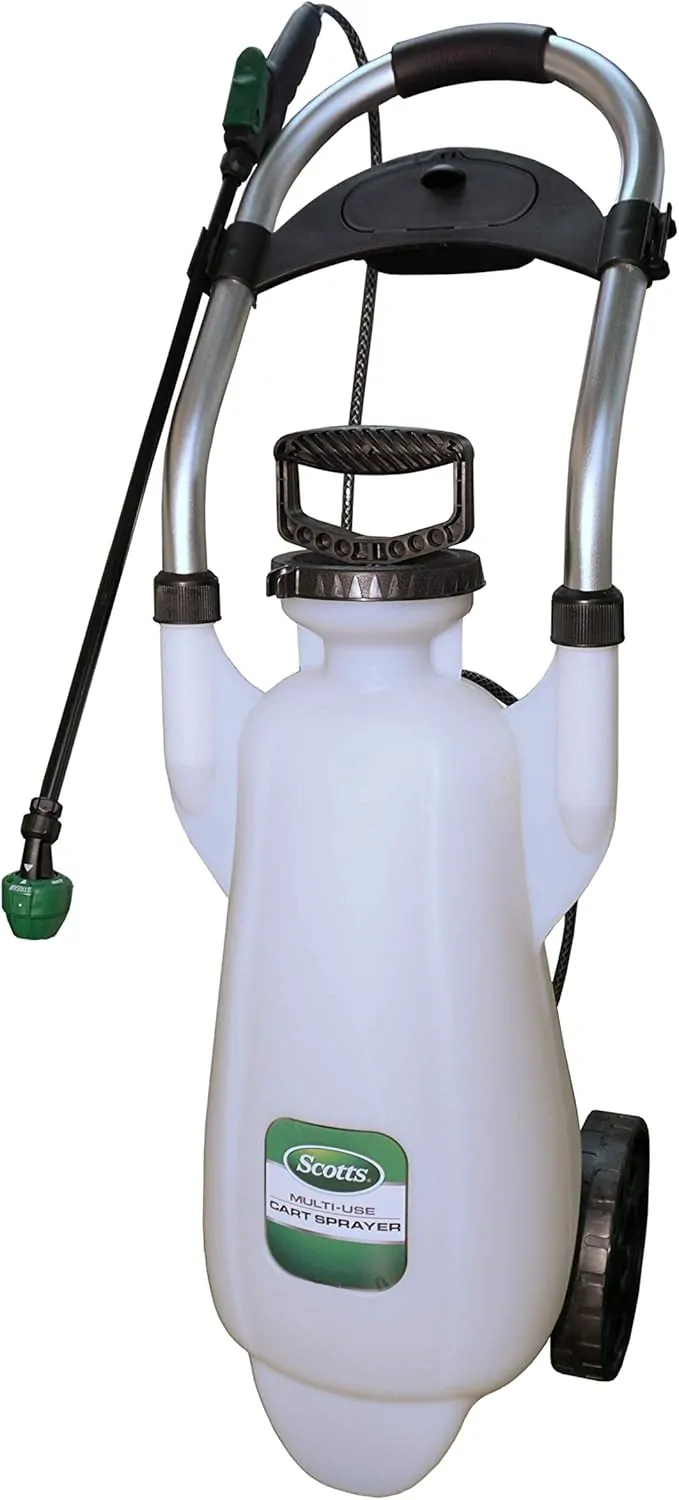 | Scotts 190618W Wheeled Sprayer Pump |
| Check Price |
Different garden sprayer pumps, such as piston, diaphragm, centrifugal, and roller pumps, work in different ways and provide different spraying results. For instance, piston pumps can create very high pressure (producing a fine mist with a long spraying distance of up to around 90 psi), while diaphragm pumps usually provide lower pressure (creating larger droplets around 60 psi) and are better suited for handling strong chemicals. Centrifugal pumps are designed to move large amounts of water with lower pressure, whereas roller pumps provide medium flow rates with stable and consistent pressure.
5 Types of Garden Sprayer Pumps
Garden sprayer pumps are the central component of every spraying system because they control how liquid is transferred, pressurized, and released. Different pump designs are developed for specific uses, liquid types, spraying capacities, and pressure requirements. Understanding these differences helps you choose a pump that matches your gardening needs.
The most common pump types used in garden sprayers are piston pumps, diaphragm pumps, centrifugal pumps, and roller pumps. Each pump type has different benefits, drawbacks, and ideal applications that influence spraying performance, accuracy, and compatibility with different liquids.
1. Piston Pumps
A piston pump works by moving fluid through a cylinder using a back-and-forth moving piston. During pumping, a metal or ceramic piston moves upward and downward inside the cylinder. On the upward stroke, it pulls liquid into the chamber, and on the downward stroke, it pushes the liquid out. This positive-displacement mechanism provides a controlled and accurate amount of liquid with every stroke. Piston pumps are capable of producing very high pressure levels – most manual backpack piston pumps can reach around 90 psi – which helps create a very fine spray mist.
The fine mist produced by piston pumps can reach greater distances, making them a suitable choice for spraying tall trees, shrubs, and areas that are difficult to reach. They are also known for their durability and accuracy because the pump delivers nearly the same spray volume with each stroke. This consistent output is one reason farmers prefer piston pumps for precise fertilizer and chemical applications. Most piston pumps are made with strong, long-lasting components and are easy to maintain because common problems can often be fixed by replacing worn seals, gaskets, or valves.
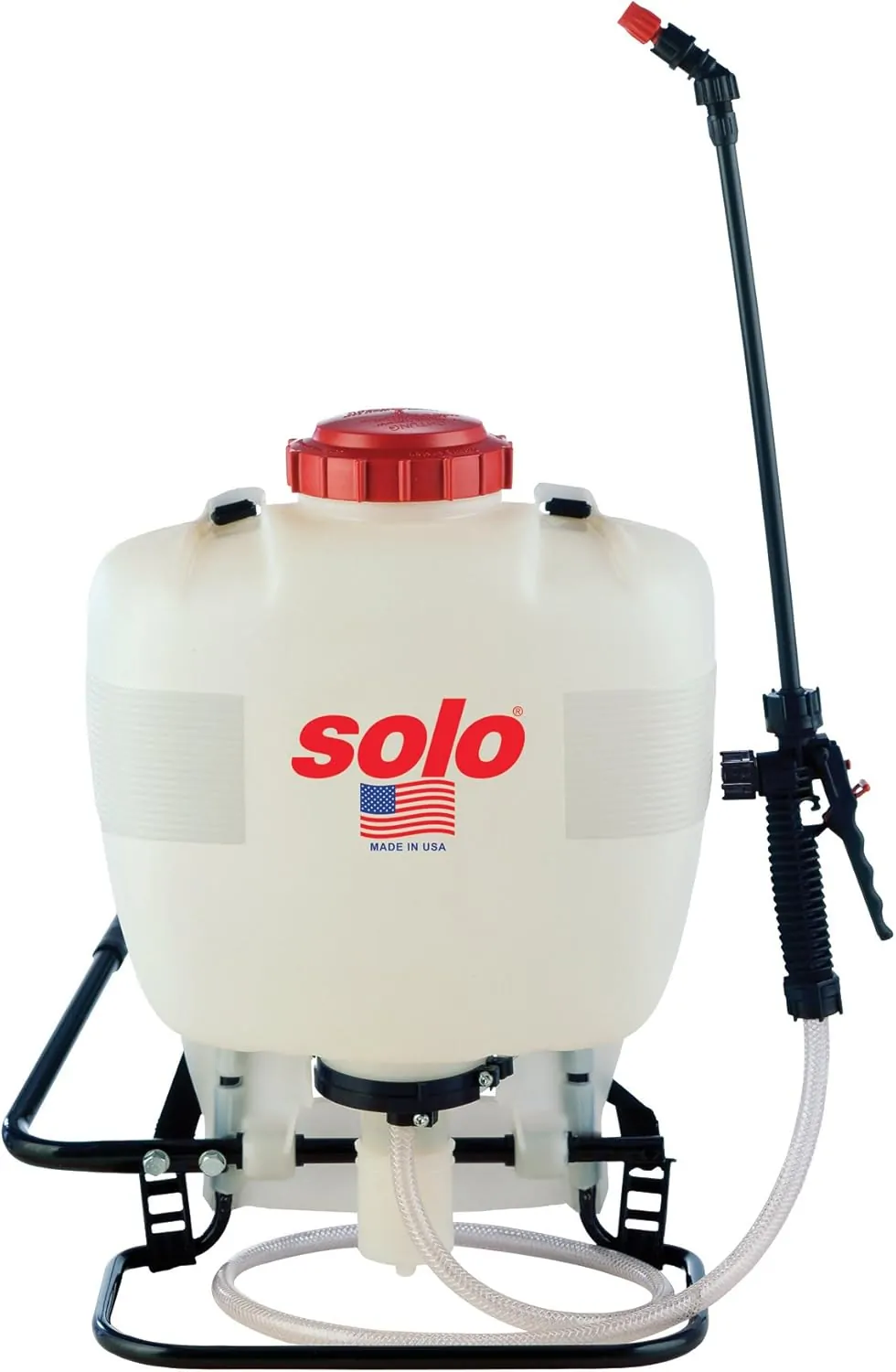
SOLO 425 4-Gallon Piston Backpack Sprayer
The high-performance piston pump generates pressure up to 90 psi, allowing powerful and consistent spraying for fertilizers, pesticides, herbicides, and disinfectants in large garden areas. It features a durable 4-gallon HDPE tank, comfortable padded shoulder straps, different nozzle options, and a long wand with a hose for better reach and flexible spraying applications. From my experience, the sprayer remained well-balanced and comfortable to operate while walking, which made spraying orchard trees much easier.
expert start
What Is It and Its Features
The SOLO 425 4-Gallon Piston Backpack Sprayer is a manual backpack sprayer built for large gardens, orchards, landscaping projects, and pest management applications. It uses high-density polyethylene (HDPE), a strong and chemical-resistant plastic material. This durable material helps protect the tank from damage caused by fertilizers, pesticides, chemicals, and exposure to sunlight. A major feature of this sprayer is its high-performance piston pump system. It can create pressure up to 90 psi, which is suitable for many demanding spraying tasks. This high pressure helps produce an even spray pattern and allows the liquid to reach plants located at a greater distance. In my experience, this feature is especially helpful when treating taller bushes and small trees.
Why It Matters
The 20-inch unbreakable wand and 48-inch high-pressure hose are also important features because they provide additional spraying distance. While using it in my orchard, I was able to reach tree branches easily without standing too close to the plants. The sprayer includes four interchangeable nozzles: an adjustable spray nozzle, fan spray nozzle, hollow cone nozzle, and jet stream nozzle. These different options allow you to select the most suitable spray pattern according to your application. For example, I used the fan spray nozzle when I needed wider coverage and the jet stream nozzle for focused spraying on specific areas.
Comfort is another strong point of the SOLO 425. The padded polyester shoulder straps help spread the weight evenly across the back. Since the tank holds up to 4 gallons of liquid, proper weight distribution is important, especially during longer spraying periods.
My Set-Up and My Experience
For my setup, I mainly used the SOLO 425 4-Gallon Piston Backpack Sprayer for applying fish and seaweed-based fertilizer in my garden and orchard. The total spraying area was approximately two acres, so I needed a sprayer that could handle extended working periods. Before spraying, I filled the tank with the fertilizer solution through the wide opening. The built-in filter screen was very helpful because it stopped unwanted particles from entering the tank and blocking the nozzle. This reduced interruptions because I did not need to clean the nozzle repeatedly during work.
I also attached a longer extension tube to the wand to improve reach when spraying higher branches of fruit trees. This adjustment worked effectively and helped me achieve more uniform coverage throughout the tree canopy.
Performance
The SOLO 425 4-Gallon Piston Backpack Sprayer provides reliable and powerful performance. The piston pump mechanism works smoothly and is simple to operate. After a few pumping movements, I was able to maintain stable pressure for continuous spraying. It performs well when covering larger areas because the strong pressure helps maintain a consistent spray pattern. This improves the distribution of fertilizers, pesticides, and other solutions across plants.
Another useful performance feature is the double filtration system. It reduces the chance of nozzle blockage, especially when using organic fertilizers that may contain small solid particles. The upright standing design is also practical because it makes filling the tank and preparing chemical mixtures easier. Although this seems like a small feature, it helps save time during preparation and operation.
Practical Tips
- Always inspect hose connections before beginning any spraying work.
- Avoid creating excessive pressure inside the tank to prevent possible leaks.
- Select the appropriate nozzle according to the spraying requirement.
- Wash and clean the tank and nozzle after every use.
- Use the trigger lock carefully and only when needed during extended spraying tasks.
expert end
pro start
| Pros | Cons |
|---|---|
| ✔️ Powerful piston pump creates high pressure up to 90 psi | ❌ Trigger lock performance may reduce during extended spraying sessions |
| ✔️ Large 4-gallon tank helps reduce frequent refilling | ❌ Hose connection can become loose if excessive pressure is applied |
| ✔️ Padded shoulder straps provide better comfort during long use | ❌ A completely filled tank may feel heavy after extended operation |
| ✔️ Multiple nozzle choices support different spraying applications | ❌ Does not include a chest strap for additional backpack support |
| ✔️ Strong chemical-resistant HDPE tank construction | ❌ Manual pumping is required to maintain spraying pressure |
pro end
2. Diaphragm Pumps
A diaphragm pump moves liquid by using a flexible rubber (or plastic) diaphragm that moves forward and backward inside a chamber. When the diaphragm moves, it creates suction on one side and pushes fluid out with pressure on the other side. Unlike piston pumps, these pumps do not have direct contact between a piston and cylinder, which helps reduce internal damage and wear. Diaphragm pumps usually work at medium pressure levels (handheld sprayers can reach around 60 psi, while larger engine-powered diaphragm pumps can achieve much higher pressure) and create bigger spray droplets.
The larger droplets provide better coverage because they attach to surfaces more easily and are less affected by wind drift. This makes them useful for weed control, lawn spraying, and similar applications. One major benefit of diaphragm pumps is their excellent chemical resistance. They can handle harsh or abrasive liquids such as bleaches, wettable powders, and fertilizer mixtures better than piston pumps. Small 12-volt diaphragm pumps, which are commonly used in ATV and battery-powered sprayers, can operate without damage even when running dry. Many models also come with an automatic “demand” switch that turns the pump on only when the spray trigger is pressed.
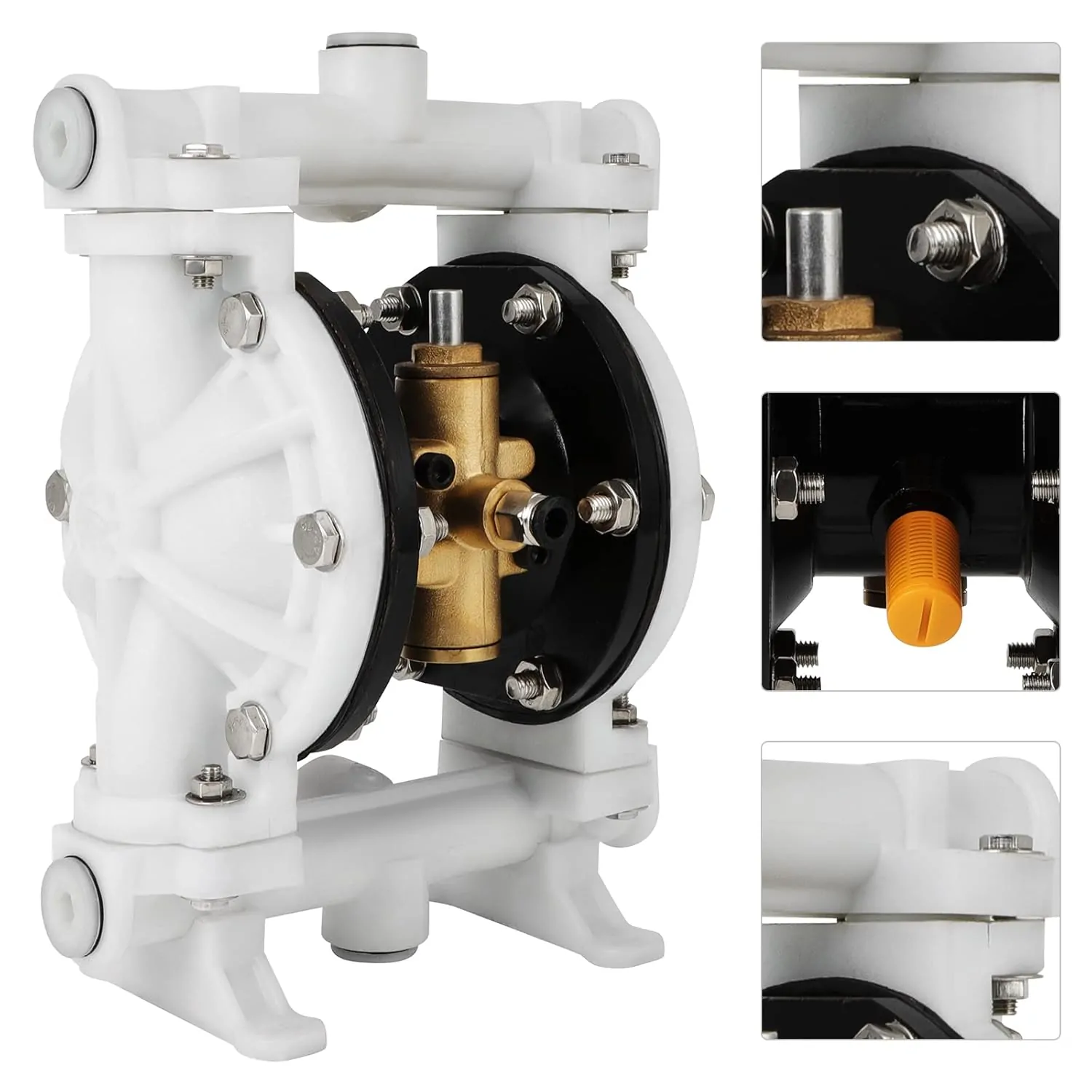
PEAYLI Air Operated Double Diaphragm Pump
Pneumatic QBK-15 double diaphragm pump provides up to 12 GPM flow capacity with 115 PSI pressure and uses strong PTFE and nitrile rubber diaphragms for durability. Its body is made from aluminum, polypropylene, and stainless steel, providing excellent chemical resistance, secure bolt construction, and dependable industrial fluid transfer performance. In my experience, the installation process was straightforward and the flow remained stable, but the suction worked better when the fluid container was positioned close to the pump level.
expert start
What Is It and Its Features
The PEAYLI QBK-15 air-operated double diaphragm pump is a pneumatic transfer pump built for industrial and workshop liquid movement applications. Rather than depending on an electric motor, this pump uses compressed air to move two diaphragms back and forth, allowing liquid to pass through the system. A key feature of this model is its double diaphragm structure. This design improves pumping performance and helps maintain a more consistent liquid flow. The diaphragms are manufactured from PTFE and nitrile rubber materials, which provide strong resistance against chemicals, heat, and wear. This makes the pump suitable for transferring liquids such as oils, chemicals, coatings, and industrial waste materials.
Why It Matters
The pump comes with 1/2 inch inlet and outlet ports, allowing it to work with many commonly available hose connections. Its 1/4 inch air inlet makes it easy to connect with most air compressors used in workshops and small industrial environments. Another useful feature is the full bolt construction design, which improves sealing strength and helps prevent leaks during operation. Leak prevention is especially important when handling chemicals or oils because liquid leakage can create safety and maintenance problems. The pump also features self-priming capability, allowing it to begin operation without manually filling the pump first. It can provide suction up to 16.4 feet (5 meters), making it useful for moving liquids from tanks, containers, and storage drums.
My Set-Up and My Experience
In my experience, setting up the Air Operated Double Diaphragm Pump QBK-15 by PEAYLI was simple and required minimal effort. I connected the pump with a small air compressor using standard 1/2 inch hoses for both inlet and outlet connections. Due to its lightweight and compact design, positioning the pump near the liquid container was easy and did not require complex installation support. After connecting the air supply, the pump started quickly and began transferring liquid through the system. During my testing with water and light oil, it performed well for regular transfer jobs. I also appreciated the pneumatic operating system because it avoids electrical power use, which can provide additional safety when working with chemicals or flammable liquids.
Performance
Regarding performance, the QBK-15 diaphragm pump delivered a smooth and stable flow when the air pressure remained consistent. It performed best when the liquid source was placed at a similar height as the pump. Under these conditions, the pump maintained reliable flow and operated without noticeable problems. However, when I tested it by pulling liquid from a lower position, the suction ability became less effective and small air leaks could occur if the seals were not properly tightened. For this reason, the pump is better suited for short-distance liquid transfer or situations where the fluid source is positioned close to the pump. Overall, it provided dependable performance for general fluid transfer applications when installed correctly and operated under suitable conditions.
Practical Tips
- Place the liquid container close to the pump height to improve suction performance.
- Use an air compressor that provides steady pressure for consistent pumping.
- Inspect suction line connections properly to prevent air leakage.
- Keep hoses and fittings clean to stop debris from damaging the ball valves.
- For improved operation, slightly prime the pump before continuous use.
expert end
pro start
| Pros | Cons |
|---|---|
| ✔️ Lightweight and compact design allows quick and simple installation | ❌ Suction capability is not as strong as expected |
| ✔️ Pneumatic operation provides safer use in chemical working areas | ❌ Ball valve performance depends greatly on gravity |
| ✔️ PTFE and nitrile diaphragms provide resistance against chemicals and heat | ❌ Air leakage can occur if suction seals are not properly secured |
| ✔️ Full bolt construction design helps minimize liquid leakage | ❌ Performance decreases when pumping liquid from lower levels |
| ✔️ Works well for different industrial liquid transfer applications | ❌ Not suitable for demanding heavy-duty suction requirements |
pro end
3. Centrifugal Pumps
A centrifugal pump works by using a rotating impeller (a rotor fitted with vanes) to push fluid outward through centrifugal force. When the impeller rotates, it pulls water into the pump and pushes it toward the outer pump housing, which creates a continuous water flow. Centrifugal pumps are designed to move large amounts of water but usually provide low to medium pressure. Sprayer-type centrifugal pumps commonly deliver around 20 to 400+ gallons per minute, while the practical operating pressure is usually about 50–150 psi.
These pumps have a simple design because they do not contain internal check valves, and some models can handle small particles or sand when specially designed for that purpose. Gardeners commonly use centrifugal pumps for irrigation systems and hose-end sprayers because they can operate continuously for watering lawns, gardens, and agricultural fields. However, centrifugal pumps generally cannot produce the fine mist created by piston or diaphragm pumps. Their spray pattern is usually larger and coarser, making them better suited for high-volume watering applications and boom spraying instead of precise plant spraying.
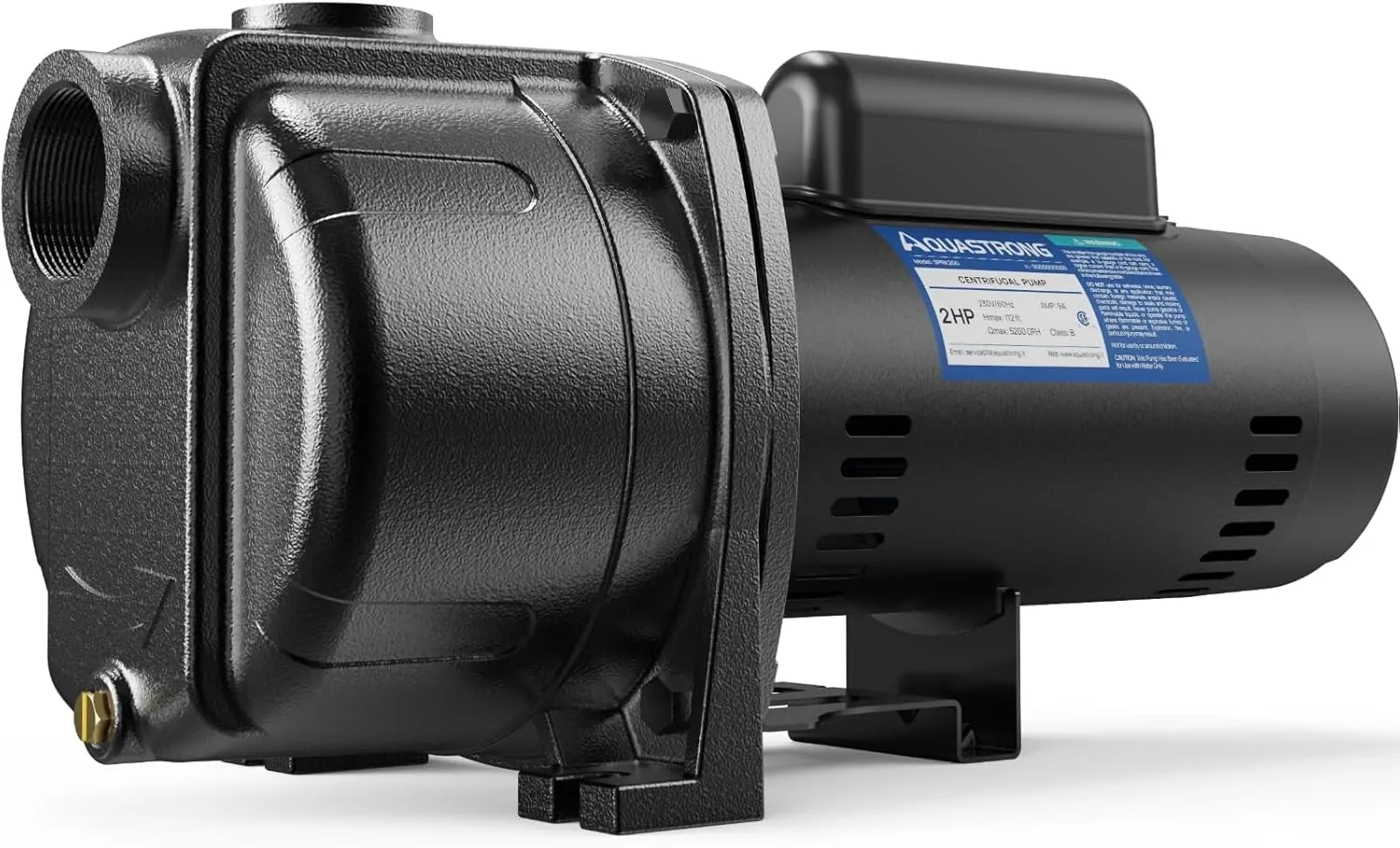
AQUASTRONG 2 HP Shallow Well Jet/Centrifugal Pump
The powerful 2 HP motor produces a maximum flow rate of up to 5200 GPH and provides 86 GPM capacity, delivering strong and stable water pressure. Its durable cast iron housing, reinforced impeller, and automatic thermal overload protection help improve efficiency, safety, and overall service life for irrigation applications. From my experience, the installation process was easy, the pump primed quickly, and it provided quieter operation with better sprinkler pressure compared to my previous pump.
expert start
What Is It and Its Features
The AQUASTRONG 2 HP Shallow Well Jet/Centrifugal Pump is a booster pump designed for lawn sprinklers, garden irrigation systems, and shallow well water supply applications. It is built to move high volumes of water quickly while maintaining reliable pressure for irrigation pipes and sprinkler systems. One of its major features is its maximum flow capacity of 86 gallons per minute (5200 GPH). This powerful flow rate is especially helpful when operating several sprinklers at once or covering a large garden area that requires strong and even water distribution. The pump can also provide a maximum lifting height of approximately 108–112 feet, allowing it to move water effectively from wells or lower water sources. Another useful feature is the reinforced impeller and diffuser system, which improves water movement efficiency and helps maintain consistent pressure while the pump is running.
Why It Matters
The cast iron volute housing provides excellent durability and makes this pump suitable for continuous outdoor use. Compared with plastic models, cast iron pumps generally offer better strength and can handle demanding irrigation tasks for a longer period. The pump also includes an automatic thermal overload protection system, which helps prevent motor overheating and protects against possible damage during operation. These safety features are important because irrigation pumps often operate for extended periods. A powerful motor, strong construction, and built-in protection system help provide dependable performance while reducing maintenance requirements.
My Set-Up and My Experience
I installed the AQUASTRONG 2 HP Shallow Well Jet/Centrifugal Pump to replace my previous sprinkler pump, and the installation process was quite simple because the inlet and outlet connections matched my existing setup. I used quick connectors on both sides, which made removing the old pump and installing the new one much easier. The electrical connection was also straightforward, requiring only two hot wires and one ground wire connected to the labeled terminals. Priming the pump was easy because I used a three-way PVC fitting with a hose bib, which allowed me to add water and remove trapped air without difficulty. The pump successfully primed on the first try and immediately produced strong water flow. Overall, the installation experience was smooth, and the pump has delivered quieter operation and improved sprinkler pressure compared with my previous unit.
Performance
The AQUASTRONG 2 HP Shallow Well Jet/Centrifugal Pump provides powerful and consistent water pressure, making it capable of running multiple sprinklers with minimal pressure loss. Compared with my older pump, this model delivers improved water flow and wider coverage, helping my lawn receive water more efficiently. Even with its cast iron body, the pump operates at a relatively low noise level, making it a suitable choice for residential garden irrigation. During use, the motor remains cool, which indicates proper water circulation and efficient operation. The priming process was quick with my three-way fitting arrangement, and the pump started successfully on the first attempt. Overall, it offers dependable, stable, and powerful performance that improves the efficiency and convenience of an irrigation system.
Practical Tips
- Use quick connectors on pump pipes to make installation and future maintenance easier.
- Add a three-way fitting or hose bib to make pump priming faster and simpler.
- Always add water to the pump before operation to prevent dry running.
- Inspect all pipe connections properly to avoid air leaks during the priming process.
- Turn off the pump immediately if it does not prime to prevent possible motor or fitting damage.
expert end
pro start
| Pros | Cons |
|---|---|
| ✔️ Powerful 2 HP motor delivers strong pressure for sprinkler systems. | ❌ The cast iron design makes the pump heavier and harder to move. |
| ✔️ High 5200 GPH flow rate supports multiple irrigation zones. | ❌ Requires 230-volt electricity, which may not be available in all locations. |
| ✔️ Strong cast iron construction provides durability and long-term use. | ❌ Does not include a separate dedicated priming plug. |
| ✔️ Standard pipe connections allow easy installation. | ❌ Uses slightly more electricity than smaller pump models. |
| ✔️ Thermal overload protection helps protect the motor and improve lifespan. | ❌ Larger size may need additional installation space. |
pro end
4. Roller Pumps
A roller pump is a positive-displacement pump that works with multiple rolling vanes placed inside a rotating housing. During each rotation of the shaft, the rollers capture a fixed amount of liquid and move it toward the outlet. Roller pumps are self-priming and can maintain almost steady pressure even when the flow rate changes. They can continue pumping even when spray nozzles are partly restricted.
Most roller pumps operate at PTO or engine speeds and are designed to provide medium to high pressure. Many models can reach pressure levels of up to 300 psi, with flow capacities commonly ranging from 2 to 60 gallons per minute. Since they are positive displacement pumps, they can create high spraying pressure even at lower engine RPM, which makes them useful for tractor-mounted and tow-behind sprayers. Roller pumps are commonly used with three-point hitch boom sprayers and turf maintenance equipment.
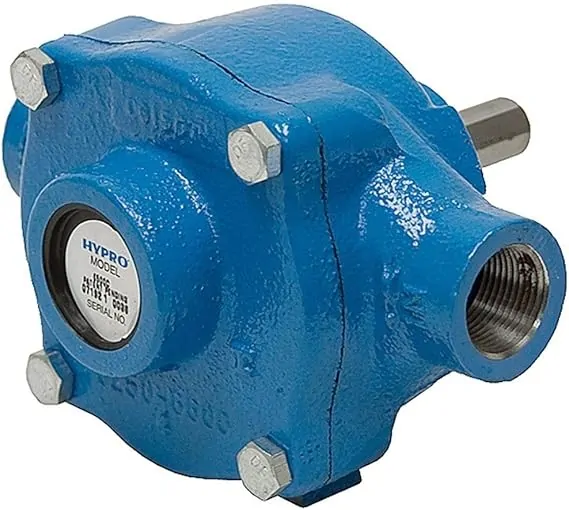
Hypro 6500C 6-Roller Pump
The Hypro 6500C 6-roller pump provides dependable spraying performance with a maximum flow capacity of 22 GPM, a strong cast iron body, and reliable PTO-powered operation. It includes 3/4-inch NPT ports, a 5/8-inch solid shaft, and an efficient roller mechanism that helps maintain smooth pressure and consistent liquid delivery during agricultural spraying. In my experience, installing this pump on my tractor setup was straightforward, and it delivered strong pressure, smooth operation, and dependable pumping performance.
expert start
What It Is and Its Features
The Hypro 6500C 6-Roller Pump is a roller pump specially designed for agricultural spraying applications. It operates through internal rollers that rotate inside the pump housing and move liquid through the system. This mechanism helps the pump maintain stable pressure and a consistent flow rate during operation. One of its key features is the maximum flow output of 22 gallons per minute at 1000 RPM, which provides enough capacity for medium and large boom sprayers. Even at a lower speed of 540 RPM, the pump can still deliver around 9.7 gallons per minute, allowing flexibility with different tractor speeds and spraying requirements. The pump is equipped with 3/4-inch female NPT inlet and outlet ports, making it compatible with commonly used hoses in agricultural spraying systems.
Why it Matters
The 5/8-inch solid shaft helps provide stable rotation and creates a secure connection with tractor PTO systems. Another important feature is its cast iron construction, which allows the pump to handle demanding farming conditions, including dust, vibration, and extended working hours. Cast iron provides better durability compared with many lightweight materials. However, some chemicals, especially wettable powders, can create additional friction inside the pump and may reduce roller life. Proper operation, cleaning, and maintenance are necessary to achieve the best performance and durability. These features are important because farmers and gardeners require equipment that is reliable, easy to maintain, and simple to repair. The Hypro 6500C provides these benefits through its strong construction and practical design.
My Set-Up And My Experience
I installed the Hypro 6500C 6-Roller Pump on my tractor sprayer system using standard 3/4-inch hoses and a medium-sized spray tank. The pump connected easily with the PTO system, and the 5/8-inch shaft provided a strong and stable attachment during installation. After completing the setup, I tested the pump using water to evaluate the pressure and flow performance. In my experience, the pump started smoothly and operated with minimal vibration. The cast iron body gave it a strong and durable feel, and the installation process was simple after confirming the correct shaft rotation direction.
Performance
During spraying operations, the Hypro 6500C 6-Roller Pump provided strong and consistent water flow throughout my sprayer system. The pump maintained good pressure, which helped the spray nozzles produce even coverage across the target area. Even when operating at moderate tractor speeds, the liquid flow remained stable and dependable. I also found that the pump handled continuous operation without noticeable overheating or pressure reduction. Overall, its performance was powerful and reliable for a roller pump, making it suitable for routine spraying and liquid transfer applications.
Practical Tips
- Use the pump mainly with water or liquids that are compatible with the pump material.
- Always confirm shaft rotation direction before installation.
- Clean and flush the pump after every use.
- Apply light oil before storage to protect internal components.
- Remove water during winter storage to avoid freezing damage.
- Regularly check rollers for wear and replace them when required.
expert end
pro start
| Pros | Cons |
|---|---|
| ✔️ Provides strong flow output up to 22 GPM | ❌ Not recommended for abrasive chemicals |
| ✔️ Heavy-duty cast iron construction | ❌ Rollers may wear after extended use |
| ✔️ Simple PTO installation process | ❌ Shaft rotation direction needs careful checking |
| ✔️ Maintains reliable pressure for spraying systems | ❌ Requires regular cleaning and maintenance |
| ✔️ Repair kits and replacement parts are available | ❌ Heavier compared with plastic pump models |
pro end
5. Battery-Powered (Electric) Pumps
These sprayers use a small electric pump (usually a diaphragm or piston pump) that operates with power from a rechargeable battery. Once switched on, the pump works automatically without requiring manual pumping. Modern lithium-ion battery sprayers (12–20V) can deliver liquid at a controlled pressure level. The biggest benefit of these pumps is convenience and consistent spraying performance because users only need to press a button and the pump maintains a continuous and even spray.
Battery-powered pumps often include adjustable pressure settings, such as 20–60 PSI, allowing users to select the pressure according to their spraying needs. They reduce hand fatigue because there is no need for repeated manual pumping. These sprayers are a good choice for larger gardens, orchards, and long spraying sessions. Due to their ease of use, electric pump systems are becoming more common, and many backpack sprayers now offer battery-powered options.
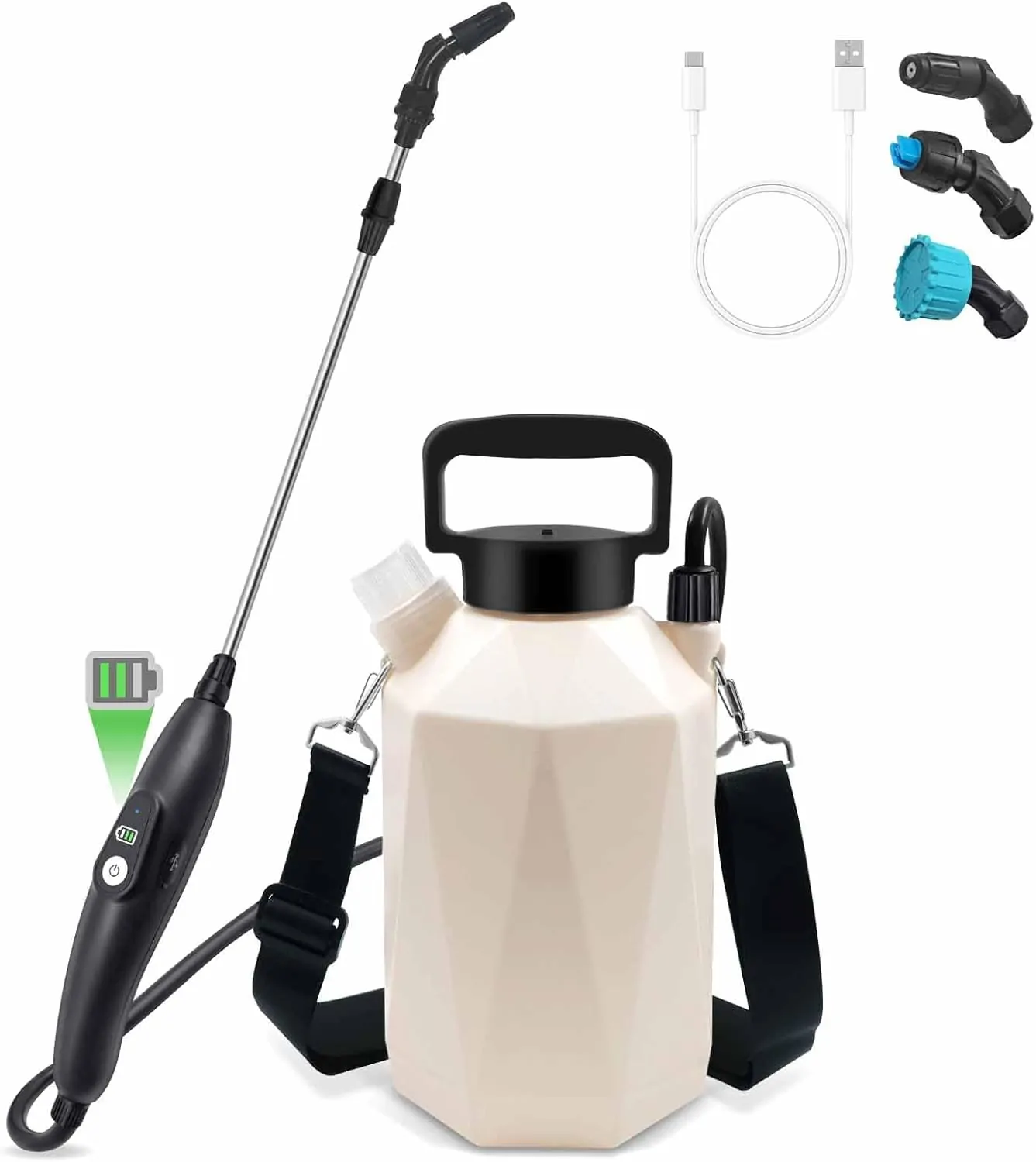
Giftsfaloy 1 Gallon Battery powered Pump Sprayer
The Giftsfaloy Battery Powered Garden Sprayer features a rechargeable 2200mAh battery that provides approximately 2,5–3 hours of continuous spraying, removing the need for manual pumping and making gardening tasks more comfortable. It comes with a 1-gallon tank, a telescopic wand extending up to 23,62 inches, and three nozzles that provide five adjustable spray patterns for different applications. In my experience, its lightweight design, reliable battery performance, and automatic spraying function made watering hanging plants and window boxes faster and easier.
expert start
What Is It and Its Features
The Giftsfaloy Battery Powered Garden Sprayer is a compact electric sprayer designed for different gardening activities, including watering plants, applying fertilizers, spraying pesticides, and misting sensitive plants. It uses a 2200mAh rechargeable battery that can provide around 2.5 to 3 hours of operation after a full charge, which is suitable for most household gardening tasks. The sprayer includes a 1-gallon tank, an adjustable telescopic wand that extends up to 23.62 inches, and three interchangeable nozzles that offer up to five different spray patterns. These spray options allow users to choose between a gentle mist for delicate plants and a stronger spray for outdoor plants or general watering.
The design also includes useful features that improve daily operation. The hose contains a small filter that helps prevent dirt and unwanted particles from entering the pump, reducing the chance of blockage and improving the overall working life of the sprayer.
Why It Matters
The Giftsfaloy Electric Garden Sprayer is useful because it removes one of the main difficulties of traditional manual sprayers: continuous pumping to maintain pressure. Manual sprayers require repeated hand pumping, which can become tiring and slow, especially during longer gardening sessions. With this battery-powered model, spraying begins with a simple button press, making the entire process easier and more comfortable.
Another advantage is its practical design for different gardening situations. The telescopic wand helps users reach higher plants, hanging baskets, window boxes, and difficult areas without stretching or bending too much. The adjustable spray patterns also increase flexibility, allowing the sprayer to handle different tasks, from gentle misting of indoor plants to stronger watering of outdoor vegetation.
My Set-Up And My Experience
I tested the Giftsfaloy Battery Powered Garden Sprayer mainly for watering hanging plants, window boxes, and several potted plants around my garden. The setup process was simple. I filled the tank with water, attached the required nozzle, and charged the handle through USB before using it for the first time. The lightweight construction made it comfortable to carry, while the adjustable shoulder strap helped reduce pressure when moving around the garden.
The retractable wand was especially helpful because it allowed me to water plants that were difficult to reach with a normal watering can or garden hose. During my testing, the battery performance was impressive because it maintained power for a long time before requiring another charge. The automatic spraying system also provided much better convenience compared with traditional pump sprayers, especially during repeated watering tasks.
Performance
The Giftsfaloy Electric Garden Sprayer performs well for light and medium gardening applications. It provides stable spray pressure, and the different nozzle options make it suitable for various plant care requirements. The fine mist setting works effectively for seedlings, delicate plants, and indoor plants that require gentle watering. The stronger spray pattern is more suitable for outdoor plants and general garden maintenance.
The battery-powered pump maintains continuous pressure without requiring manual pumping, making spraying smoother and less physically demanding. The telescopic wand works efficiently for reaching hanging baskets and taller plants. The 1-gallon tank capacity provides enough water for several small watering tasks depending on garden size and plant requirements. While it is not designed for very large-scale spraying, it performs effectively for regular home gardening needs.
Practical Tips
- Charge the battery completely before the first operation for improved performance.
- Select the fine mist nozzle when working with seedlings and delicate plants.
- Keep the nozzle in an upright position after use to reduce possible dripping.
- Clean the filter and nozzle regularly to prevent blockage.
- Avoid using very thick liquids or chemicals that are not compatible with the sprayer.
expert end
pro start
| Pros | Cons |
|---|---|
| ✔️ Lightweight design makes it easy to carry | ❌ Nozzle can drip slightly when placed horizontally |
| ✔️ USB rechargeable battery provides long working time | ❌ Spray output is slower compared with a garden hose |
| ✔️ Automatic spraying reduces hand fatigue | ❌ Not suitable for very large garden areas |
| ✔️ Telescopic wand helps reach taller plants | ❌ Plastic components have a basic feel |
| ✔️ Multiple spray patterns support different gardening tasks | ❌ One-gallon tank requires frequent refilling for larger jobs |
pro end
Matching Pump Types to Sprayer Types
Different types of sprayers, including handheld trigger sprayers, small-capacity pump sprayers, and electric sprayers, need pumps that provide the right pressure, flow rate, and spray pattern. The correct pump type helps the sprayer work efficiently. Generally:
1. Handheld sprayers
These compact 1–3 gallon sprayers usually use either a piston pump or a diaphragm pump. Many handheld models use piston pumps because they can create higher pressure for mist spraying, while diaphragm pumps are preferred in some models because they provide smoother operation and are easier to handle.
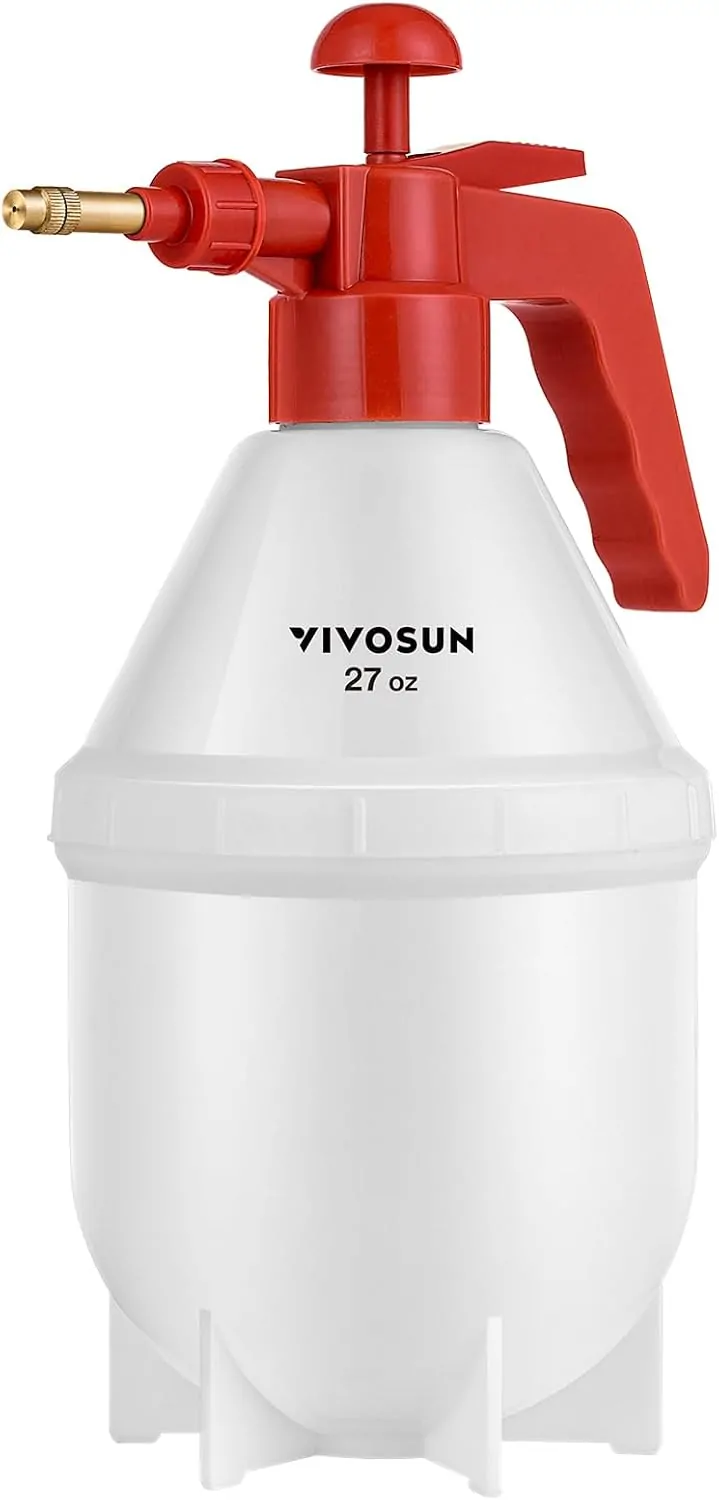
VIVOSUN 27oz Handheld Garden Pump Sprayer
The adjustable brass nozzle and manual hand pump system provide a steady spray pattern, while the translucent bottle with a measurement scale helps make solution mixing easier. Its compact 27oz tank, pressure release valve, and strong thickened base improve safety, stability, and durability. This sprayer is suitable for plant care, cleaning, and gardening activities. In my experience, it was lightweight, simple to operate, and delivered a consistent spray for weed control and regular plant maintenance.
expert start
What Is It and Its Features?
The VIVOSUN 27oz Pump Sprayer is a handheld pressure sprayer made for small gardening and cleaning applications. It operates through a manual pumping mechanism. You simply fill the bottle with water or your required spray solution, pump the top handle several times to create pressure, and then press the trigger to release the spray.
The sprayer comes with an adjustable brass nozzle that lets you change the spray output from a fine mist to a stronger stream according to the task. It also features a translucent bottle with a visible calibration scale, making it easier to monitor the liquid level and measure the correct amount of solution. The built-in pressure release valve allows safe removal of internal pressure after use. Additionally, the thickened base design improves stability and helps increase the overall lifespan of the sprayer.
Why It Matters
A compact and dependable sprayer like the VIVOSUN 27oz Pump Sprayer can simplify many everyday gardening and cleaning activities. Instead of carrying heavy backpack sprayers or using large equipment, a handheld model is ideal for small and quick applications.
For example, it works well for spraying indoor plants, applying diluted fertilizer solutions, or treating limited weed areas. It also provides better control over liquid usage. The adjustable brass nozzle allows you to choose the right spray pattern, from a gentle mist for sensitive plants to a stronger stream for cleaning purposes.
The comfortable handle and locking trigger make spraying easier with one hand. This feature is useful when your other hand is needed to move leaves, hold branches, or reach difficult areas of plants.
My Set-Up and My Experience
When I used the VIVOSUN 27oz Pump Sprayer for the first time, preparing it was very simple. The sprayer required minimal setup, and I only needed to fill the bottle with my desired spray mixture.
I mainly used it for applying weed control solutions in my garden and watering some indoor plants. The pumping system was smooth and created pressure after only a few pumps. The biggest advantage I noticed was its comfortable handling. The small bottle size made it easy to carry around without causing hand fatigue.
I could easily operate it with one hand while using my other hand to move leaves and spray areas that were harder to reach. The translucent bottle was another useful feature because it allowed me to quickly check the remaining liquid level.
Performance
The VIVOSUN 27oz Pump Sprayer performed effectively for small spraying requirements. It produced an even spray pattern, and the adjustable brass nozzle made switching between mist and stream settings easy.
For plant watering and pest control applications, the fine mist setting worked especially well because it distributed liquid evenly across leaves. The pressure system also performed efficiently for a small handheld sprayer. After pumping, it maintained pressure long enough to spray multiple plants before requiring additional pumping.
The trigger and locking feature improved comfort during continuous spraying, especially when covering several plants. Even with repeated use, the sprayer continued to provide reliable performance.
Practical Tips
- Clean the sprayer with fresh water after applying chemical solutions to reduce the chance of blockage.
- Select the fine mist option when spraying young plants and sensitive seedlings.
- Avoid filling the bottle completely; leave enough empty space for proper pressure formation.
- Pump slowly and evenly to maintain consistent pressure inside the container.
- Use the safety valve to release pressure before opening the sprayer.
expert end
pro start
| Pros | Cons |
|---|---|
| ✔️ Lightweight design makes it easy to carry and use around the garden. | ❌ The small tank capacity means it needs refilling more often. |
| ✔️ Adjustable brass nozzle allows different spray patterns for various tasks. | ❌ The plastic construction may produce minor creaking sounds during operation. |
| ✔️ Transparent bottle design helps users easily monitor the remaining liquid. | ❌ It is not designed for large gardens or extensive spraying work. |
| ✔️ Simple pump mechanism creates pressure quickly and efficiently. | ❌ Long spraying sessions may require additional pumping to maintain pressure. |
| ✔️ Suitable for gardening, cleaning, and other small spraying applications. | ❌ The spray distance is shorter compared with larger sprayer models. |
pro end
2. Backpack sprayers
Backpack sprayers commonly use either piston pumps or diaphragm pumps. These two pump types create different spraying characteristics. Piston-pump backpack sprayers can usually reach pressures of up to around 90 psi, making them suitable for producing a fine mist that can reach taller plants and detailed areas. Diaphragm-pump backpack sprayers generally provide smoother operation and are better suited for handling stronger chemicals because of their improved chemical resistance.
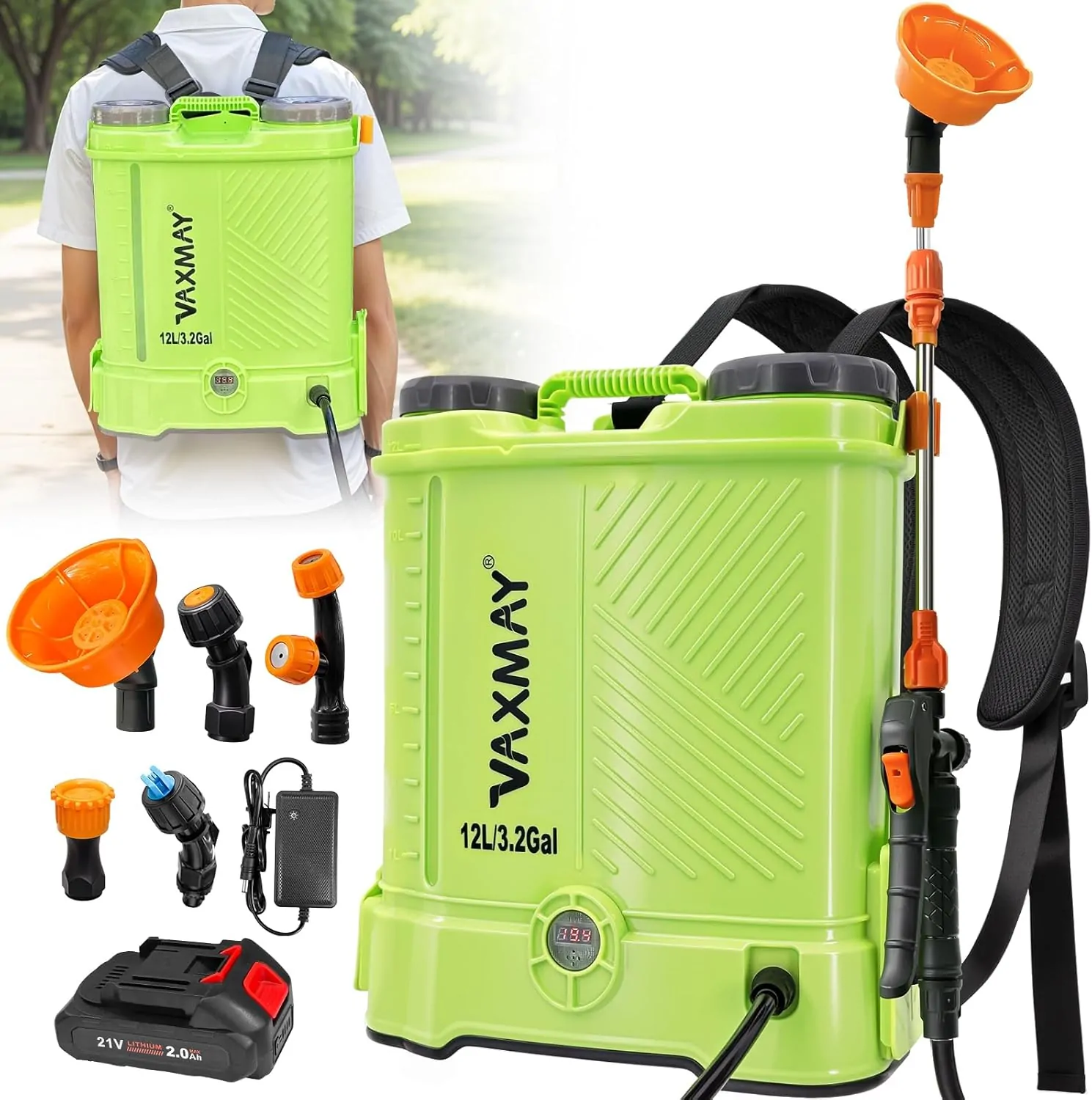
VAXMAY Battery Powered Backpack Sprayer
The VAXMAY Battery Powered Backpack Sprayer features a powerful 80 PSI electric pump, adjustable pressure control, telescopic wand, and five different nozzles for flexible spraying applications. It is suitable for gardens, lawns, weed control, fertilizer application, and other outdoor tasks. The sprayer works with Makita 18V batteries and includes a 2,0Ah battery, digital voltage display, and discharge protection system to provide dependable power and improved battery life. In my experience, it provides stable pressure, good battery performance, comfortable backpack support, and makes regular spraying jobs quicker and more convenient.
expert start
What Is It and Its Features
The VAXMAY Battery Powered Backpack Sprayer 3.2 Gallon is an electric backpack sprayer developed for garden spraying, weed management, fertilizer application, and general outdoor cleaning work. It comes with a 3.2-gallon tank made from durable polyethylene and polypropylene materials, which keeps the sprayer strong while maintaining a lightweight design. The unit operates using a rechargeable 2.0Ah battery and also supports Makita 18V batteries, making it a useful option for users who already own Makita tools. A digital voltage display is included to show the remaining battery level, helping you know when charging is required. The sprayer also includes battery discharge protection, which automatically stops operation when the voltage falls below 14V to help protect battery performance and lifespan.
Why It Matters
The VAXMAY Battery Powered Backpack Sprayer 3.2 Gallon is important because it removes one of the main difficulties of traditional manual sprayers: repeated hand pumping. With manual models, users often need to stop spraying to rebuild pressure, which can become exhausting during larger spraying jobs. This electric sprayer maintains pressure automatically, creating a smoother and more comfortable spraying experience. Another major benefit is improved efficiency. According to the manufacturer, the sprayer can complete up to 15 tank sprays on one full charge, allowing users to handle several garden tasks without frequent battery charging. The backpack design with padded shoulder straps and lumbar support also helps spread the weight more evenly, improving comfort during longer use.
My Set-Up And My Experience
Setting up the VAXMAY Battery Powered Backpack Sprayer 3.2 Gallon was easy and straightforward. The package arrived safely, and I only needed to connect the hose, wand, and nozzle before using it. The removable battery was simple to install and charge. Before adding any chemicals, I first filled the tank with clean water to test the sprayer, which is a good practice when using any new spraying equipment. In my garden, I mainly used this sprayer for watering container plants and applying fungicide on vegetable plants. For watering, I often used it without a nozzle because it provided a steady water flow. When spraying fungicide, I changed to the mist nozzle to achieve better plant coverage. I also liked the adjustable pressure feature because it allowed me to lower the pressure for sensitive plants and increase it when I needed extra reach.
Performance
The performance of the VAXMAY Battery Powered Backpack Sprayer 3.2 Gallon was impressive, especially because of its stable spray pressure. Unlike manual sprayers that can lose pressure during operation, the electric pump maintained a consistent spray output throughout the task. The adjustable pressure knob made it easy to control the spray intensity according to different applications. The telescopic wand was another helpful feature because it allowed me to reach taller plants and spray difficult areas behind bushes without unnecessary bending. The five included nozzles increased the overall versatility of the sprayer. I used the fine mist nozzle for delicate plants and stronger spray options for weeds and cleaning areas such as driveway edges. Battery performance was also reliable in my testing, and I was able to cover my complete garden area on a single charge.
Practical Tips
- Always test the sprayer with clean water before applying chemicals.
- Adjust the pressure setting according to the job to protect sensitive plants.
- Use the telescopic wand for reaching tall plants and difficult garden areas.
- Clean the tank and nozzle after every use to avoid blockages.
- Avoid fully draining the battery regularly to help increase battery lifespan.
expert end
pro start
| Pros | Cons |
|---|---|
| ✔️ Strong 80 PSI electric pump delivers powerful spraying performance | ❌ The sprayer may feel heavy when the tank is completely filled. |
| ✔️ Works with Makita 18V batteries for added convenience. | ❌ Plastic construction may feel less durable compared with some metal models. |
| ✔️ Includes five spray nozzles for different spraying requirements | ❌ Wand storage holder could be improved. |
| ✔️ Comfortable backpack design with padded straps for easier carrying | ❌ Minor leaks can happen if connections and washers are not properly tightened. |
| ✔️ Large 3.2-gallon tank reduces frequent refilling during work. | ❌ Charging duration may vary depending on the remaining battery level. |
pro end
3. Hose-end sprayers
These sprayers connect directly to a garden hose and use the water pressure from the hose to operate. They work like a simple low-pressure system and do not contain their own pump. Their working principle is similar to a low-pressure centrifugal pump where water movement helps draw and mix liquid through a venturi system. They are commonly used for applying fertilizers, weed killers, and other liquid treatments across larger areas where low flow rate and pressure are sufficient.
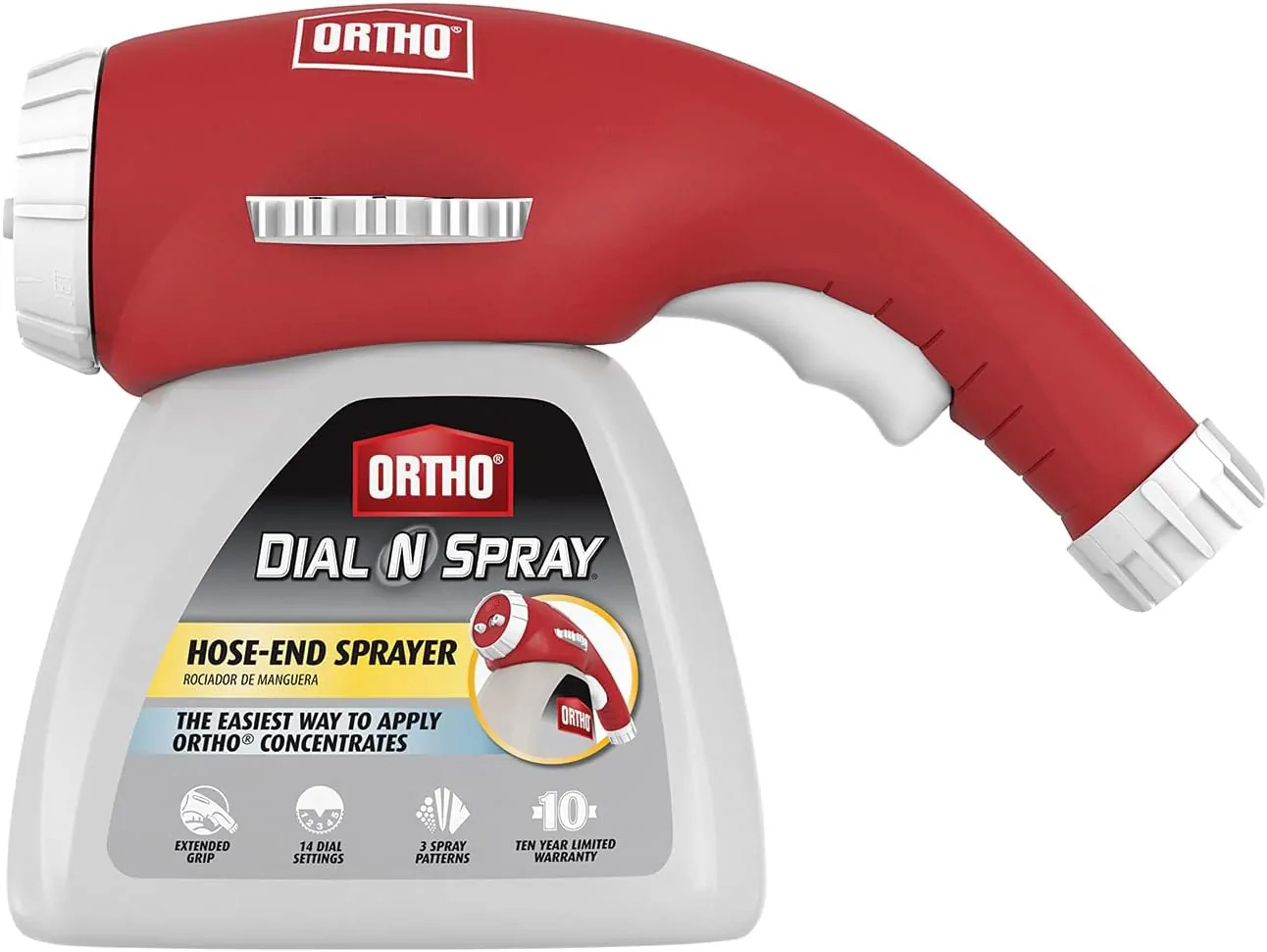
Ortho Dial N Spray Hose-End Sprayer
The Ortho Dial N Spray Hose-End Sprayer offers accurate solution mixing with 14 dilution settings and three spray patterns for different gardening needs. Its ergonomic handle, anti-backflow protection, and strong water flow help provide safe, efficient, and uniform spraying for lawns, plants, flowers, and outdoor areas. From my experience, the sprayer is simple to prepare, provides reliable mixing accuracy, and performs better than many basic hose-end sprayers.
expert start
What Is It and Its Features?
The Ortho Dial N Spray Hose-End Sprayer is a hose-connected sprayer that automatically combines liquid concentrate with water during spraying. Instead of manually measuring chemicals and mixing them in a separate container, you only need to add the concentrate into the sprayer jar, attach it to your garden hose, and select the required dilution setting. The sprayer then automatically draws the concentrate into the water stream according to the selected ratio. This makes application faster and helps reduce mixing errors.
This model provides 14 dilution settings, ranging from approximately 1 teaspoon to 8 ounces per gallon of water, giving users flexibility for different products and applications. It also includes three spray patterns: broadcast for covering larger lawn areas, jet for reaching taller plants or handling cleaning tasks, and shower for gently watering flowers and sensitive plants. Additional features include an ergonomic trigger handle, extended grip design, rotating hose connector, and anti-backflow device that helps protect the water supply from contamination.
Why It Matters
The Ortho Dial N Spray Hose-End Sprayer is valuable because accurate chemical mixing plays an important role in successful gardening. A solution that is too concentrated may harm plants, while a weak mixture may fail to control weeds, insects, or diseases effectively. This sprayer helps solve this issue by allowing users to choose the correct dilution level and automatically mixing the product during application.
Another important advantage is speed and convenience. Treating large lawns or garden spaces with manual pump sprayers can require significant time and effort. Since this model connects directly to a hose and can deliver approximately 2 gallons of water per minute, it helps cover larger areas much more quickly. For gardeners who regularly apply fertilizers, insecticides, or fungicides, this feature can save both time and physical effort.
My Set-Up and My Experience
Setting up the Ortho Dial N Spray Hose-End Sprayer was quick and simple during my testing. I added the liquid concentrate into the container, connected the sprayer to my garden hose, and selected the desired dilution level using the adjustment dial. The dial provided clear clicks at each setting, making it easy to choose the required ratio.
In my garden, I tested the sprayer for fertilizer application and also used it while adjusting water pH for my container plants. The solution was distributed evenly, and I found it convenient to change dilution levels whenever I needed a different concentration. The handle design was comfortable during extended spraying sessions, while the rotating hose connector helped reduce hose twisting and made movement easier.
Performance
The Ortho Dial N Spray Hose-End Sprayer delivered strong performance during use. The water pressure from a normal household hose produced a powerful spray, and the broadcast setting helped cover large areas quickly. This was especially useful for lawn treatments because I could spray wider sections without frequently repositioning equipment.
The jet spray pattern also performed well and provided enough reach for taller plants and hanging baskets, making it useful when applying insecticides or fungicides in higher areas. The shower pattern worked effectively for delicate plants because it produced a softer spray that was less likely to damage leaves or flowers.
One of the strongest points was the consistent mixing performance. After testing the spray solution multiple times, I noticed that the concentration remained fairly consistent throughout operation. This helped provide confidence that the sprayer was applying the product accurately.
Practical Tips
- Use the broadcast spray pattern for lawns and larger garden areas.
- Select the jet pattern for tall plants and difficult-to-reach locations.
- Choose the shower setting when spraying flowers and delicate plants.
- Clean and rinse the sprayer with fresh water after chemical applications.
expert end
pro start
| Pros | Cons |
|---|---|
| ✔️ 14 adjustable dilution settings provide accurate chemical mixing | ❌ Small leaks may appear around connection points over time |
| ✔️ Three spray patterns support different gardening applications | ❌ Some plastic components may feel lightweight |
| ✔️ Simple hose attachment and quick setup process | ❌ May not work well with very thick liquid concentrates |
| ✔️ Strong water flow allows faster coverage of larger areas | ❌ Requires sufficient hose water pressure for maximum performance |
| ✔️ Comfortable ergonomic handle and trigger design | ❌ Container capacity may be limited for extremely large gardens |
pro end
4. Wheeled/tow-behind sprayers
These large sprayers are usually designed as pull-behind units or tractor-mounted systems and are commonly used for bigger spraying jobs. They often use powerful roller pumps or large diaphragm pumps to provide high flow rates and pressure. Roller pumps are widely used with 3-point boom sprayers, while heavy-duty hydraulic diaphragm pumps are commonly found in commercial sprayers that require continuous high-volume spraying.
Scotts 190618W Wheeled Sprayer Pump
The Scotts 190618W Wheeled Sprayer Pump comes with a 3-gallon tank, strong wheels, a comfortable handle, and a 3-in-1 adjustable nozzle. It includes a heavy-duty wand, lockable premium shut-off, no-spill funnel, and a transparent tank that helps monitor liquid levels easily. Based on my experience, it is simple to operate, reduces physical effort, provides even spraying, and makes regular garden care quicker and more convenient.
expert start
What Is It and Its Features
The Scotts 190618W Wheeled Sprayer Pump is a manual cart-style sprayer with a 3-gallon tank made for home gardens and light commercial applications. It comes with a premium shut-off system featuring a comfortable grip that can be locked for continuous spraying, helping reduce hand tiredness during longer spraying tasks. The sprayer includes a long, durable, non-corrosive wand, a clear tank with measurement markings, and a no-spill funnel opening that makes filling easier and cleaner.
It also features a 3-in-1 adjustable nozzle that provides fan, stream, and cone spray patterns for different gardening needs. The strong six-inch wheels make movement easier, while the ergonomic handle includes a built-in wand clip for convenient storage. Constructed from high-quality polyethylene, the sprayer is lightweight but durable, and the nickel-plated brass poppet improves strength and accuracy during spraying operations.
Why It Matters
The Scotts 190618W Wheeled Sprayer Pump is useful because it helps overcome common spraying problems, especially for gardeners who regularly apply weed killers, fertilizers, or insecticides. Many modern sprayers are backpack or handheld models, which can become uncomfortable when carrying liquid chemicals for a long time.
This wheeled design removes much of the pressure from your shoulders and back while providing better stability and controlled spraying. The adjustable nozzle allows gardeners to select the right spray pattern for different applications, from covering larger surfaces to treating smaller flower beds. For older gardeners or anyone looking for a more comfortable spraying method, this sprayer offers a practical and efficient solution. Its strong construction and easy operation make it a valuable tool for keeping gardens healthy and well-maintained.
My Set-Up and My Experience
Using the Scotts 190618W Wheeled Sprayer Pump has been a comfortable and enjoyable experience. As a female gardener, I especially like the wheel design because it saves me from carrying heavy liquid loads on my back, unlike many backpack sprayers. The pump starts easily, and one filling provides enough spray time to cover different areas without frequent refilling.
I have used it for applying weed killers, insecticides, and fertilizers, and the adjustable nozzle gives excellent control over spray direction and pattern. I completed around five fills of 2–3 gallons within a short period, and the sprayer worked smoothly without leaks or causing excessive effort. Although the tank is advertised as holding three gallons, I found it can hold slightly more while still leaving enough air space for proper pumping.
The assembly process was straightforward, and considering its features and performance, the price feels reasonable.
Performance
The performance of the Scotts 190618W Wheeled Sprayer Pump is excellent for regular garden applications. The pumping system operates smoothly, and the lockable shut-off feature helps reduce hand pressure during extended spraying sessions.
The fan spray pattern covers larger areas such as decks and sidewalks quickly, the stream spray works well for targeted weed control and cracks, and the cone spray provides even coverage for plants. The strong wand and comfortable handle improve control, while the six-inch wheels make transportation easier across different surfaces.
I have used this sprayer for several years for weed control and insecticide applications, and it has maintained good performance with regular care. Compared with handheld and backpack sprayers, it requires much less physical effort and allows more efficient garden maintenance.
Practical Tips
- Always prime the pump properly until it becomes firm to maintain steady spraying.
- Select the correct 3-in-1 nozzle setting (fan, stream, or cone) according to the spraying task.
- Use the no-spill funnel carefully while filling the tank to prevent chemical spills.
- Keep the wand stored in the built-in handle clip after every use.
- Clean the sprayer and filter after each application to improve durability and performance.
expert end
pro start
| Pros | Cons |
|---|---|
| ✔️ Easy transportation with strong 6-inch wheels. | ❌ Manual pumping may become tiring during very long spraying periods. |
| ✔️ 3-in-1 adjustable nozzle provides multiple spray options. | ❌ The 3-gallon tank may not be enough for very large spraying areas. |
| ✔️ Comfortable ergonomic handle helps reduce hand and arm stress. | ❌ Wheels may have difficulty on extremely rough surfaces. |
| ✔️ Transparent tank with measurement marks helps maintain accurate filling. | ❌ Not designed for industrial-level or heavy commercial spraying. |
| ✔️ Durable wand provides accurate spraying for different garden tasks. | ❌ Some assembly is needed before first use. |
pro end
Factors to Consider When Choosing a Pump
When choosing a garden sprayer, selecting the right pump is as important as choosing the sprayer itself. The pump controls how effectively the liquid moves through the system, the amount of pressure it can create, and how well the sprayer performs for different applications. Important factors such as pump strength, chemical resistance, maintenance needs, and pressure adjustment should be considered before making a decision. Therefore, keep the following points in mind:
1. Pressure and Flow Needs:
Before selecting a pump, consider the required PSI and GPM for your spraying work. Small handheld sprayers usually operate at around 20–60 psi, while tractor-mounted boom sprayers may require 100 psi or higher. A piston backpack pump can produce around 90 psi, a small diaphragm sprayer usually provides about 60 psi, and heavy-duty roller pumps can reach pressures up to 300 psi.
Flow rate is another important factor. A 12V backpack pump generally delivers around 1–5 GPM, which is suitable for a single spray gun. In comparison, centrifugal pumps can provide dozens or even hundreds of GPM for large boom sprayers and irrigation systems. Always make sure the pump’s pressure range and flow capacity match your nozzles and the size of the area you want to spray.
2. Chemical Compatibility:
Always check whether the pump materials, including seals and housing components, are suitable for the chemicals you plan to use. Diaphragm pumps are highly effective in this area because they can handle fertilizers, bleach, and wettable powders with less risk of damage. Centrifugal pumps can also be used with chemicals when they are made from compatible materials.
Piston pumps require more care because abrasive or corrosive mixtures, such as sand particles or undissolved powders, can damage internal parts over time. Some pumps are available in different material options, such as “Silver” iron or stainless steel models, which provide better durability when working with aggressive herbicides. Always flush the pump after using strong chemicals to prevent buildup and extend its working life.
3. Durability and Maintenance:
Consider how much maintenance you are prepared to perform before selecting a pump. Piston and roller pumps contain more mechanical moving parts, which can wear over time and may require repairs such as replacing pistons, seals, or rebuilding vanes.
Diaphragm pumps generally require less maintenance because they have fewer wear components, mainly the rubber diaphragms and valves. Centrifugal pumps are strong, simple, and reliable but should never be operated without liquid because running them dry can cause damage. Regardless of the pump type, regular cleaning and maintenance are necessary for long-term performance.
4. Noise and Ease of Use:
Different pump types produce different noise levels during operation. Manual piston and roller pumps usually create a repeated pumping sound, while diaphragm pumps, especially electric 12V models, operate more quietly.
Electric pumps (12V or 120V) provide a smoother experience and often include useful features such as an on-demand switch that automatically stops the motor when spraying stops. If comfort is a priority, especially when using backpack sprayers, choose a pump that is easy and comfortable to operate for longer periods.
Advantages and Disadvantages of Garden Sprayer Pumps
Every garden sprayer pump has its own benefits and limitations. Choosing the correct pump can reduce effort, improve spraying accuracy, and save valuable time. Understanding the advantages and disadvantages of different pump types helps gardeners select the best option according to their specific requirements. The following summary provides a quick overview.
Advantages
- High Pressure Options: Piston and plunger pumps can create high pressure, making them suitable for fine mist applications and reaching taller plants.
- Chemical Resistance: Diaphragm pumps are designed to handle fertilizers, herbicides, and other challenging chemicals safely.
- Ease of Use: Battery-powered pumps reduce manual pumping effort and make long spraying jobs more comfortable.
- Durability: Many pumps, especially diaphragm and plunger models, can provide years of service when properly maintained.
- Versatility: Different pump types are available for various sprayers, including handheld, backpack, wheeled, and battery-powered models.
- Consistent Spray: Good-quality pumps maintain stable pressure, helping provide even coverage on plants.
Disadvantages
- Cost: Battery-powered and plunger pumps usually cost more than basic manual pump systems.
- Weight: Some pump types, especially plunger and battery-powered models, can be heavier and less convenient to carry.
- Maintenance Needs: Piston and diaphragm pumps require regular cleaning and occasional replacement of seals or other parts.
- Chemical Wear: Piston pumps may experience faster wear when exposed to strong or unsuitable chemicals.
- Overkill for Small Tasks: High-pressure and electric pumps may not be necessary for small home gardens or simple spraying jobs.
Pump Maintenance Tips
Proper maintenance of garden sprayer pumps is important for keeping them efficient, reliable, and long-lasting. Regular care helps prevent problems such as leaks, reduced pressure, and early component failure, which can save both money and time. Knowing the differences between piston pumps, diaphragm pumps, centrifugal pumps, and roller pumps allows you to apply the correct maintenance methods for each type. Important maintenance practices include:
a. Flush with Clean Water:
After completing every spraying job, remove any remaining chemicals and unwanted particles from the system. Fill the tank with clean water, operate the pump, and spray the water through the system until all chemical residue is removed. This process helps prevent chemical deposits, blockage, and corrosion.
The Wilco farm store guide recommends rinsing the sprayer and pumping clean water through the system after use. Similarly, irrigation maintenance recommendations suggest flushing lines and strainers regularly to maintain proper operation.
b. Inspect and Clean Seals/Valves:
Regularly inspect important pump components such as rubber seals, valves, and diaphragms, especially after heavy seasonal use. Remove dirt, chemical buildup, and mineral deposits from these parts.
Replace damaged O-rings, diaphragms, or check valves when necessary. For piston pumps, check that the piston and cylinder surfaces remain smooth and free from scratches or damage.
c. Lubricate Moving Parts:
Some pump models require regular lubrication to maintain smooth operation. For example, large diaphragm pumps may have oil chambers that need replacement after a certain number of operating hours.
If your sprayer includes a grease fitting or oil reservoir, follow the manufacturer’s instructions and service these parts regularly.
d. Store Properly:
After cleaning, completely drain liquid and remove remaining moisture from the pump and tank. Store the sprayer upside down or at a slight angle to prevent water from collecting inside the pump.
Proper storage helps protect seals from drying out and reduces damage during long periods without use. In colder regions, prepare the pump for winter by draining it completely or using RV antifreeze to prevent freezing damage.
e. Replace Worn Components:
No pump can last forever, especially when used frequently. Keep replacement parts such as diaphragms, seals, and rollers available if you depend on your sprayer regularly.
If you notice reduced pressure, unusual sounds, or poor spraying performance, repair or replace worn components before the pump fails during an important spraying task.
Conclusion
In conclusion, there is no single pump that works best for every type of sprayer. The ideal choice depends on the specific spraying requirements. Handheld and backpack sprayers commonly use piston or diaphragm pumps. A piston pump is the better option when maximum pressure and a fine spray pattern are required, such as spraying tall plants or reaching difficult areas. In contrast, a diaphragm pump is more suitable for stronger chemicals, applications requiring gentle spraying, or situations where long pump life is important. Hose-end sprayers generally use the water supply itself to create pressure, working similarly to a low-power centrifugal pump system.
references:
1. Beach, S. A. (1903). Spray Mixtures and Spray Machinery (No. 243). New York Agricultural Experiment Station.
2. Kerr, J. (1980). Knowledge of spray equipment contributes to applicator efficiency. Weeds Trees & Turf, 19, 28-44.
3. Suguna, M., Swapna, M., Meghalatha, K., Maneesha, N., & Meghana, K. Pesticide Spraying Equipment and Their Operating System. Recent Trends in Plant Protection, 187.
4. Raut, L. P., Jaiswal, S. B., & Mohite, N. Y. (2013). Design, development and fabrication of agricultural pesticides sprayer with weeder. International Journal of Applied Research and Studies, 2(11), 1-8.
5. Yu, Z., Geng, M., Zhao, K., Meng, X., Zhang, H., & He, X. (2025). Design and experimental operation of a swing-arm orchard sprayer. Agronomy, 15(7), 1706.
6. Suguna, M., Swapna, M., Meghalatha, K., Maneesha, N., & Meghana, K. Pesticide Spraying Equipment and Their Operating System. Recent Trends in Plant Protection, 187.
7. Rahman, S. Design and Fabrication of an Agricultural Spraying Machine Using a Knapsack Sprayer.

